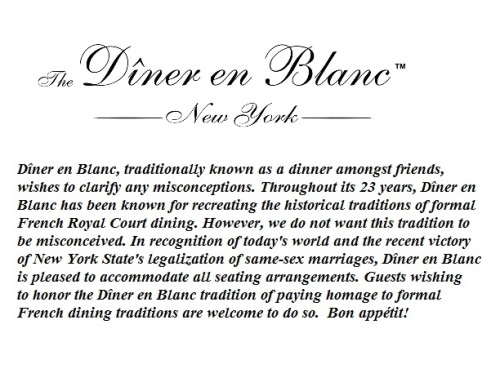
Diner en Blanc: some accomodations aren’t that accomodating (now with a positive resolution!)

Tomorrow, registration for New York’s first Diner en Blanc begins, and I want to go, badly. It seems like a manifestation of so many things I adore: the power of cities and the cheerful clinging to things passing out of the world just a little too quickly.

Today, I received an email explaining how the registration process for the event will work. It contains the following sentence: “In order to avoid any discrimination toward homosexual couples, you will be able to register up to 2 tables at a time (2 men/2 women).”

At first, I could not parse its meaning, but after discussing it with friends and reading the rules, it seems to indicate the following:

Women must be seated on one side of tables; men on the other. Thus, a single individual may register up to two tables, so if they are gay, they can register themselves and their partner, and then two individuals to gender balance them.

This does not, however, prevent discrimination, as the email suggests. Rather, it places an undue burden on gay couples to find beards for the sake of gender balance. Our gayness is welcome, but only if it looks all nice and neat from afar.

Additionally, who decides what gender I am? Regardless of how I feel about my gender, the reality is I rarely pass as male in the US (I almost always do in Europe, it’s sort of weird), and since we’d be registering on my credit card would my very feminine legal name cause me not to get invited back as per the rules?

And I’m just genderqueer and ornery. How’s it going to go for trans people who don’t have legal name changes yet or who the organizers feel can’t pass? Will they not be invited back?

Diner en Blanc seems like a GORGEOUS thing, and I feel like I am most probably jeopardizing my potential participation in it by raising these questions. But an event that strikes me as about the ghosts of finer things should be not about the world as it was (and is) often cruel, but about the world as we have always wished it to be.

At the end of the day, I have to believe that people like me are part of our collective daydream; sometimes, in fact, it has seemed as if it is only in daydreams that we exist. So I certainly hope the organizers can figure out a way towards making our participation as easy and full of grace as the event itself strives to be. Because the current solution isn’t actually much of one at all.

EDITED TO ADD (8:40pm 8/11): An email from Diner en Blanc announces a resolution to the problem. A discussion of what formal dining traditions should be anywhere in this modern age, however, is probably merited.

“Sanquali” in Bitten by Moonlight

While we are still living in a city of boxes (and we can’t put out recycling until Sunday night), just a very quick post to note that my novella, “Sanquali,” is now out as part of the lesbian werewolf anthology Bitten by Moonlight edited by Joselle Vanderhooft.

My own copy has not yet arrived, so I don’t know much about the other stories, but if you want your Georgette Heyer queerer, hairier and about the servants with some really, really creepy mythology behind it, you’ll want to check “Sanquali” out.

The anthology is available in both hard copy and ebook.

Moving is its own time zone

I’ve been absent of late. Not just from this blog, but from my life. The thing about moving is that there is only moving.

The good news is that we have a date, a plan, keys to the new place and a fabulous couch on the way. We’ve also just come back from the beach (which is its own post because of the town we usually go to and its part in America’s wacky religious history). But it’s crunch time now, and I doubt you’ll hear much of anything from me, deep or casual, beyond a bit of Twittering until the move is done.

But, I can still tell you a few random things, including that a guy I’ve known in passing forever (seriously, he’s like a random spoke in every social circle I’m in, it seems), is doing Kickstarter fundraising for his board game, Oh My God! There’s an Axe in My Head!.

I also just want to jump up and down briefly not just about the fact that I’m going to see Darren Criss in How to Succeed in Business Without Really Trying, but that one of my dearest friends is coming to NYC for the first time to go with me. Apparently we’re going to be going to piano bars and Ghostbusters locations. Nerdiest weekend, EVAR. Although, I can’t help being put in mind of the fact that about a billion years ago this happened.

Meanwhile, in an effort to foster discussion (no, really), I need advice on what color claw caps to get the cats to protect the new sofa. Weigh in! Or something.

Finally, as an aside, I post a lot about my personal and my working life here and the giant grey area in between. What I do post here isn’t, however, comprehensive. It can’t be, and it shouldn’t be. I have lots of balls in the air all the time with both short- and long-term projects and possibilities. And just because I totally talk about some stuff before it’s ready for public consumption doesn’t mean I’m obligated to talk about anything before that moment happens or that I actually have any consistent habit or policy around that sort of stuff, because I totally don’t. The more the Internet gives us the illusion that we can see the whole of anyone’s life, the more it actually becomes impossible for that to be the case. It’s sort of a neat trick, but one I suppose we’re all still learning how to navigate.

Anyway, I promise, thinky thoughts will be back next week. This will finally include some writing about the latest season of Torchwood and possibly something on the ever wavering semi-structure that is Glee‘s fourth wall.

Weekend wrap-up: logistics, logistics, logistics and Paul McCartney

Patty’s parents are in town so Trash Day around here sort of got trashed. On the other hand, we did get approved for our shiny new apartment (we’re signing the lease tomorrow and now we just have to figure out if we’re going to be able to paint and what day we’re moving), and they took us to see Paul McCartney last night.

McCartney, I suppose, isn’t really my speed (although considering the stuff currently in rotation on my iPod, that seems inaccurate). But Patty’s parents are as fannish about all things The Beatles as I am about my own obsessions, so there were were, and it was a pretty mind-blowing show in terms of technical skill, audience engagement and sheer length. And, of course, I knew a ton of the songs, and the audience was just so so so present; Billy Joel made a surprise appearance at one point, and I certainly teared up more than once (the entire audience singing “Blackbird” in the appropriate context; a lengthy mention of John Lennon; the overwhelming sense that this might be one of the last chances to see McCartney like this).

Unfortunately, we also discovered that you can’t bring laptops into Yankee Stadium because they “might interfere with the internal communications systems.” Whatever. Yankee Stadium is not an airplane, and that’s all crap too. But we had to (and thankfully we could) check our bags at a parking garage a couple of blocks up that does just that for people like us. So now we know, and so do you.

I don’t really have a lot of links this week. Life here at home has been so busy with logistics, I feel like Patty and I haven’t even really had time for ourselves. It’s how are we going to do what when, and if you’ve never done the apartment search in NY, I can’t really describe the level of stress involved. But considering a couple of hours we got to spend in Brooklyn yesterday with an old (and complicated) friend of mine, I’d be remiss if I didn’t link to an article on the impending destruction of the building holding Mars Bar.

The building, and the one next to it, is part of an older, uglier, more brutal New York. And Mars Bar a the site of not just a lot of the stupidity of my 20s, but also what passed for my family in my twenties. Year after year, it seemed, I wound up there in the winter with a group of people I’d met in an online community, until someone would invite the whole crowd to their house to continue the party, and we’d walk outside and it would start to snow. That snow, then, always felt like my good luck charm.

Sure, we went other times of year; I think it was summer the time we actually got kicked out of the place. But if I’m telling the story, it will always be winter, my friend Tom slinging an abandoned Christmas tree over his shoulder as we walked through the snow for no good reason.

So on that note, I have some work to do before catching up with Patty and family again this evening and before we throw ourselves back into the logistics again tomorrow.

Oh yeah, and for those playing along at home, there’s still plywood on our window.

Harry Potter & Glee: Hoping some boys can save themselves

Shanna Yarbrough, the hostess over at Don’t Turn It Off, and I have been emailing about a whole bunch of things lately: Glee, the New York real estate market, a secret project or seven, and Harry Potter. And, in one of those emails, where we were talking about going from being Harry Potter fans (and specifically Snape fans) to Glee fans, I said in an offhand way, “Well, Severus Snape is the guy we’re all praying Kurt doesn’t grow up to be.” And, even though I hadn’t consciously gone through the list on it at the time, it turns out, it’s sort of really true.

There’s an external perception of gender variance that follows Snape his whole life if you buy the reading in my post of the other day; I doubt Kurt’s apparent gender non-conformity is going anywhere soon.

There’s Kurt’s incredibly sharp tongue, a trait certainly shared with Snape.

There’s the history of being bullied, and the working hard to seem like something other than what he is: Mechanic’s son? designer clothes? trying to fit in at Dalton? Kurt’s perceived status and choices regarding that status can certainly be read as fairly similar to those of the “Half-Blood Prince.”

And, of course, there’s also the obsessive love and the self-restricted sexuality.

Which is sort of why I’ve just got to hope this Blaine thing works out, because a wounded Kurt is a scary thing. And I have to think, even if only from having been such an obsessive HP fan, that if this boy gets his heart broken, or, rather, blows everything up with his own sharp tongue and natural, reasonable distrust of other people, he’s far too likely to go down the road of someone like Snape, or, to keep it in Glee terms, Sue Sylvester. We’ve already seen Kurt have a surprising rapport with Sue on more than one occasion. Arguably, that’s Kurt’s very real generosity and kindness; or it’s Kurt seeing his own nature and seeing the person he’s trying desperately not to become.

There’s always a temptation, I think, in large swathes of Glee fandom to address Harry Potter. The teen protagonists are the right age to care, and once Darren Criss was cast as Blaine, the opportunity for boy wizard references became ridiculously difficult to ignore. Often, this seems forced. And, in particular, Harry Potter seems like a poor fit for Kurt’s pop-culture interests, which, outside of Broadway, largely seem taken from the lives of queer teens in the 1980s.

But now I can’t help wondering if Kurt did read the Harry Potter series and if they even do midnight screenings of the films in places like Lima. I wonder if he read those books and felt like Harry (Shanna recently summarized the plot of the series on Twitter as “Closeted boy must defend himself and those like him from violence and oppression. Do not despair, Harry: It Gets Better.”) or recognized himself in Snape. Did he think of the man’s spying as he went to snoop around Dalton? Did he smile in the dark at the films every time he noticed all the buttons on Snape’s clothes speaking softly to a love of detail and a pride in confinement? If any or all of these things are true, what does it feel like for Kurt every time he looks at Blaine and realizes he won’t become quite the man he always thought, or perhaps feared, he would?

Certainly, especially during this fandom old home week, I am always fascinated by the way fandoms sometimes migrate collectively to new interests. For example, it seems a large contingent of the broken-hearted over Torchwood‘s third season moved to White Collar en masse: No aliens, but the pretty suits and good banter have made a certain amount of sense as a new focus.

So I have to wonder now if there’s a fair portion of us who somehow migrated from Harry Potter to Glee or rather, from Severus Snape to Kurt Hummel, because after the tragedy of Snape’s end (Snake bubble to the head? Really?) it just feels so damn good to watch this very difficult, talented, wounded, and vicious boy who just might be able to save himself.

Harry Potter: Severus Snape as a representation of female heroism

At, I believe, Terminus, I gave a paper related to Snape and female heroism. I’ve threatened for years to turn it into something more formal, and no doubt should. But since people are always asking me for it, and I actually want to reference its arguments in a post I’m working on about the patterns in how people jump from one fandom to another, I’d thought I’d throw up an edited, bloggy version of it here.

I should warn you it’s profoundly dichotomous about gender, because with the possible exception of Tonks and various people expressing horror at having to polyjuice themselves into the form of another gender, the Harry Potter universe is profoundly dichotomous about gender, so I’m arguing from within its constraints.

One of the persistent criticisms of the Harry Potter series has been its portrayal of gender roles, and specifically its lack of representation when it comes to female heroism. While significant female characters exist in the form of Hermione Granger, Bellatrix Lestrange and Molly Weasley, each of these characters are largely defined by their relational roles: Hermione is Harry’s friend. Bellatrix is Voldemort’s romantically, or possibly erotically, chosen, and Molly Weasley is defined through her epitomization of motherhood.

In fact, while the Harry Potter series can only barely pass the Bechdel Test, the test is arguably a poor gauge of female strength for novels which center constantly on the status of both Harry Potter and his adversary, Lord Voldemort, within the plot.

Despite all this, adult fan involvement with the world of Harry Potter can look predominantly female (certainly HP cons are generally 90% female in attendance). This can be explained by many things, including word-of-mouth fandom culture in female-dominated spaces like Livejournal, the long-standing not not especially proven argument that “girl will read books about boys, but boys won’t read books about girls” and, of course, the possibility that the conservatism of the Harry Potter universe’s view of women may be reflective of real world norms and even desires.

Or, it might be something else entirely.

In fact, I’m now going to totally contradict myself and say that female heroism isn’t absent in the shadow of Harry’s journey, it’s just in a superficially male guise. That guise being the character of Severus Snape.

In many ways, none of what I’m about to go into regarding Snape is a particualrly unique phenomenon. There is, of course, a long history of queering the villain. However, as the series ultimately reveals, Severus Snape is no villain, which is what makes his representation of female attributes, and in fact, female heroism, so unique.

From the first time we meet Snape we are presented with a powerful figure, but not one who is overtly masculine. In fact, almost immediately, from his first speech about “foolish wand waving,” JK Rowling informs us that this character is, on some level, a rejection of masculinity, especially in light of the many moments of phallic humor wands provide us throughout the series.

This is compounded by other key details of Snape’s work from the cauldrons in which he brews to the very nature of the cultural associations we have with potions work. Potions are easily interpreted as women’s work, whether you examine them from the Muggle equivalent of cooking or the fairytale lexicon of witches stirring pots.

Even the violence in Snape’s work – from the dissection of ingredients to the presumed skill with poisoning – speaks to feminine archetypes. In traditional narratives (and Harry Potter is a decidedly traditional narrative, a man murders with a gun or a sword or a knife. A woman poisons.

Additionally, coded language about gender exists in almost every description offered of Snape throughout the series. Mad-Eye Moody is particularly vocal on the matter of Snape’s Dark Mark. He says in chapter 25 of The Goblet of Fire, “There are some spots that don’t come off, Snape. Spots that never come out.”

On the surface, this remark speaks solely to the series’s cultural centerpiece of the Death Eaters and their social structures. However, it also speaks to that thematic element of forgiveness and redemption that has so often been highlighted in the novels. That Mad-Eye Moody feels Snape is precluded from redemption, speaks to the nature of his perception of Snape’s sins in his time with the Death Eaters. However, to speak of an irremovable taint is to also invoke the spectre of Original Sin, which, in Christian mythos, of course, arose into the world through first Eve and not Adam.

And the idea of a woman being marked or tainted and ultimately of lesser social or commoditized value because of often youthful indiscretion – often sexual – is sadly ubiquitous in our culture.

While Snape’s indiscretion is arguably more one of violence than sexuality (although that issue does loom large through implication throughout the series both in terms of Snape’s own suspected sexual history, which I’ll address later, and and also through repeated instances of implied sexual violence in the series.), rape is an acknowledged crime in the Wizarding world, and one we must suspect Death Eaters of having committed.

Sirius Black and the Marauders of memory, too, offer commentary on Snape from a gendered perspective both in word and in deed. While “Snivellus” is a typical school-yard taunt – after all, in our gendered society bullies have long mocked children of both genders for non-strict compliance with expected rolls and behavior, the comment is of significance in light of both the other language used to address Snape and the fact that he does frequently deviate from the expected portrayal of masculinity in Harry’s world.

In fact, feminine references follow Snape back into his childhood. Not only does Harry note the handwriting in the Half-Blood Prince’s book looks like that of a girl, but in the memory presented of Snape’s first meeting with Lily Potter he is described as wearing something that looks like an old women’s blouse. This is not only the second reference the series gives us to Snape in women’s clothes (the other being Lupin’s encouragements to Neville to picture Snape in his grandmother’s wardrobe to defuse the boggart that has taken on the potions master’s appearance), but it references a common piece of generally British slang. To call someone a “girl’s blouse” is, according to urban dictionary, to call them “a male displaying percieved feminine characteristics through actions which cause his peers to think less of him.”

And as much as Snape is embroiled in both the first and second Wizarding wars, he is not a fighter, but a spy. He doesn’t duel at dawn (that training incident with Gilderoy Lockhart aside) or look a man in the eye and draw on the count of five. While Rowling gives us no clear portrayal of the violence Snape commits in the name of his mission, his function is clear from the moment Dumbledore asks him if he is ready, if he is prepared. He will not fight, but observe.

In war (and we must acknowledge the Harry Potter series is, in fact, that of a world at war, even if it is largely a guerilla war and not one of standing armies and open fields), women have historically not been open combatants. Even today’s American military theoretically bars women from combat positions. Yet, women have long fought in war through activities of support, resistance and covertcy. This is the role Snape takes in the struggle – that of secrecy and betrayal, characteristics historically portrayed in literature as women’s sins.

Snape has a range of other female roles throughout the series as well. His expertise at legillimency and occulmency are, as psychic arts, also stereotypically feminine skills.

Narcissa Malfoy’s request that Snape protect her son in the place where she is unable to do so, portrays Snape not as a father figure, but as a mother figure as he is to stand in her stead.

And, of course, in Harry Potter and the Deathly Hallows, Snape takes on his most prominently female gendered role in his clandestine provision of the true Sword of Gryffindor to Harry through the use of his patronus. In this scene, Snape essentially plays the Lady of the Lake, which is consistent with broader Arthurian readings of the Harry Potter series.

Snape’s role as The Lady of the Lake is broader than the simple provision of a magical weapon, for not only does he lead Harry to this necessary tool, but he also reunites the young man with his most loyal companion, or, it might be said, knight – Ron Weasley.

Shades of Snape’s role as the Lady of the Lake also exist in his complex relationship with Albus Dumbledore. While Dumbledore has clearly served as a mentor, friend and confidant to Snape, Snape’s contempt for Dumbledore’s use, and, it can be argued, exploitation of him, is clear, implicitly throughout the series and explicitly in Harry Potter and The Deathly Hallows. Additionally critical to Snape’s portrayal of the Lady of the Lake is his role in Dumbledore’s demise.

These matters of status and use between the two men mirror the problematic relationship between Merlin and The Lady of the Lake in Arthurian legend. While there are many different versions of these tales –- in large part because Arthurian legend has been the subject of fanfiction-like cultural revision and expansion for centuries — one oft repeated theme in these stories is that Merlin mentored the Lady who took on her exile within the lake in response to and rejection of his unwanted romantic and sexual advances. In these stories, ultimately, it is the Lady who eventually helps to secure Merlin’s downfall.

Snape is clearly mentored by Dumbledore throughout his history, but he also rejects Dumbledore’s attempts to make him a truly different man. Just because Snape rejects the evil of the Death Eaters, does not mean he does so for noble purposes. Rather, they are selfish and so he essentially rejects Dumeblore’s own greedy advances to sway him to the side of light. Finally, it is Snape who assassinates Dumbledore. While this is planned between the two men and is clearly portrayed as a subject of grief for Snape, the fact remains that Avada Kedavra requires feelings of true hatred and it is certainly possibly that Snape found these feelings not just about Voldemort and his actions, but towards Dumbledore in the moment in which he utters the killing curse.

Snape’s actions in the Sword of Gryffindor scene also offer us another, non-Arthurian nod to his representation of female gender in the form of his patronus. Snape’s patronus is explicitly female, and this possession of a patronus of a different gender than its caster is, in fact, nearly unique in the series. While Tonks’s patronus is noted to be a dog or a wolf when she is harbouring her then unexpressed crush on Lupin (a feeling mistakenly thought to be directed at Sirius Black), its gender is not, in fact defined. Additionally, as a metamorphmagus, it’s arguable that Tonk’s gender is not really defined either despite the fact we always see her in female form. While it is certainly possible that her patronus is male to represent her feelings for Lupin, this seems unlikely or at least atypical in light James and Lily’s patronuses matching but being gender-consistent.

This leaves Snape’s Doe patronus as a startling anomaly for which we have no clue within the text on how to decode. In thinking about this, I kept trying to look at the way the daemons work in His Dark Materials – same sex demons only occur in gay individuals – what does a same sex patronus mean? Is it representative of great sexual or romantic love? Is it symptomatic of Snape’s profound covetousness of the woman he can’t have? Is it an expression of grief? Or, does it ultimately emphasize Snape’s feminine characteristics and underscore both Snape’s identification with, and the reader’s identification of Snape with, the feminine within the Harry Potter series?

Snape’s association with the feminine is also highlighted by his struggles to claim a masculine role. While being unable to claim masculinity must not be equated with being able to claim femininity, these two conditions so work together to help to establish Snape’s literary gender. For example, Snape’s insistence that he is “not a coward” is an attempt to claim masculine authority, as no idealized man, especially in a society as Western-tradition bound as the wizarding world, could if suffering under that label.

Snape’s performative masclininity is also challenged in his love for and loyalty to Lily Potter. Being so driven by romantic love is, of course, an arguably stereotypically feminine trait in the modern world. By contrast to Snape, Harry rejects his relationship with Ginny to be a warrior, whereas Snape only chooses to go to war out of his adoration of Lily Potter.

To a certain extent this mirrors the well-documented phenomena of women going to war, disguised as men, largely during the 19th century in order to follow lovers who had left them behind to fight.

Similarly, we learn that there have been no other women for Snape because of his devotion to Lily Potter, or, at least, her memory. This is, in the context of the books likely to be both an emotional and sexual fidelity. Snape can then, therefore, be speculated to be a virgin – a state often revered in women, but maligned in men.

It is, in fact, only in death that Snape achieves literary manhood, for his passions and desires are only revealed in the examination of his memories, which he emits in viscous fluid at the moment of his death. While this is no little death, that is, no orgasm, it is the culmination of all that Snape is, and stands in for the sexual and romantic life he subsumed to duty, obsession and error.

And it is in death, that even Harry acknowledges Snape’s manhood, calling him, “the bravest man [he] ever knew.”

RPF: Sometimes the medium is the meta

RPF (Real Person Fiction) is one of those things I have lots of thinky thoughts about, but nearly always bring up tangentally in some broader FPF (Fictional Person Fiction) conversation such it doesn’t really get explored. But I’ve been sitting on a link of vague interest in this regard for ages, and since we’re still in this zone where Time magazine makes us talk about fanfiction a lot, now seems like the time to share.

RPF is a funny animal, in that is has a lot of different purposes if one’s going to argue for any agenda or intent beyond just telling a story. RPF shows up in satire (e.g., the Guardian on Clegg/Cameron), literary fiction (e.g., The Imagined Life of James Dean), historical fiction (e.g., The Other Boleyn Girl), professionally published erotica (e.g., Starf*cker), and, of course, unpaid, community/audience-oriented fanfiction (e.g., Bandom, PunditSlash, and more). And because I love backstage stories of all varieties, whether they be fictional (e.g., Kiss Me Kate, Moulin Rouge) or not, I’m completely fascinated by it.

This isn’t an abstract, look-at-the-bug-under-glass fascination. After all, I’m in fandom; and hence fandom and its foibles is not the Other. I’ve even run into RPF about people I know (an experience which has proved to be more bizarre than awkward) and have encountered many, many ethical discussions about RPF (which are important, if not always compelling). And yes, I am also perfectly aware of the “fanfiction authors write RPF about other fanfic authors” meme.

For me, the fascination is absolutely, positively about the process of fame and the nature of celebrity. How do people — fictional or fictional versions of real people’s already somewhat fictional public personas — navigate private life under public scrutiny? When I’ve read RPF, speculation and argument about that is generally what’s driving my interest. Hell, arguably, that’s what’s also driving some of my interest in Twitter: the ability to witness part of a process — actual, fictionalized or fictional — generally outside of my ability to access.

Anyway, while I know this is far from the only reason people read RPF, I have to assume it’s a reason I’m not alone in. That reason is also one that, if simplified, pretty much boils down to the reader asking questions like “Holy crap, how does that work?” or “If presented with this set of choices I can’t even comprehend, what ridiculousness would I commit?”

Which is pretty much why my eyes bugged out of my head when I heard that a fanfiction author who goes by Neaf wrote a piece of RPF involving Glee cast members in a “Choose Your Own Adventure” format. Thus the fic in question can be a friendship fic or a relationship fic or a porn fic or an angsty dramarama fic, and so involves a significant (yet unspoken) acknowledgement of the degree to which RPF may often be something read from the context of self-insertion, even without the overt presence of a Mary Sue.

Neaf’s story, no matter how you feel about the existence of RPF at all, is a pretty fascinating case of (to borrow a phrase clumsily) the medium being the meta.

That’s all I’ve got for you on this beautiful Saturday. But before you check the fic out: remember that this might squick you, remember to read warnings, remember I am not offering a value judgement on RPF good or bad, and please play nice in comments; I know RPF discussions can get seriously heated.

“The Boy Who Lived Forever”

To say it’s been kind of a surreal couple of days around here would be vastly understating the case. If I let myself think about it, it’s more like a surreal couple of weeks, but I sort of can’t let myself think about it. Forward motion, it’s all I got. There’s still plywood over our window.

Yesterday, when I wrote my post about fandom old home week, I wrote it expecting the Time article (“The Boy Who Lived Forever”) to drop today (when the print edition comes out). Imagine my surprise when I got a Google alert for it an hour later, and then saw that I was in the lead of the thing.

I think it’s a really lovely piece (I mean, gosh, I even told my parents about it), and that Lev captured the 101 of what fanfiction and fandom is both in content and tone. I laughed aloud reading the thing more than once (sex pollen!), and I’m really happy the article exists. It’s just an entirely random bizzareo-world bonus thing that I don’t really know how to process that I got to be in it too and that the company I’m keeping is sort of intense and includes some fandom friends (hi, XT!), Naomi Novik (who had a book release party I danced at), and Darren Criss (enough said). Seriously, I have been laughing about this whole thing on and off since I read the article.

For the record, I wound up in the piece pretty much the way anything happens — I was in the right place at the right time and put myself forward. In this case, that really meant being able and willing to have my real name in the thing. Despite the way I can be (which is something I actually have a lot of inner conflict with these days, but you don’t need to see my internal wank), I can really only speak for myself and my own dorky fannish life, so mostly I just hope I did okay.

Anyway, in the interest of living up to the Harry Potter portion of the piece, Kali and I unlocked a few pieces of fic from our co-written fanfic universe Descensus Facilis Averno: October 31, 1974 and April 15, 1978.

Both of these are PG-13, both of these are Slytherin backstory from around the time that Lucius, Narcissa, Severus and Lily were in or just out of Hogwarts. There’s probably a lot of context missing because these were part of a much larger arc with ridiculous amounts of world-building/additions, but they might amuse anyway.

From the stuff written all by my lonesome, I’ll inflict these two on you: Sometimes Knowledge, which is rated R and is also about Slytherins, and The Convenient Marriage, which is rated 16+, but is a really dark, post-Voldemort victory world where Snape and Hermione are trying to survive as collaborators.

Anyway, all of this is not, actually, the only thing that’s been a part of that “RSN, I have stuff to tell you!” chant I’ve been doing around here lately, but it is a part of it, although probably the least important and yet most bizarre. If nothing else, it’s been a brilliant distraction from looking at all the pics from the London premiere of HP7.2, which seem to have been triggering a major waterworks for everyone. I watched a little bit of it yesterday until I finally had to turn it off. My heart was just a little too permeable to get through work with dry eyes, and I really needed to.

It is certainly remarkable, I think, to look at how important and poisonous the subject of immortality is in the Harry Potter books (did Christian send me a photo of a t-shirt yesterday that says “Make Love, Not Horcruxes”? Yes, yes he did) and yet also realize that Harry has achieved on an extradiegetic (sorry, favorite word!) basis what Voldemort could not on an intradiegetic one. But because we, as fans, continue the story, and because Harry Potter also extends our own stories as something that has marked time and events in our lives, there’s also a sort of victory over mortality for the character in and beyond (as opposed to outside of) the original context of the narrative as well.

On that note, I’m headed off to work now, and then Patty and I are going to continue our plan to eat fabulous food in Boston and environs (if you don’t all know Evoo, know Evoo), and do as little else as possible. After the weekend we’re back into our busy lives, our apartment hunt, our battle against the plywood, and just trying to do what it takes to be ready for whenever we’re in the right place at the right time.

Soon, hopefully, I’ll get caught up on Torchwood: Miracle Day and have time to write about another boy who lived forever; this one, because he was loved in a way he didn’t quite want.

Fandom Old Home Week: I’m not ready yet

I’m on another very early train to Boston (wrapped in my Slytherin hoodie, I might add, because it’s really cold on this thing) with very little sleep. In fact, four hours of sleep is sort of becoming my new six hours — i.e., less than I’d like but certainly enough that I’m perfectly capable of functioning. In a way, I’m thrilled. I need more hours in the day, and I’ve always been envious of micro-sleepers. On the other hand, the idea of crashing out for ten hours multiple nights in a row sounds really, really sexy right about now.

While this doesn’t count as a Friday trash day post (since it’s actually Thursday), I did want to sneak in here and mention that it’s sort of fandom old home week around here right now. The last Harry Potter film is coming out next week, and Torchwood: Miracle Day launches this weekend. And I have a bucket of feelings about both.

For Harry Potter all I can think is that this is the end. Again. I mean, we already did this right? There was that night the last book came out and small child came up and introduced itself to me because he wanted me to know that Severus Snape was his favorite (yeah, I was totally in costume), and then Kali and I stood on the street corner and squeed at each other about Lucius Malfoy’s albino peacocks.

No, really. Sure, I cried multiple times during the seventh book (and not just because of the tedium of the Endless Camping Trip of Despair), but for Kali and I, all the vindication was totally in those albino peacocks; they are so the same sort of ridiculous stuff she and I are always coming up with. Because Harry Potter was how she and I started writing together.

It was fanfiction at first (and sometimes still) — starting with Harry Potter and then moving on to Torchwood (200,000+ words of that on something called I Had No Idea I Had Been Traveling, and it’s what the tattoo on my back comes from) — but as the question ranged farther and farther from the source material (“Okay, so how does a society that has a 2:1 male/female ratio work and what happens when it stops working?” “Right, now what does the evolution of Christianity look like in a world with magic? Does the formation of the CoE happen for more interesting reasons than divorce?” “All right, but, what if we take the European banking/sovereign debt crisis as a model for our magical system?”) we wound up working on our own original novel full of multi-generational intrigue, war and desire. About the only resemblance it bears to Harry Potter at this point is its length. One day we’ll finish it (in the midst of the gazillion other projects we both have our hands in together and seperately with other collaborators), and find a way for you to see it.

She and I are both too old to have grown up with Harry Potter, but maybe we found a way to be grown-ups in the decade plus we’ve spent being fans of it. Without the demarcations of high school and college to keep track of what happened when, I find I can often recall what year I was with which lover or worked on which show or lived in which apartment by mapping it to which Harry Potter book or movie had most recently been released.

Despite being the author of The Book of Harry Potter Trifles, Trivias and Particularities, I’ll admit haven’t been as close to Harry Potter in the last few years as I once was; I haven’t even been to a Harry Potter con since Terminus. I guess, at some point, I stopped feeling like Severus Snape and started feeling like Captain Jack Harkness, which is either a story for another day, or one I’ve already told.

These days, as you know, I’m sort of consumed with Glee, which is pretty much the definition of a bright, shiny object, and which harbors a character I identify with in some pretty uncomfortable ways. But just because my new relationship energy is all over that doesn’t change all the other people I’ve been and all the other stories I’ve loved.

Which means I’m not ready yet. I’m not ready for it to be the last Harry Potter movie anymore than I was ready for it to be the last Harry Potter book. And I’m really not ready to see Jack struggle with the consequences of realizing that there’s a good man in him somewhere that he’s really never quite going to be able to be.

We’re going to go to the last midnight Harry Potter opening together with our partners. And I’m sure that somewhere during Torchwood: Miracle Day she’ll call me and laugh sadly and say, “Are you all right, Jack?” while I pace on the sidewalk outside my apartment because I just can’t stand how much it all hurts.

But until all that happens and the tears come, I’m going to dig up my old wizard rock playlist, explain to Patty why Hermione Granger really is the most beautiful girl in the world, and be very, very glad for the very real adventures I’ve gotten to have because of a whole bunch of people who never were.

holiday weekend trash day is sort of filled with serious stuff

Greetings from Boston after one hell of a week. Patty’s in Ohio dealing with some family stuff and I’m up here for work, although I am headed back to New York tonight.

Not a lot has changed since the amazing adventures of last weekend. We’ve replaced our electronics; there’s still plywood on the window and we’ve been dealing with tons of apartment/lease related stuff. We’ll be moving out of our current place by August 15, and would love to find a new place with a lease that begins on or around August 1. If you have any leads for us (2 bedroom, around 2K) in Brooklyn or Manhattan, please get in touch.

Perhaps the most upsetting part of the entire situation at the moment (and there are a lot of upsetting parts, I’ve been a bit sparse on some of the more aggravating parts of this publicly) is that I’m in a really good mood today, but I keep waiting for the other shoe to drop. This is not normally how I do things.

Meanwhile, I know I’m always like “I have news, soon!” but I really, really do! The RSN is getting RSN-ier.

Lately, I’ve been having a great time on Twitter. Some of that’s been a small world theater experience that’s been slightly surreal, some of that is all the new people that I’m talking to in the wake of all my #NY4M tweets, and some of that is the wackiness of the Glee fandom (Chris Colfer needs to know where to buy sea monkey food, okay?).

Via one of those channels I was recently pointed to Dorothy Surrenders which bills itself as “A Gay Gal’s Guide to Pop Culture.” I’m just so glad this thing exists. I’m so sick of the whole “lesbians are dour” thing (among a million other stereotypes that screw over pretty much every one).

The piece that pointed me there was also interesting because it was about gay by association, but what really startled me was that I assumed the piece would be about “look at how gay and straight public figures can’t be seen in public together because everyone assumes the straight one is gay and then it’s a big PR headache.” Instead, it’s about this sort of thing from the queer perspective, i.e., “I wonder if she’s on our team.”

So, a bit less grim than I expected, but wow, I’d really like a world where closeting and speculation weren’t so part of the game, because this whole thing where speculation, regardless of whether with positive or negative intent, adds a layer of scandal and whisper to sexual orientation conversations that serve no one.

Which brings me, oddly, to another topic entirely. While I’ve been focusing on and will continue to focus on queer equality issues, there’s also a war on women going on in the U.S., specifically as regards reproductive rights and access to both birth control and safe, legal abortion services. One very prominent example is in Kansas.

As regards queerness, I believe that coming out is a privilege, but also that it is a responsibility. If you can come out safely (and safely doesn’t mean “without risk” it means “without what you define as unreasonable risk”), you have a moral obligation to our community to come out. I also believe it is inappropriate to out anyone unless they actively, publicly work against queer causes.

But there are, in this world, a whole lot of things to come out about other than sexual orientation. And abortion is one of them. 35% of all women in the US of reproductive age will have had an abortion by the time they are 45. 35%.

But we never talk about that do we? Do you want to know why? Because when women write articles about their abortion experiences, such as Mikki Kendall’s “Abortion Saved My Life” they get harassed, threatened and publicly shamed; they wind up in danger.

So I would like to add to “if you’re queer and you can be out, you should be out” with “if you’ve had an abortion and you can be out about it, you should be.” Because being out about issues that put people at risk does, over time, make everyone safer. I promise I’ll be revisiting this topic in a few weeks when my life is a little less consumed with plywood, brokers fees and moving, because I believe in the obligation.

In completely different and more cheerful news, since people keep asking since it’s programming season: no Dragon*Con for Patty and I this year (I’ve mentioned this before, but that was months ago and it’s slipped everyone’s minds, including ours). We’re going to San Francisco instead. I promised I take her one day right when we first started dating and this is the year. Woo!