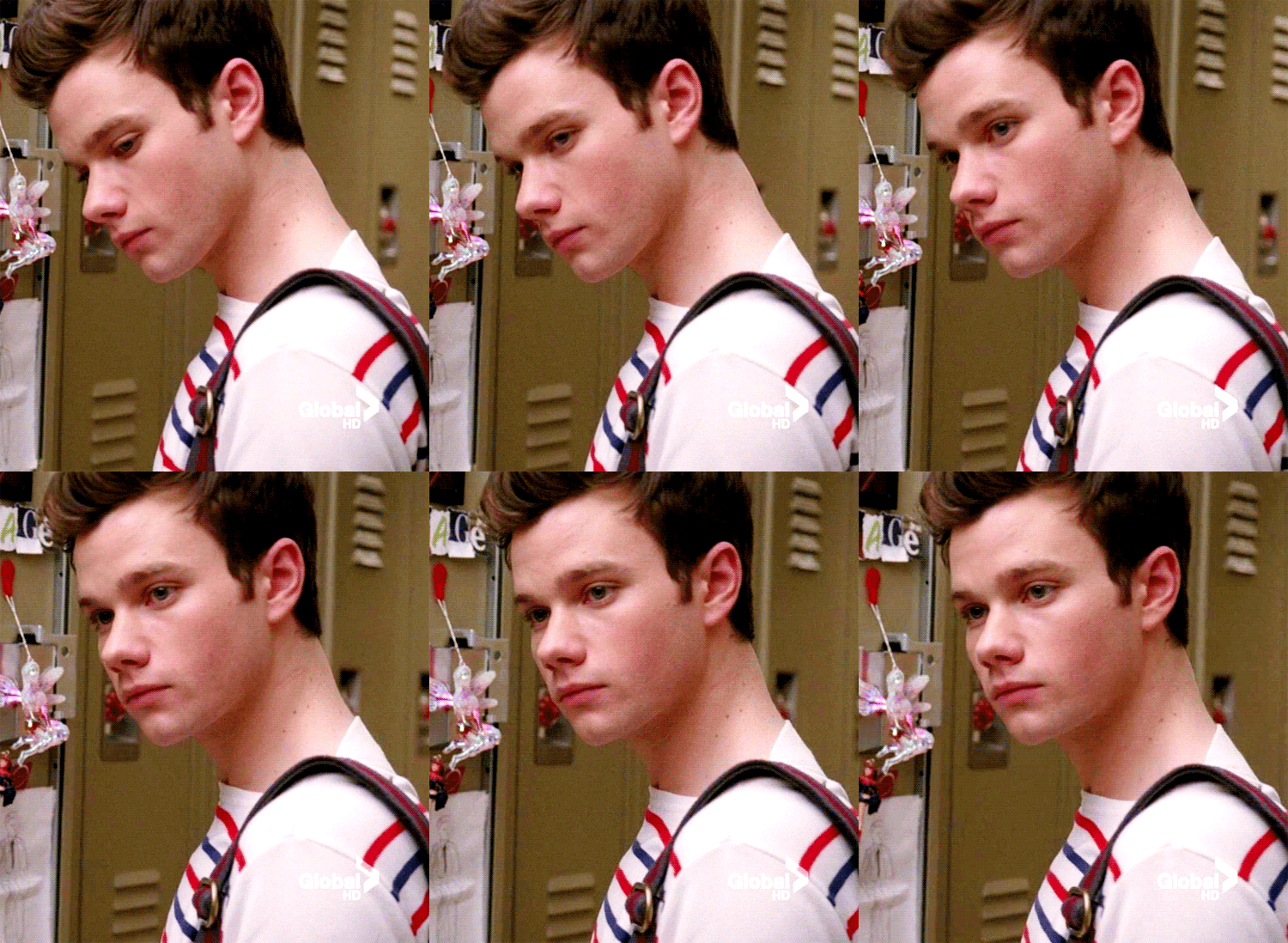
There are a few things we know unequivocally about Kurt Hummel. He has an astounding voice; he has an uncanny ability to spot trends in men’s fashion; and he knows when it comes from a bottle. He also really, really likes weddings. Just look at his fixation with the royal event (who could forget his still unrealized musical about Pippa Middleton?), and, of course, his amazing wedding planning for his father and Carole.
So, in an episode all about planning weddings and proposals, where the hell was Kurt Hummel?
The fact is, I have no idea. Because in an episode that gave us amazing content around Artie and Becky, underscored the very real chemistry between Sam and Mercedes, and treated us to another round of Finn Has No Idea What To Do With His Life, there really wasn’t room for another great scene that had no tonal relevance to any other scene in what was an information-rich, but largely hideously structured episode.
But I do have a theory. Although it’s one built, largely, not on the presence of data, but the absence of it, which isn’t my favorite basis for constructing an argument. I suspect whatever was going on in this episode goes back to the ring box scene between Kurt and Blaine that was supposed to be in the Christmas episode, but got yanked for time because what the episode needed to say about Kurt and Blaine got said in other ways.
The ring box wasn’t necessary to the Christmas episode, no. But it was necessary to this one, and if it had been broadcast, it might help explain not only Kurt’s non-participation in the marriage narratives of “Yes/No”, but why Beiste’s elopement was also a critical detail when it comes to this season’s ongoing marriage theme.
That season three is all about marriage we learn right at the start of 3.01. Kurt and Rachel are being interviewed by Joseph ben Israel about their plans for the future and Kurt says, “Married by 30, legally!”
I squealed at that line when it aired because of the turning tide, because of the recent marriage equality decision in New York (which Colfer gave a shout-out to while that was in process during the Glee Live dates here), and because of the state of marriage equality in Ohio.
You need to know it’s bad. Like really, really bad. Like, should the state, its people and its government have the will, it will still be a hot mess to fix. Ohio has multiple laws and even an amendment in the state constitution banning marriage equality. It’s not that it’s not legal, as is the case in many states; it’s that it’s explicitly, constitutionally illegal. In fact, despite not being the worst place to be gay, at all (especially if you’re in the Columbus area), Ohio has some of the ugliest legal language out there on marriage equality.
At any rate, 3.01 is hardly the last time we hear about marriage. 3.05 and the ramp-up to it is littered with references to spiritual marriage (I’m working on something with someone on that theme for this blog; we’ll get it to you one day), and that theme continues in its immediate aftermath through everything from Kurt’s wardrobe to a number of interactions between Santana and Brittany.
The Christmas episode also underscores marriage themes — around Kurt and Blaine euphemistically, and around Finn and Rachel and all that fretting about jewelry purchases. We also, of course, lost a Santana scene in the Diamond Basement in that episode, as well.
And then we come to “Yes/No”, an episode centered around something Kurt adores, and yet he’s no where near it. Why? Or, as gets said on Tumblr (and surely other spaces): “Why is Klaine being left out of this incredibly romantic episode?”
But I don’t think that’s the right question, because I don’t think this episode is supposed to be about romance. Or even marriage, as an act or a state of being. I think “Yes/No” is about the public spectacle and status conferred by marriage (and relationships) and the toxicity excessive focus on that public spectacle can engender.
When Will wants to marry Emma everything is fine until he starts to engage with the expected rituals of marriage with others by asking her family’s permission to marry her. Things then promptly go (temporarily) to hell.
Meanwhile, Finn’s proposal to Rachel at the episode’s end is far more about trying to find an identity for himself than it is about loving her, despite the fact that he does love her. Not knowing what will mark the culmination of his high school career, he chooses to propose to her — again, the need for spectacle and status getting in the way of good choices and the actual relationship.
Additionally, the glee club worries about Artie’s reputation if he is romantically linked to Becky; they can say it’s because they don’t trust her, but people on Glee date unpleasant people all the time, and Artie is right to call them out on their discomfort with her Downs.
And let’s not forget Shane, pulling Mercedes away from Sam right after he gets slushied. It’s all about relationships and partners as status items and possessions.
Even the opening use of “Summer Nights” focuses on that. The currency in that song is gossip, cars, and sex, and in case you forgot about the sex, Rachel was back with an I’m-about-to-lose-my-virginity-oh-wait-I-already-did capelette in that number.
So were does that leave Kurt, a young man who loves the spectacle of weddings, but also recently, according to canon we haven’t actually seen, received an age-appropriate token of affection from his boyfriend in private? In a pretty awkward place, I’m guessing. Because Kurt, more than anyone else in this show, has had significant time and cause to consider the status impacts of relationships conducted both in public and in private. Remember, it’s dangerous to other people for him to be their friend too; I wonder if he and Becky ever talk about that.
That the status of how people relate to him is critical to Kurt is something we see in play at Burt’s wedding. We see it at Kurt’s prom. We see it in Kurt and Blaine agreeing to have sex with each other for the first time in a conversation on a stage in an empty theater.
There is no audience for Kurt an Blaine’s commitment to each other, whatever it may be. No matter how out they are, the audience cannot exist; they aren’t paying the right type of attention; the script and framework are absent. Because this is Lima, Ohio, and certain spectacles are barred to boys like Kurt and Blaine in this place and time. Really, it’s even written down.
For Kurt, that has to be profoundly challenging. Here is a boy who just wants to be both seen and valued for what he is, but is often misinterpreted and devalued. Now that he has something that elevates his own feelings about himself and seems to fit the model for public celebration and status, he still doesn’t quite get to have that. Remember how tainted the prom was?
And then, we hear, Blaine gives him a ring and a promise. The ring is too delicate to wear regularly. The promise would make no sense to those around them: not to Rachel, who is leaning harder and harder towards her career and doesn’t have a partner who can take that journey with her; and not to Finn who would just shrug and say, “Dude, sucks you can’t get married.”
In a world where the ring box scene had actually been broadcast in the Christmas episode, there would be a clear thru-line from Kurt’s marriage fantasies about New York through the spiritual marriage theme of “The First Time.” This would then journey on to the commitment of the gum-wrapper ring, followed by this episode that largely shames the ways status rituals around marriage can get in the way of love. Note, of course, the one angst free marriage/partnership situation in this entire episode was Cooter and Beiste, and they eloped.
These themes, currently elucidated murkily thanks to the absence of that critical piece of connective tissue from the Christmas episode, seem as if they will be further underscored based on the spoilers we have for the Michael Jackson episode, in which we apparently see Kurt comforting an injured and/or emotionally miserable Blaine. This is something very different from the demonstrations of affection we see in the other couples on the show, and will probably then be in play again (in a state of absence due to Blaine missing a few eps due to Darren Criss’s run on Broadway) as the Valentine’s Day episode likely once again focuses on the toxicity of status issues around love and romance.
Glee, increasingly, seems to be about the public/private divide, about what you keep close, and what you can feel belongs to you — your pride, your talent, your capacity to love, and what is beyond your control — other people’s reactions, your success, the people you love. This is unavoidable in a narrative in which kids learn about themselves by performing, and Kurt, for all his striving since the show began, has, unfairly, some of the hardest, cruelest lessons to learn in this regard, in part, because of inequalities that are underscored by his blessings: his voice, his fashion sense, and, yes, his boyfriend.
Would “Yes/No” still have been incoherent on the “where is Kurt?” issue if we’d had that ring-box scene in the Christmas episode? Probably. The structural flaws were pretty epic on multiple fronts. But with the connective tissue of that ring box scene, I’m fairly sure we would at least know what Glee was aiming for, not just tonight, but with its ongoing marriage theme, that keeps making me want to quote Leonard Cohen: Love is not a victory march — not for Kurt and Blaine, who don’t get a parade; and not for Finn and Rachel for whom marriage seems to be a plan B to bigger dreams.
Where this will all go in the end, I’m not sure, but I am certain we’re not done with this marriage theme, nor are we done with Kurt and Blaine being absent or ambivalent around public displays of romantic status. They’re getting a little older and the realities of the public spectacle fairytale are getting much clearer for them — both in terms of what they can and can’t have, but also in terms of whether that’s really a fantastic mode for building a life.
That’s one thing about being a gay kid. Fewer blueprints on hand. And sometimes, that’s the best thing in the world.
 Letters from Titan