Glee has always, necessarily and unavoidably, offered us a clear link between desire and instruction. It’s there in Rachel’s early crush on Will Schuester and Kurt’s fascination with David Martinez and Cooper Anderson. It’s also present, whether we like it or not, because Sandy Ryerson and April Rhodes both exist.
Meanwhile, Quinn’s affair with her teacher at Yale; Cassandra’s relationship with Brody; Brody’s relationship with Rachel; as well as the high probability that a WMHS student in the crush-focused episode 4.11 (“Sadie Hawkins”) will have a thing for Finn while Kurt also grapples with interest from and in an older man, makes it clear that this dynamic is currently the subject of particular narrative focus.
This eroticization of instruction, however, is not exclusively about sex acts or the desire for them. This is particularly evident around Kurt, despite his long and overt history with the theme even beyond the examples cited above (Blaine, of course, enters Kurt’s life as a mentor character and while they’re still friends, offers, to not great effect, to teach him about being sexy).
While it’s, of course, impossible to listen to Chris Colfer’s remarkable interpretation of “Being Alive” from Company (it’s all over Tumblr and I’ll post an official link as soon as I have one), which Kurt will be singing in this week’s episode (4.9, “Swan Song”) without thinking of the current negotiations and difficulties between Kurt and Blaine, the song serves another purpose, not just as Kurt’s re-audition for NYADA, but as a narrative about erotics that is not necessarily directly connected to sexual desire or Kurt’s romantic entanglements.
This blog speaks often about Kurt’s relationship with Death, and as such, it is impossible to listen to “Being Alive” and not be particularly struck by the part of the song that is a plea from the singer to “make me alive.” This, after Kurt’s voice has been mostly silent this season, as he’s first been depressed about not getting into NYADA and then talked about feeling like he’s dying in the wake of Blaine’s betrayal, is startling.
But things have also not been all bad for Kurt. He has, for the first time, adults giving him advice that is shaping. Cassandra sends him back to Ohio to make him look at Blaine and what he did, while Isabelle who is, like Kurt, also marked with death symbols (mostly in the form of skull- and phoenix- related jewelery) tells him to take control of that relationship, even if it is ending and then embraces him after a song in which Kurt’s main line is “mother” (largely because “Let’s Have a Kiki” was cleaned up for TV).
These events are unique in Kurt’s experience because nearly everyone who has ever tried to offer him instruction or discuss the matter with him prior in the series has failed. But these women who have a darkness to them, mirroring the idea of Kurt’s dead mother, finally, start to fill this long missing function of meaningful instruction for him.
Will never knew what to do with Kurt. April Rhodes got him drunk. Blaine offered terrible and hurtful advice more than once (ultimately they learn together, but instruction from Blaine has always failed). Rachel, Brittany, and Finn all do Kurt harm through poor advice and advocacy on his behalf as well. Even Burt Hummel, who is definitely father of the year, tells Kurt he’ll have to go it alone creatively, and often throws his hands up and tells Kurt he’ll just have to wait various indignities out.
But Kurt, who still wants to go to NYADA, rejects this idea of having to remake the world by himself just so that he can fit in it. Yes, he’s a magician, but he’s been bumbling about in the dark with his power. It’s dangerous and confusing to him. It’s overlooked and frightening to others. And he needs.
In that context “Being Alive” is not just Kurt taking the emotions he has experienced over Blaine and transmuting them into a performance that makes Carmen Tibideaux rethink her annoyance with the song as an audition piece and let Kurt into NYADA. Rather it is Kurt begging for instruction in the tradition of a certain Internet story some of you may be familiar with regarding a tea cup begging to be put in the kiln.
Huge swathes of “Being Alive” can speak powerfully to an erotic understanding of instruction. In fact, for someone seeking instruction for a career in that which we call the creative arts, but should also be referred to as the emotional arts, most of the song can be read to speak to the way we often romanticize (and can benefit from) certain brutalities and perhaps excessive intimacies of instruction:
Somebody, need me too much,
Somebody, know me too well,
Somebody, pull me up short
And put me through hell
And give me support
For being alive,
Make me alive.
Make me confused,
Mock me with praise,
Let me be used,
Vary my days.
But alone is alone, not alive.
Somebody, crowd me with love,
Somebody, force me to care,
Somebody, make me come through,
I’ll always be there,
As frightened as you,
To help us survive
Being alive
This feels particularly truthful regarding Kurt, not only for the walls he puts up, but because the people that he has started to acquire in actually useful instructive roles are as vulnerable as he is, hence the singing of “as frightened as you.” The desire to have loyalty to an instructor as their subject and their product doesn’t come from nowhere. The affection he shows Isabelle from the moment he meets her as she worries about being a fraud and losing her job, and even towards Cassandra when they finally meet over her drama with Rachel, is clear.
While many people who are exposed to college-age actors often cruelly joke about where they’re going to find any stakes for their scene work, saying “‘My roommate drank my milk again’ only goes so far,” Kurt demonstrates in “Being Alive” that he has both emotional experience and the skill to convey that experience.
Yet, as much as “Being Alive” is a song of realization and maturity, it is also a song of begging. And in Kurt’s case, what he’s begging for is the ballet teacher who slaps your thigh with a ruler until you stop shaking and your leg goes higher. He’s begging for the instructor who says Again, again and again. He’s begging for the instructor from which he must learn that each criticism is an act of love and that he must have faith to hear it and see it and feel it.
Kurt is begging not to be the diamond (as Rachel always does) — not yet — but the carbon. He’s begging to be the teacup.
And this is one of the reasons, surely, that this episode is titled “Swan Song,” because this is the song of the ugly duckling becoming a swan. It’s not that Kurt achieves his full beauty in this moment, but rather, that he has somehow shaken off the useless and devastating brutality he’s endured (that helped make him a magician) to beg for the brutality of the instruction he’s finally willing and able to accept that he needs. And desires.
It’s a powerful, moving, and almost frightening naming of desire for the character and for the audiences (Doylist and Watsonian) watching him. It also speaks to the maturity and eroticism we’ve seen many characters try to claim in desire towards instructional figures. Yet, it’s only “a touch of the fingertips is as sexy as it gets” Kurt Hummel who gets the metaphor for what it is and takes it on for what it can really be worth.
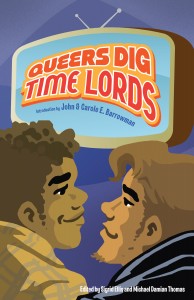 I’m really happy to finally get to post about Queers Dig Time Lords: A Celebration of Doctor Who by the LGBTQ Fans Who Love It, edited by Sigrid Ellis (Chicks Dig Comics) and Michael Damian Thomas (Apex Magazine). It’s being released on June 4, 2013, already seems to have great buzz, and has one of my essays in it.

 Letters from Titan