Glee: Following up – Blaine and gender; Sebastian, Blaine, Santana and race

Two quick Thursday afternoon followups to some of our recent Glee discussions:

First, the detectives over at CSI Tumblr have been having some fun figuring out what’s on Blaine’s bookshelf. Aside from toy robots and old film-based cameras, they’ve also identified some SAT study guides, a book on the American theatre, and what someone is pretty sure is a history textbook. That isn’t the awesome part though.

The awesome part is not only does he have Mockingjay, he has What If… You Broke All the Rules, a-choose-your-own-adventure book in which the reader is a teenage girl neglected by her parents who must decide which boy or fabulous group of friends to spend her spring break with.

Next to that? Official and Confidential: The Secret Life of J.Edgar Hoover. I don’t need to give you Hoover history here, do I?

The job of set dressers isn’t, really, to be ready for CSI Tumblr, but to make things look good at the level of detail the TV audience is supposed to see things at. That said, HD TV and digital fandom really changes the game, and I love that the folks working on Glee are not only hilarious, but seem to agree with me that maybe Kurt’s not the character we should be asking gender identity questions about. Blaine passes as a lot of things, and maybe that’s not just straight if he wants to; remember the Sadie Hawkins dance?

On a completely separate note, that does however touch on this season’s themes around passing, biyuti has written about Sebastian’s bad behavior and subsequent reactions in the context of race. Because, of course, it’s not just that he says unbelievably offensive stuff to Santana; Blaine’s not white (at least as of this writing, more on that in a moment) either, and while Dalton looks a lot more diverse than the private school I went to growing up, that still doesn’t mean that what’s happening with the power structures in this episode isn’t all about race too.

Meanwhile, for those who haven’t heard (and remember, this is not a spoiler-free blog), the very white Matt Bomer has been cast as Blaine’s brother for an episode airing in April. Considering that Glee‘s canon has glancingly acknowledged Blaine has having a non-white background (Rachel wanting to have his “vaguely Eurasian babies”), a lot of folks are head-tilting at this choice, especially when Glee has often used details of the actors’ personal lives in crafting character backgrounds (i.e., both Jenna Ushkowitz and Tina, the character she plays, are adopted). Stay tuned….

Glee: Gender, violence and power

While most of what I had to say about last night’s episode of Glee remains firmly centered around “Smooth Criminal,” which was just as creepy in context as out of it, I did want to briefly mention how intensely focused the whole episode really was on gendered types of violence and gendered responses to that violence, with most of it being in the realm of the feminine, despite most of the players being men.

The slushie meant for Kurt that Blaine steps in front of contains rock salt, which heats when it comes into contact with water and ice. This implies strongly that Sebastian’s initial goal was for Kurt to experience chemical burns, and it certainly evokes a type of violence generally directed at women by men and that the media tells us transpires because those women do not obey the wishes of those men.

This is violence about damaging the one asset these women are believed to have (appeal to men) and publicly shaming them through the lasting mark of that violence, and in Glee, it hardly represents the first time that Sebastian objects to Kurt both on the basis of the charms he holds for Blaine and for the degree to which he is not straight-acting.

That Blaine’s eyesight is then damaged when he engages in a traditionally masculine act (I’m sorry, Glee is broad, and I have to use a lot of normative gender expectations to take it apart) of protecting a lover, then serves to recode Blaine as the feminine, thanks to the long history of, as an anonymous user pointed out to me on Tumblr, blindness and blinding being used as a metaphor for impotence.

From there, we witness the strongly implied violence of “Smooth Criminal” in which both Santana and Sebastian are using sexuality in their duel, but in which only one of them, Sebastian, is able to successfully imply the perpetration of acts of sexual violence through that performance.

When Sebastian slushies Santana at the end of that number, the same form of violence against women by men seen in “Bad” is again evoked, but he doesn’t even bother with the rock salt this time; Santana isn’t worth the trouble, perhaps because her lesbianism in Sebastian’s eyes already renders her of little use to men, even, or perhaps particularly, to a predatory gay one.

Responses to this violence from the New Directions team is also highly gendered. Multiple people on multiple occasions talk about how the police won’t be interested in, or believe, what was done to Blaine. This includes, most notably, Schue’s attempt to minimize it in a kids-will-be-kids way and move on, and Kurt’s privately furious catharsis which later gives way to a brave-faced comment on rising above, largely because that seems to be the only weapon he has.

Meanwhile, Santana, we later find out, wasn’t actually trying to fight Sebastian on his own terms of overt sexual aggression, so much as she was both literally and metaphorically taking one for the team in order to get him to confess on tape. A woman fights a man by appearing to yield; it gets her close enough to do real damage.

This constant metaphor of rape and response to it in the episode is even underscored by small, seemingly throwaway lines, like Brittany saying, “I don’t know how,” when told to lock the door to the choir room. This is further highlighted by the contrast of Artie, who has been constantly used to explicitly define what masculinity is and isn’t this season, blowing up at Schue for his lip-service sympathy.

But outside of the near explicit implications of Sebastian’s actions, most of the episode’s masculine violence is metaphorical and unrealized from the dancing-fighting of “Bad” to Artie’s fantasy sequence.

Lima, OH is a world where people only dream about conventional forms of power and nearly everyone must accept violation. By bringing back the slushies, Glee‘s original iconic bullying instrument, in this form, Glee tells us that all of this bullying has been serious (and sexual) business all along, and that the worst thing anyone can be in this place is feminine and feminized; the problem, however, is that nearly everyone is. There are almost no men, and remarkably few honorable ones, here; the brutality of WMHS and of Lima don’t allow there to be.

Which is really why the ridiculousness of Quinn getting into Yale feels so good. She’s the character most explicitly punished for the feminine on Glee, and so she’s the first one victoriously out. Kurt, the character next most explicitly punished for the feminine, also has his huge NYADA finalist victory moment in this episode, in a way that, unlike Rachel’s victory letter, is untainted.

Glee has always been a story about a terrible place in which to be a girl, or gay, or disabled, or different in any way. That makes people angry often, largely because the show doesn’t tell us bullying is bad, but merely shows us it is awful and exists largely without correction. But as the adult world encroaches as the stakes get bigger, at least 3.11 reminds us that the powers that be know the only way up is out.

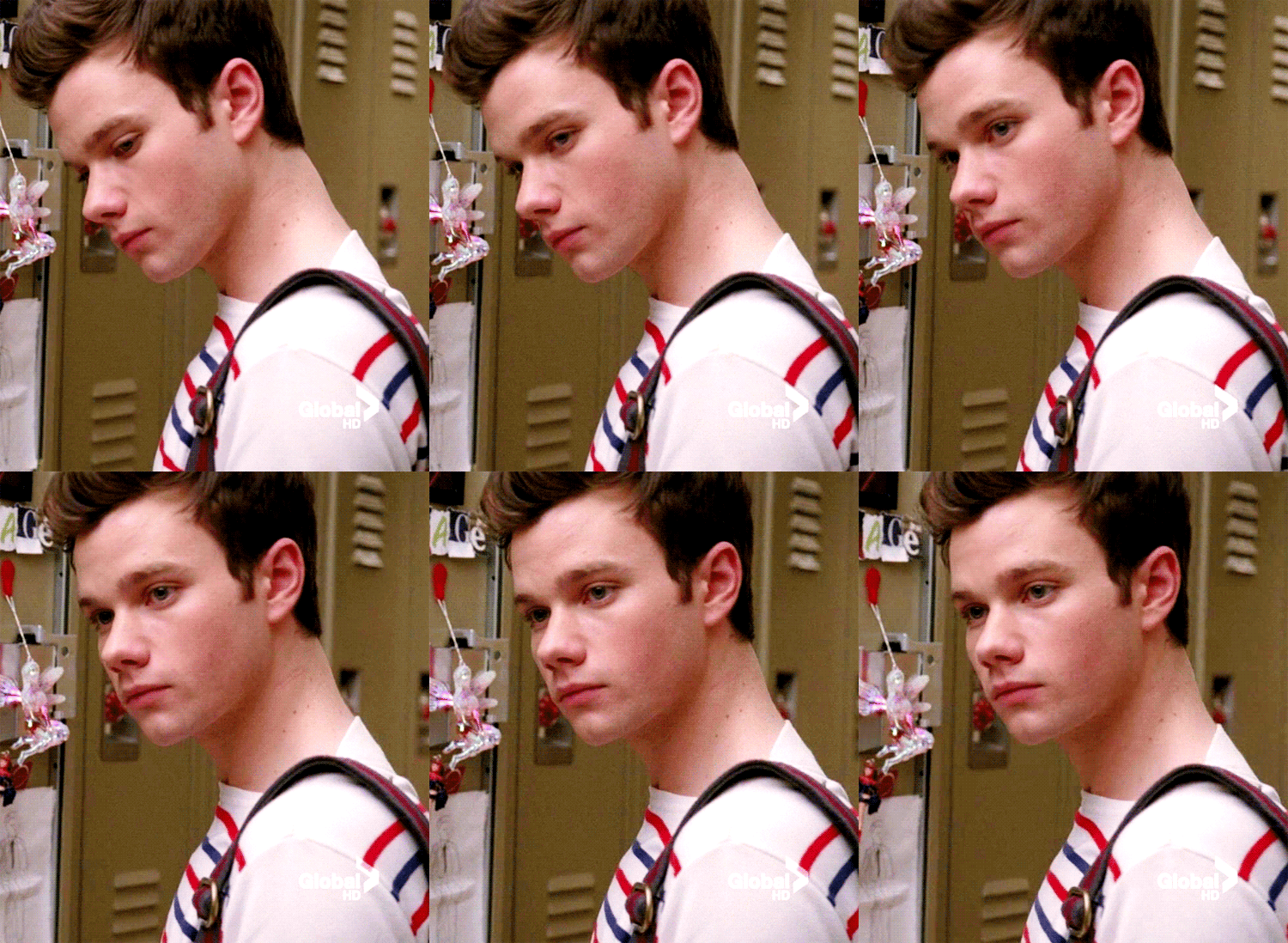
Finally, on an almost, but not entirely, tangential note, I just want to point you to the faerie trinkets that are currently adorning Kurt’s locker. Rae Votta, who also writes stuff about Glee and other pop-culture interests, pointed them out to me last night, and I haven’t stopped thinking about them since. They seem to be references queer, magical, and feminine, as if they are the small tokens by which Kurt, who seems to always be in exile from something (a dead mother, his straight friends, his horrible high school, his gay fantasy land, a still faintly out of reach New York City), always remembers who, and what, he is.

SAG Awards: Chris Colfer and the smartest tuxedo ever

I haven’t written about menswear here since the great customized pinstripe discussion from almost a year ago, but I can’t stop thinking about what a clever choice Vivienne Westwood’s harlequin-evoking tuxedo was for Chris Colfer at the SAG Awards last night (look, the SAG awards are a snoozer, but clothes are fun and since I get to vote in them I do feel faintly obligated to watch).

Aside from the fact that the man knows how to wear a suit and seeing him going a little more daring in that regard was delightful, the more I’ve pondered the various origins of what we think of as the harlequin, the more taken I am with this choice. A trickster, an acrobat, and a being that runs around with a bunch of demons chasing damned souls to hell is some pretty powerful stuff. It’s also some pretty clever and wry stuff when the person sartorially referencing this bit of theatrical history is a young performer and writer who just happens to be gay in what is still a homophobic culture.

Making it all even more delicious is the fact that the Vivienne Westwood suit’s harlequin details only extend from the shoulders to mid-chest, so what we’re looking at isn’t the full garb of the harlequin, but merely the mantle. All clothes are about playing a role, of course, especially clothes worn for the camera at an awards ceremony, but this particular tuxedo, on anyone, is explicitly so.

I haven’t the faintest idea if anyone in Colfer’s camp thought consciously about the motif of the suit, although I imagine all those people are certainly smart enough for it to be a possibility.

Regardless, I can’t stop being tickled by what I read immediately as a playful and intellectual skewering of a weird business and its intersection with an often cowardly culture. Reception is only within an artist’s control to a profoundly limited degree, and I love seeing that celebrated and played with, even if my experience of such is well outside its original intent.

Glee: Honor, duels, and consent

One of the things I’ve been meaning to write about here for a while is how intensely creepy the Warblers have become in Glee‘s third season, but I haven’t really had an excuse to go back to that somewhat boggling performance of “Uptown Girl” and talk about the predatoriness of these particular denizens of faerieland. (If you haven’t caught it here before, Glee actually, explicitly, frames Dalton this way, from Puck’s sending Kurt there to spy to Kurt’s amazed little query as to whether all the boys at Dalton are gay. The answer is no, but that doesn’t stop the school from being, at least, temporarily, a magical haven for him).

But today’s release of the full clip of Santana and Sebastian singing “Smooth Criminal” has made me want to revisit that earlier performance, which foreshadows this new release quite nicely.

But to get there, I have to work backwards, so first I should note that “Smooth Criminal” is one of the most menacing and interesting things I’ve seen Glee do, and it manages to evoke the consent-related themes that simmer constantly under show’s surface but are rarely explicitly addressed. Additionally, the performance is a truly masterful representation of a duel, and serves to finally clarify for us why Sebastian is anything but a trivial villain.

As a fight scene, the number is remarkably well done. Yes, both Santana and Sebastian do things that would make no sense to do in an actual fight, but that’s how fights in fiction work: some big, showy stuff that would get you killed in non-fiction life is necessary to make the duel read on-screen for the viewer. If we brush those choices aside (mainly, how often they turn their backs on each other), there’s a lot of good strategy on display.

Santana begins by conserving her energy. She lets her bigger opponent, who will tire more easily, wear himself down by showing off and providing her with data. Then, once she has the data from afar, without touch, she allows him to come in close so she can see what that is like; she let’s him touch her, and it is awful.

And then, because she’s smaller and faster, Santana gets inside his reach, and goes on the offensive; this is where she’s grabbing and shoving at him, something some people in fandom have been saying was uncalled for on her part. I think it was necessary; without it, in the duel metaphor of the performance, she wouldn’t have even lasted the whole song.

Then, after she makes contact, Santana obeys the most important rule of a duel: “When in doubt, get the hell out.” She spends most of the rest of the song keeping Sebastian as far away from her as possible, so as not to lose what ground she’s gained. The scene between these two works, because if you were to replace the song with swords, you’d barely have to change any of the physicality.

But despite this relatively good strategy from Santana (Sebastian has the advantage, but he’s cocky, and one day that’s going to bite him, hard), what I can’t stop being fascinated by in the scene is how frightened she looks.

Yes, she stands her ground, and laughs Sebastian off before the song starts when it seems like he’s challenging her to a duel (note: he challenges; she chooses the weapons, that is, the song), but she knows things with this guy aren’t necessarily going to be just some allegorical vocal duel, especially after he dismisses the Warblers from the room because he doesn’t want witnesses.

This tells us several things about Sebastian. The first is that he is concerned with modes of honor. That’s why he wants this duel, and that’s why he doesn’t want witnesses when he does something dishonorable (making a girl cry). But in a duel without actual weapons or violence, not having an audience makes no sense; if there are no witnesses to the event, without blood, how do you know who has won?

Which is exactly why Santana is nervous. Despite scoffing at the ridiculousness of the initial duel challenge, she gets the implied threat of the Warblers’ dismissal immediately. After all, this is the girl who at least fantasizes about knowing how to fight even if she doesn’t actually (never forget those supposed razor blades in her hair).

When Sebastian dismisses the Warblers, Santana realizes that whatever they are framing this battle as now, there’s a very real possibility that he’s interested in doing some sort of lingering, visible, tangible damage to her. Otherwise, a victory on his part would be intangible, and not serve his oft-highlighted status-related desires.

And it’s the role desire plays in this confrontation that is critical to understanding the intensity of the scene’s menace. Because while the chemistry between Santana and Sebastian is off-the-charts, they are also both gay. Which means that the sexuality overtly present in the scene isn’t about desire, but arguably about power, control, and violence. The fact that the song being sung is about a woman being assaulted in her bedroom, and that Santana is singing response to Sebastian’s lead until she gets to do some gloriously powerful notes at the end, further underscores that Sebastian is one more Glee character with an unhealthy perspective on sex, power, and consent.

Frankly, I find Sebastian far creepier than Dave Karofsky, because while Karofsky systematically harassed and eventually assaulted Kurt with that kiss, a lot of that at least had to do with what Karofsky wanted for himself and his anger around that. Sebastian just wants to take for the sake of having and hurt for the sake of his own amusement. For me, that feels a lot more dangerous, because it’s harder for me to understand. At a distance, Dave Karofsky has my empathy; Sebastian can’t.

Which brings us back, finally, to the Warblers in their creepy, corrupted “Uptown Girl” state from the beginning of the season. Not only does that number feature echoes back to the slow-motion of Blaine’s introduction of Kurt to Dalton in season two, but this time with Sebastian dragging Blaine into the number (the risks of faerie rings, anyone?), it also foreshadows the circling choreography that is central to the Sebastian and Santana “duel.”

In “Uptown Girl,” however, it is a female Dalton teacher circled first by one boy, then by two, then by the whole group of them as she tries to exert her authority. Eventually, she succeeds, but it seems like a near thing and one where the boys have retreated only because they’ve become bored.

By the time we get to “Smooth Criminal,” we know from other spoiler clips that the Warbler’s Council seems to be no more, replaced instead by Sebastian as captain, and if he tells those boys to leave him alone with a girl so he can fight (brutalize) her, in private, they go without question. Sebastian has rewritten their notions of honor and eliminated whatever code would have forced them to stand up to him and to say no to him, had he been present in the season two Dalton landscape.

While Sebastian’s clumsily aggressive and showy attempts to hook up with Blaine have been largely laughable, I think “Smooth Criminal” and its growth out of “Uptown Girl” shows us we may now be looking at the realest, darkest villain Glee has ever had. Watching his corruption of the Warblers is like watching fruit rot, and the sexual aggression that at first seemed interesting and seductive to both Blaine and the viewer now just seems like an explicit, ongoing threat of sexualized violence.

I’ll be surprised if Glee ever actually addresses, as opposed to just demonstrates, the consent issues many of its plot lines raise. But I’m not even sure the show actually has to do anything more than point to the existence of these situations to be effective, not when I see Santana, despite standing her ground, actually looking afraid of this boy Sebastian.

Suddenly, I feel very clear on why Blaine — nearly always presented in canon as taking a traditionally feminine role, at least in his thoughts about himself — has such a hard time saying no to Sebastian. Like everything else surrounding this situation, it’s not about desire. It’s about feeling like he’s even less safe in the face of this boy than he already is if he were to say no.

How to Succeed in Business Without Really Trying: Ambition and the desire to disappear

Since I had a friend in town this weekend (and that was sort of chaotic, since he wasn’t staying with me and I got sucked into bad work stuff and the amount of time we got to hang out outside of shows we went to see was super minimal), I wound up seeing How to Succeed… again. Yes, that’s an excuse. I would have done it anyway. But that’s also not the point.

The point is that since the show remains slight and still drags in the middle and all the other things I tend to think are wrong with it structurally, I had to stretch a little to find something to hold my attention for the two and a half hours in question (Darren Criss: cute, but not that cute).

On the surface How to Succeed… is a show about ambition: Finch wants to climb the corporate ladder; Rosemary wants to escape the life of a secretary and marry a rich executive; Heddy wants to be a star at whatever she does. Even Bud Frump wants to be important, and the head of the mail room is proud of his promotion to shipping.

There’s just one problem. How to Succeed… might actually be a show about people who want to disappear: If Finch has a self, not only does the audience arguably never see it, but Finch probably hasn’t seen it in a long, long time either; Rosemary fantasizes about having the perfect man who will look right through her as she wears the “wifely uniform”; Heddy drinks and plays the bimbo with little goal-oriented intent, while Bud Frump’s ambition doesn’t involve distinguishing himself in the slightest; meanwhile, the head of the mail room’s entire strategy for success is never being noticed. Through a certain lens, what all these people are striving for seems to be an absence.

Of course, all of this is creepiest with Finch, who generally gets played as innocent and lucky, or charmingly (and mostly, but not entirely, non-maliciously) conniving. But if I really start thinking about Finch, I frankly start getting entirely creeped out.

I noticed it a little bit the first time I saw the show, in that I just couldn’t get a handle on what was going on with Finch’s sexuality. He doesn’t seem particularly interested in Rosemary, only realizing he’s in love with her to avoid another woman’s advances. Then he installs her as his secretary so that they can’t have a personal relationship until they marry, when, based on the songs Rosemary sings, they stop interacting again except for the occasional entertaining the neighbors and enough obligatory sex to produce a child. But all of that nonsense is in keeping with the public face of the period, especially in satire, and I sort of blew it off as another oddity of an odd show.

But then I saw it again. And Criss’s performance was a lot weirder and a little darker.

So I started asking myself, who is Finch when he’s at home? What does he do? Does he have hobbies? Friends? Does he ever pop into the local bar? What does he fantasize about? Is he crazily breaking into libraries to research the Old Ivy fight song in the middle of the night? Or is he sitting on his couch, staring at a blank wall and being empty until it’s time to go into work and find the next executive to push off a metaphorical cliff?

Between that thought process (and I do think Finch sits in his miserable little apartment and stares blankly at a wall practicing his self-erasure) and a performance that seemed to deliver a Finch who is terrified of female sexuality and only marginally more comfortable with male sexuality yet seemingly equally uninterested in it, I was suddenly a lot more engaged with this odder than I had previously realized show.

By the time Finch sang, “I Believe in You,” the hairs on the back of my neck were standing up, because whenever I tried to picture what Finch was seeing in that mirror, the only thing I was sure of was that it wasn’t his own face. I wondered if the moment was for him any different than the moment when the show starts and he’s peering in at the world he wants to conquer through window glass. Whoever and wherever Finch is, there doesn’t seem to be any there, there. Ever. And the creepiest part is that he seems to be aware of this only about half the time.

How to Succeed… remains an uneven show burdened with workplace culture history that’s too recent for us to really distance ourselves from no matter who is in it. But I don’t regret braving it more than once now, if only because my restless brain was apparently impelled to turn it into a horror narrative.

Certainly, I’ll now be chewing over the idea that ambition is an act of wishing to disappear rather than wishing to be seen for a long time to come.

Glee: The ferryman always takes a toll

“These next six [episodes] are designed to be fun, fun, fun. They’re big, glossy, star-studded. Then the last six will be very heartbreaking.” – Ryan Murphy in Entertainment Weekly

I was in the airport when fandom found this and got understandably anxious. Me? I just got excited. Like, tapping my feet, fidgeting, get-me-off-this-plane, I have stuff to write, excited. Not because I like tragedy, but because I like stories, conclusions, and victories that are earned. And it occurred to me, reading Murphy’s rather Persephonean remark and thinking about some of the ongoing discussion of “Yes/No,” that I think we have to expect that no one gets out of William McKinley High School without paying a price. No one gets to have everything they want, especially before this story is over, and it’s probably time to start getting ready to pay.

Sadly, I think, the character many of us would like to be most immune to this debt, is the one most susceptible to it to it: Kurt Hummel, who has the show’s closest relationship with death, and often serves as its mediator.

Kurt still opens the drawers of an old dresser to catch his dead mother’s scent; he worked to call his father back from the dead (and not with the help of any god, it should be noted in the face of Kurt’s atheism, which in no way diminishes the otherworldly themes with which he is surrounded). He’s the boy who got death threats, who arranged Sue’s sister’s funeral, who was able to walk in and back out of the faerie kingdom of Dalton, and the one who has a dead animal trophy motif in his wardrobe from fox tails to hippo heads.

He is also the boy who struggled the most with the idea of sexuality and losing his virginity and then took the most ownership of it (big death, little death, spiritual union, Kurt Hummel has got this death and associated metaphors thing covered). I’ve written about it before: Kurt is a magician and a creature who lives between many worlds, including, but not limited to, two schools, a blended family, his gender presentation.

But in many ways, it’s not that Kurt’s a Persephone, cycling in and out of the realms of Hell, not now that his bullying isn’t so terribly plot central and dangerous. Rather, it’s that he’s an Orpheus who didn’t look back when he left Dalton (remember that when Blaine sang “Somewhere Only We Know”, they had their “I’m never letting you go” moment, but then Blaine looked back while Kurt, surrounded by his friends, did not), and so got to keep his Eurydice.

For now.

If we argue that William McKinley High School is Hell, or a realm of it — and I think that’s a pretty easy argument to make, not just because it’s awful, but because of the heightened reality of Glee, and because of the themes of Ryan Murphy’s work (all his stuff is arguably set in different realms of Hell, sometimes explicitly so) — we sort of also have to assume that Death may be the least inclined to grant favors of escape to his most cherished servants.

Because Death’s been kind to them in a way, and wouldn’t want to see them go. More than anyone, Death’s given Kurt a place, and a very specific function in the world of Glee in which his otherness is less a role and more a symptom of this unique purpose. For that matter, Death gave Kurt Blaine when Pavoratti died; as such, Death might be inclined to have some demands, if Kurt is going to leave.

This suggests to me that if Kurt gets into NYADA and chooses to go (and I believe, deeply, that Kurt will get into NYADA, but that he may possibly choose not to go, sacrificing that dream for Blaine or his father), either he will then break up with Blaine or his father will die. That’s the price to cross the river (Manhattan is, after all, an island): NYADA, romantic life, or family; Kurt can only choose two.

Rachel will also have a price to pay on her graduation journey, but I suspect (and let’s be frank, this is what I would do if I were writing the show) it may be a less obvious, but not less significant, toll. If Rachel gets into NYADA and goes (and I can’t see a way towards a moment where she chooses not to), I believe she will also, as recompense, agree to marry Finn, and take him to a New York where he will not be happy.

Many fans, of course, will yell and scream at the end of season 3 if and when this happens, especially if Kurt and Blaine have broken up (which I suspect they will), but, again, to quote the same Leonard Cohen line twice in a week, love is not a victory march.

What we’ll be seeing won’t be Rachel getting a happy ending and the gay boys getting screwed by network TV homophobia. I promise you. Because Glee loves mirrors. For a pair of friends who are getting out of Lima to both pay the debt to do so with their hearts, in ways that seem to be polar opposites of each other, is the type of elegance that Glee does well, and makes the show worth watching despite all the other places in which it gets lost while trying to play its long game.

So I suspect Rachel will get to New York without having really escaped; and Kurt will arrive as less than what he has always been meant to be by denying his nature — that is, that he is a boy from Lima, and his heart is tied to that place and to Blaine, no matter how far he goes and no matter how true his dreams become. Season 4, in turn, will then be about renegotiating the prices of their escapes.

These inevitable tolls to cross out of WMHS and Lima aren’t limited, of course, to Kurt and Rachel. The other seniors will surely have things dear to them taken too. Quinn, for example, probably won’t get out of Lima, but in exchange, will get to retain a connection to Beth. Santana will likely have a choice that involves Brittany, her family, and possibly a Lima escape. Mercedes, I suspect, may be dancing back and forth between Shane and Sam for the rest of the season, simply because the show hasn’t really given her another dilemma. Finn’s going to have to choose being a big fish in a small pond (and taking over Burt’s garage) or getting over his conception of being a man (Finn’s not leadership material, and you don’t have to be a leader to be a man, but that’s going to be hard leap for him to make).

None of these choices will be easy to make for any of the characters; all of them will hurt, and many of them will be the wrong ones.

My gut tells me Kurt will get into NYADA around episode 3.17 and then break up with Blaine in the second to last episode, although in that final episode they’ll probably have a small moment where there’s a kiss goodbye or some other gutting sign of hope (Note to the powers that be: all I want for early Christmas is Kurt and Blaine singing Mika’s “Happy Ending” to each other as everything falls apart because they are still in love).

Rachel, meanwhile, will commit to going to New York, whether or not she gets into NYADA and will bring an uncertain, plan-free Finn with her. The New York half of season four will likely feature Finn not being able to hack it and going back to Lima for a while (although not necessarily permanently); and Kurt and Blaine dating around miserably (Kurt has dinner with a myriad of boys and can’t stomach more, while Blaine’s probably going to be very busy in the back seat of cars) before he and Blaine get back together towards the end of that season.

It’s hard, of course, to want stuff like this to happen to characters and relationships we love, that keep us, frankly, company in the dark. Kurt’s been through enough, we say. But they have such great chemistry, we remind. We’ve been through so much watching these people, don’t they deserve happily ever after?

Don’t we?

But narrative, of course, thrives on conflict. And fandom and general audiences both thrive on longing. When will they kiss? Doesn’t he realize he still loves him? These are the questions we ask. These are the questions we will be asking.

Because loving fiction that is out of our hands is one of the realms of Hell too. It is a place of shades and ghosts that we can almost, but not quite, touch, and who we strive to make tangible through our desire and our grief.

But the ferryman always takes a toll, and he’ll take it at the end of this season of Glee not just from Kurt and Rachel and Finn and all the other WMHS high school seniors, but from us. That’s the price for all the love and yearning these stories give us.

The secret, of course, is that it feels good to pay that price, and to drink from the river, and forget.

Glee: Marriage, public status, and private lives

There are a few things we know unequivocally about Kurt Hummel. He has an astounding voice; he has an uncanny ability to spot trends in men’s fashion; and he knows when it comes from a bottle. He also really, really likes weddings. Just look at his fixation with the royal event (who could forget his still unrealized musical about Pippa Middleton?), and, of course, his amazing wedding planning for his father and Carole.

So, in an episode all about planning weddings and proposals, where the hell was Kurt Hummel?

The fact is, I have no idea. Because in an episode that gave us amazing content around Artie and Becky, underscored the very real chemistry between Sam and Mercedes, and treated us to another round of Finn Has No Idea What To Do With His Life, there really wasn’t room for another great scene that had no tonal relevance to any other scene in what was an information-rich, but largely hideously structured episode.

But I do have a theory. Although it’s one built, largely, not on the presence of data, but the absence of it, which isn’t my favorite basis for constructing an argument. I suspect whatever was going on in this episode goes back to the ring box scene between Kurt and Blaine that was supposed to be in the Christmas episode, but got yanked for time because what the episode needed to say about Kurt and Blaine got said in other ways.

The ring box wasn’t necessary to the Christmas episode, no. But it was necessary to this one, and if it had been broadcast, it might help explain not only Kurt’s non-participation in the marriage narratives of “Yes/No”, but why Beiste’s elopement was also a critical detail when it comes to this season’s ongoing marriage theme.

That season three is all about marriage we learn right at the start of 3.01. Kurt and Rachel are being interviewed by Joseph ben Israel about their plans for the future and Kurt says, “Married by 30, legally!”

I squealed at that line when it aired because of the turning tide, because of the recent marriage equality decision in New York (which Colfer gave a shout-out to while that was in process during the Glee Live dates here), and because of the state of marriage equality in Ohio.

You need to know it’s bad. Like really, really bad. Like, should the state, its people and its government have the will, it will still be a hot mess to fix. Ohio has multiple laws and even an amendment in the state constitution banning marriage equality. It’s not that it’s not legal, as is the case in many states; it’s that it’s explicitly, constitutionally illegal. In fact, despite not being the worst place to be gay, at all (especially if you’re in the Columbus area), Ohio has some of the ugliest legal language out there on marriage equality.

At any rate, 3.01 is hardly the last time we hear about marriage. 3.05 and the ramp-up to it is littered with references to spiritual marriage (I’m working on something with someone on that theme for this blog; we’ll get it to you one day), and that theme continues in its immediate aftermath through everything from Kurt’s wardrobe to a number of interactions between Santana and Brittany.

The Christmas episode also underscores marriage themes — around Kurt and Blaine euphemistically, and around Finn and Rachel and all that fretting about jewelry purchases. We also, of course, lost a Santana scene in the Diamond Basement in that episode, as well.

And then we come to “Yes/No”, an episode centered around something Kurt adores, and yet he’s no where near it. Why? Or, as gets said on Tumblr (and surely other spaces): “Why is Klaine being left out of this incredibly romantic episode?”

But I don’t think that’s the right question, because I don’t think this episode is supposed to be about romance. Or even marriage, as an act or a state of being. I think “Yes/No” is about the public spectacle and status conferred by marriage (and relationships) and the toxicity excessive focus on that public spectacle can engender.

When Will wants to marry Emma everything is fine until he starts to engage with the expected rituals of marriage with others by asking her family’s permission to marry her. Things then promptly go (temporarily) to hell.

Meanwhile, Finn’s proposal to Rachel at the episode’s end is far more about trying to find an identity for himself than it is about loving her, despite the fact that he does love her. Not knowing what will mark the culmination of his high school career, he chooses to propose to her — again, the need for spectacle and status getting in the way of good choices and the actual relationship.

Additionally, the glee club worries about Artie’s reputation if he is romantically linked to Becky; they can say it’s because they don’t trust her, but people on Glee date unpleasant people all the time, and Artie is right to call them out on their discomfort with her Downs.

And let’s not forget Shane, pulling Mercedes away from Sam right after he gets slushied. It’s all about relationships and partners as status items and possessions.

Even the opening use of “Summer Nights” focuses on that. The currency in that song is gossip, cars, and sex, and in case you forgot about the sex, Rachel was back with an I’m-about-to-lose-my-virginity-oh-wait-I-already-did capelette in that number.

So were does that leave Kurt, a young man who loves the spectacle of weddings, but also recently, according to canon we haven’t actually seen, received an age-appropriate token of affection from his boyfriend in private? In a pretty awkward place, I’m guessing. Because Kurt, more than anyone else in this show, has had significant time and cause to consider the status impacts of relationships conducted both in public and in private. Remember, it’s dangerous to other people for him to be their friend too; I wonder if he and Becky ever talk about that.

That the status of how people relate to him is critical to Kurt is something we see in play at Burt’s wedding. We see it at Kurt’s prom. We see it in Kurt and Blaine agreeing to have sex with each other for the first time in a conversation on a stage in an empty theater.

There is no audience for Kurt an Blaine’s commitment to each other, whatever it may be. No matter how out they are, the audience cannot exist; they aren’t paying the right type of attention; the script and framework are absent. Because this is Lima, Ohio, and certain spectacles are barred to boys like Kurt and Blaine in this place and time. Really, it’s even written down.

For Kurt, that has to be profoundly challenging. Here is a boy who just wants to be both seen and valued for what he is, but is often misinterpreted and devalued. Now that he has something that elevates his own feelings about himself and seems to fit the model for public celebration and status, he still doesn’t quite get to have that. Remember how tainted the prom was?

And then, we hear, Blaine gives him a ring and a promise. The ring is too delicate to wear regularly. The promise would make no sense to those around them: not to Rachel, who is leaning harder and harder towards her career and doesn’t have a partner who can take that journey with her; and not to Finn who would just shrug and say, “Dude, sucks you can’t get married.”

In a world where the ring box scene had actually been broadcast in the Christmas episode, there would be a clear thru-line from Kurt’s marriage fantasies about New York through the spiritual marriage theme of “The First Time.” This would then journey on to the commitment of the gum-wrapper ring, followed by this episode that largely shames the ways status rituals around marriage can get in the way of love. Note, of course, the one angst free marriage/partnership situation in this entire episode was Cooter and Beiste, and they eloped.

These themes, currently elucidated murkily thanks to the absence of that critical piece of connective tissue from the Christmas episode, seem as if they will be further underscored based on the spoilers we have for the Michael Jackson episode, in which we apparently see Kurt comforting an injured and/or emotionally miserable Blaine. This is something very different from the demonstrations of affection we see in the other couples on the show, and will probably then be in play again (in a state of absence due to Blaine missing a few eps due to Darren Criss’s run on Broadway) as the Valentine’s Day episode likely once again focuses on the toxicity of status issues around love and romance.

Glee, increasingly, seems to be about the public/private divide, about what you keep close, and what you can feel belongs to you — your pride, your talent, your capacity to love, and what is beyond your control — other people’s reactions, your success, the people you love. This is unavoidable in a narrative in which kids learn about themselves by performing, and Kurt, for all his striving since the show began, has, unfairly, some of the hardest, cruelest lessons to learn in this regard, in part, because of inequalities that are underscored by his blessings: his voice, his fashion sense, and, yes, his boyfriend.

Would “Yes/No” still have been incoherent on the “where is Kurt?” issue if we’d had that ring-box scene in the Christmas episode? Probably. The structural flaws were pretty epic on multiple fronts. But with the connective tissue of that ring box scene, I’m fairly sure we would at least know what Glee was aiming for, not just tonight, but with its ongoing marriage theme, that keeps making me want to quote Leonard Cohen: Love is not a victory march — not for Kurt and Blaine, who don’t get a parade; and not for Finn and Rachel for whom marriage seems to be a plan B to bigger dreams.

Where this will all go in the end, I’m not sure, but I am certain we’re not done with this marriage theme, nor are we done with Kurt and Blaine being absent or ambivalent around public displays of romantic status. They’re getting a little older and the realities of the public spectacle fairytale are getting much clearer for them — both in terms of what they can and can’t have, but also in terms of whether that’s really a fantastic mode for building a life.

That’s one thing about being a gay kid. Fewer blueprints on hand. And sometimes, that’s the best thing in the world.

From Stephen King to The Last Seduction: uncomfortable things about pop-culture, gender and desire

Since I first started saying words on the Internet, over 20 years ago (so weird), one of the things I’ve heard over and over again is some version of women write about relationships, but men write about ideas. It made me angry then, and it still makes me angry now, even if I get that it’s kind of absurd. But, as I’ve written more and more about pop-culture, what I really find myself wondering the most often is, what the hell’s the difference?

Because stories are about the relationships people have: to each other, to power, to technology; to the state, to money, to hope, to loss; to their children, their parents, to a spouse; to neighbors, to jobs; to loneliness; and, of course, to the stories themselves.

Since the evening I met one of my more recent friends, I’ve been sort of vaguely promising to write her a blog entry about something we both know and talk about a lot: that both being a fan and being someone who writes about pop-culture can be complete a minefields for girls, whether they are 16 or 46.

As women, she and I often have a lot to prove. Namely, that our lives aren’t some big-word version of drooling over Tiger Beat; that we’re not starfuckers; and that our affection for our fannish interests is complex and mature, as if there is some terrible sin in being a twelve-year-old about some things at some times.

The boys we know in the many arms of this business don’t tend to face those particular conundrums and are not expected to self-monitor in the same way, and so there’s a game we play, early and often, called “What would people think of so-and-so if he were a girl?”

As a rule, we don’t answer those questions once we pose them. It’s too unpleasant. And besides, we both already know.

But, yet, we also know that Stephen King once told us that the best friends we’ll ever have are the ones we had when were were twelve. He’s not wrong, I don’t think; there was an absolute shimmering perfection to the relationship I had with my best friend at that age. So isn’t there some good in being a certain sort of giddy?

Isn’t it sort of absurd that in writing about pop-culture, which is something structured through the lens of commercialized teen desire even when it is not marketed to or as about teens, that one of the biggest insults and risks to the women who write about these sorts of topics with any ambition is that of being dismissed as a girl-child of that particular age?

Sadly, even as I am writing about this topic here, I am not sure I truly know how to do so comprehensively. It feels too nervous-making, too forbidden. As if there is some terrible fate in confessing that yes, I am a woman who writes about relationships, because that is what pop-culture is: stories, their construction, and how we desire entrance into them, whether it’s Ziggy Stardust and the Spiders from Mars, the train to Hogwarts, a fight to the death amongst children, or a daydream about what it’s like to be a a celebrity or, at least, be seen by one.

They’re all common enough thoughts, but to say them aloud forces acknowledgements that are largely uncomfortable all the way around. When we write about pop-culture we expose desire, wear at privacy, and betray loneliness, in ourselves and others. It’s like when Wendy Kroy in The Last Seduction says “a woman loses 50 percent of her authority when people find out who she’s sleeping with.”

When you’re a woman who writes about pop-culture, about what turns your emotional, intellectual and aesthetic crank, you’re revealing a lot about who you are, what you like, and what you don’t, necessarily, have. The assumptions, because there are always assumptions (as vicious, vicious Wendy Kroy makes clear) tend to flow from there.

Being a woman in the world of entertainment and pop-culture media — or just in the world of fans who have loud opinions and big readerships — can all too easily mean that anything you say positions you as a complainer or a whore, too affectionate and too greedy. It is always different for girls here. When we love things, it is suspect; in the construction of stories the female magician is a witch (or a bitch), while the male one is Chosen; he may pay a price for those rewards, and a steep one, but at least there is an exchange. I mean, you have read Dune, haven’t you? Or Harry Potter?

But at the end of the day, whether it’s too personally revelatory, too suspect, too much about relationship and desire, or too bound up with how people interpret my body, my face and my motives, these are the stories I want to be telling: about how we love fiction, about how we love things we choose to see as truth, and about how we love them both in public and in private — not just through desire, sexuality and fondness, but also through pattern recognition, remembrance, curiosity and, the greatest gift of all storytellers, lies.

Gallifrey One: Panel news and other goodies

I’ve spent this dreary Friday doing a large number of logistics for a large number of things, and in a moment I’m going to go out and brave the grocery store. Otherwise, it’s more enchiladas from the amazing, yet odd, Mexican/Teriyaki place across the street (welcome to my bachelor lifestyle — Patty’s been in India since January 5, so I’m on my own for a few months). Anyway, the place that makes the enchiladas of my dreams also blasts Abba, often. It’s pretty awesome.

Also awesome is that, on the logistical front, I can now report that I’ll be doing two panels at Gallifrey One in Los Angeles over President’s Day Weekend: I Ship Everybody With Everyone Else in Every Fandom Ever @ 10:30pm on Friday, February 17 and Sarah Jane is My Doctor @ 2:30pm on Sunday, February 19th. I encourage you to bring your adult beverages to the Friday panel, and I am hoping I will be in the clear to announce something I have coming out that’s particularly about Sarah Jane by the (likely to be emotional) Sunday panel.

Also, in the spirit of that first panel, take note that if you’re a Glee fan who will be at Gally, make sure to find me. I may have slightly appalling trinkets for you.

See you in LA! In a while. I’ve got a ton of other crap to do first.

Details: a first fandom, a lost world, & discovering that fame has an architecture

In the 1980s, before it was what it is now, Details magazine was a style bible for New York’s downtown party scene, and it covered the social life of night clubs in dozens and dozens of pages of gossip columns about people with funny names most people had never heard of.

My mother read it religiously, sending my father out to check the newsstands for it regularly. We lived uptown, but my parents had owned an art gallery once and my mother had worn Norma Kamali before anyone had ever heard of her. And so, instead of Vogue, this was what was in our house, and as my mother read it, so did I.

I loved it. I loved its gorgeous over-saturated black and white photos, and the hint of danger and fantasia there was in scurrilous stories about people with names like Kenny Kenny and James St. James and Magenta. I was ten-, twelve-, fourteen-years-old, and I wanted to be a club kid too.

I wasn’t, not really, not ever, but it was New York in the 80s and people my age often got to do things it never should have been reasonable for us to do. I went to Area, to MARS, to the Limelight and Tunnel, the Palladium before it was an NYU dorm; I remember squirming out of the grasp of some 25-year-old med student in the bathrooms at MARS late one night when I was 13; he’d grabbed my wrist and tried to get me to touch his dick, and I ran back out into the crowd and then danced until dawn.

But mostly… mostly I just read Details in my parents’ living room, my mother insisting I just liked it for the clothes, and my father approving because it was so beautifully art directed.

After my junior year in high school, I decided I didn’t want to be in school anymore. Freshman year had been spent at the private school that had dwindled down to a class of eight, and I’d been at Stuyvesant for the following two years.

A selective, hard-to-get into public school focused on science education, Stuy had an intense party culture that overlapped with the world of Details more than any of our parents would have liked. But I was bored, felt at sea in the circle of friends I had managed to develop, and had humiliated myself epically over a boy, and I wanted out.

So I applied to an internship program through another high school. Once accepted, it meant I would work full time and write essays about the experience and then graduate, on-time, with my Stuyvesant class, without having to deal with actually being in school. It seemed perfect.

And so, I set out to become who I had always wanted to be, alternately laying on my living room floor and dancing (when I could find an excuse to be out) alone in clubs, and I called up Details magazine, and said, “I want to work for you.”

Somehow, I secured an interview. I wore this gorgeous suit I had — brown, high-waisted sailor pants with a cropped, black, asymmetrical jacket with bronze buttons. I put a flower in my lapel and geta on my feet and decided I was Oscar Wilde as I took myself off to that interview. I was 16.

And it went well! It really did. It was everything I’d ever wanted, although, to appease my parents and my internship coordinator, I also talked to the March of Dimes Birth Defects Foundation, for which I did a ton of volunteer work in high school and college (that, by the way, is its own set of amazing and bizarre stories), as a backup plan.

And then I heard nothing.

Nothing and nothing and nothing.

And my parents said, “Well, you know, they are all gay boys over there, they probably don’t like you because you are a girl.”

“No,” I said. “It’s not like that. Same tribe. I wore the best outfit.”

Late the next night our phone rang, and I, against house rules (we screened all our calls because of the harassment and prank phone calls I would receive from peers), answered it. It was the man I had interviewed with.

Details was being sold to Conde Nast. I couldn’t tell anyone. It wasn’t public yet. He thought they all might be fired any day. He certainly couldn’t bring me into the middle of that.

And then we talked. For thirty minutes, me on the plastic Garfield phone my parents had bought me for my 13th birthday, sitting on the floor of my room in the dark, as this stranger told me to be beautiful and fabulous and fierce and just as sharp as I clearly was, and to remember that in the homes outcasts make for themselves it’s normal to still feel like an outcast.

Details announced its sale a few days later, and continued as what it had been, briefly. Eventually it was moved to Conde Nast’s Fairchild unit and publication was ceased, before it was relaunched as what it is today: a men’s magazine that anticipated the metrosexual craze and created itself by gutting its original content that was queer in both senses of the word and also ridiculously provincial to this one small corner of my beautiful New York.

I wound up working for the March of Dimes Birth Defects Foundation for a woman who is younger than I am now, who once sent out a letter to 400 people that accidentally listed her title as “Director of Pubic Relations” (lesson: why spellcheck is not enough). She took me under her wing and showed and told me things about adult life she probably shouldn’t have, and, while grateful, in retrospect I am also embarrassed for us both.

Snippets of what Details once was can be found with some effort on the Internet. WFMU managed to preserve this random sample album of behind-the-scenes celebrity wackiness. The stunning photography of its Hidden Identities series also, thankfully, still exists. And, if you search hard enough, some of the old cover images and table of contents can also be found.

All in all, it was a lovely dream that it was probably for the best that I never achieved in any particularly concrete way. I got into quite enough trouble as a teenager in New York without ever being able to say I worked at Details. But in many ways, Details was my first fandom, my first keen media interest, the first time I sat down and said, “Fame is this constructed thing, how is it made? and what is it about beyond the things it claims to be about?”

From time to time, that magazine and the world it covered pops back to mind for me: like when the Michael Alig murder case happened (a story later made into the film Party Animal) or when the Limelight got turned into a high-end mall. I hate that it is a lost world, a queer one, that was erased by mainstream culture, but I also recognize that it met its end in poetic fashion, as narrative in the mists, and that’s satisfying, not only to who I am today, but to who I was at 16 sitting in the dark of my bedroom, listening to a journalist who, scared about his job, for thirty minutes treated some kid he didn’t know as if she was his friend.

This bit of history no one really cares about anymore brought to you by members of one of my current fandoms cooing over an article in Details as it is today.

But, oh, the things it once was.