Glee: Tune in to FY Glee Podcast, Episode 4 (“All the Other Ghosts”)

So it’s podcast time again this Sunday. This time I’ll be moderating a discussion on “All the Other Ghosts” that amazing fanfiction about Glee, superheros, identity, and fannish desire that I wrote about a couple of weeks ago.

I’ve pretty much said what I have to say about it, so you’ll be hearing from lurkdusoleil, purplehairedwonder, luckyjak, and yourebrilliant on a range of awesome topics related to this ridiculously complicated fic. You can tune in Sunday 3/17 at 12pm EST to hear it live at the FY Glee Podcast’s YouTube channel, but there also be an archive version available after for those who can’t join us live as well as a transcript which I’ll link here when it’s available.

If you have topics you’d like to see discussed during this hour, please drop the podcast team a note at fyeahgleepodcast@gmail.com or leave a comment here and we’ll try to get it in!

Kinkstarter II: The 7 Deadly Virtues

It’s baaaaImageaack!

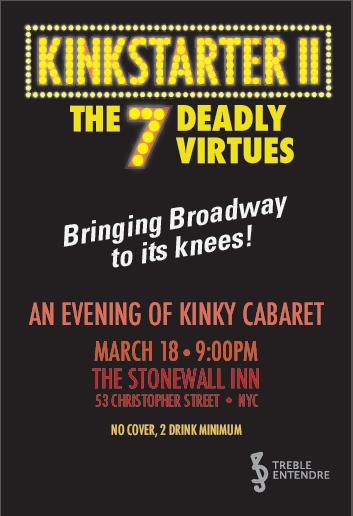
Please join us for an evening of cabaret as Dogboy & Justine alumni and friends once again bring Broadway to its knees by putting a naughty, kinky twist on musical theater classics with Kinkstarter II: The 7 Deadly Virtues.

The event will be at the historic Stonewall Inn on Monday, March 18, 2013 at 9pm. The Stonewall Inn is located at 53 Christopher Street in New York City.

There’s no cover and a two drink minimum for this event as we pass the hat in support of Dogboy & Justine‘s ongoing development.

Last time we did this it involved a BDSM striptease version of “Baby It’s Cold Outside” and the mouse was a dude.  Do you really need more incentive?

Doctor Who in Time and Space: Essays on Themes, Characters, History and Fandom, 1963-2012

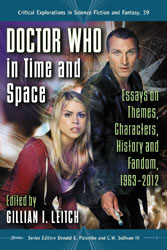
978-0-7864-6549-1This snuck up on me because it’s been such a long process but Doctor Who in Time and Space: Essays on Themes, Characters, History and Fandom, 1963-2012 is finally shipping from McFarland. I have a piece in it on “Narrative Conflict and the Portrayal of Media, Public Relations and Marketing in the New Doctor Who,” which, because of the time lines involved in academic publishing, covers the ninth and tenth Doctors, most of Torchwood and The Sarah Jane Adventures.

The whole collection is full of really awesome stuff from fans who are also academics/academics who are also fans, and I’m really excited to finally get to read it. While I wait breathlessly for my contributors copy, you can order it from McFarland’s website at the link above.

Glee: Deconstructing Moulin Rouge

When I first heard that Glee was going to do a Moulin Rouge episode, I was ecstatic. Moulin Rouge is a film that has had a tremendous impact on me; once upon a time I even took a month out of my life to run away to acting school in Sydney. As such, I’m always interested in both its themes and how its stylistic construction continues to move through the culture.

Of course, my enthusiasm was tempered when it became clear we would be getting a general tribute to the movie musical on Glee instead. However, having just watched “Boys (and Girls) on Film,” I am struck by just how closely id adheres to the themes of Moulin Rouge without retelling its story or offering any direct one-to-one character correlations.

Glee achieves this thematic resonance in part because it extends out significantly from this episode, appearing first in episode 4.08 (“Thanksgiving”) when Marley collapses on stage in a torrent of confetti. This echos Satine’s final collapse in Moulin Rouge and is truthful to the structure of Baz Luhrmann’s Red Curtain Cinema (RCC) in that RCC stories always begin with the end. In keeping with this Glee’s tribute to Moulin Rouge begins in 4.08 with a reflection of the end of the film.

But Marley, of course, hasn’t collapsed from consumption on Glee. Yet, the reference to Satine’s end is still clear. Because Marley has collapsed because of what she will not allow herself to consume (food) and what she is consumed with (fear that she will wind up like her mother), thanks to the gaslighting Kitty provides as one of the clear parallels to Satine’s rival, Nini Legs-in-the-Air.

Similarly, another key element of Moulin Rouge has only been foreshadowed in “Boys (and Girls) on Film,” yet spoilers tell us that Brody isn’t a drug dealer, but a sex worker, as is Satine and essentially at the denizens of the Moulin Rouge in Luhrmann’s film. That Satine desperately wants to be “a real actress” and engages in prostitution because of her engagement with art is echoed in the fact that Brody is the first NYADA student Rachel meets. His association with the aspiration to being “a real actor” is absolute and that is why it has been unavoidable that he gets this particular sex work narrative (which is hardly Glee‘s first). This is compounded by his history with Cassandra — the power differences and his multiple uses to his employers are as essential to Brody’s role in the story as they are to the women of the Moulin Rouge.

The bulk of the deconstructed Moulin Rouge content, however, does fall within “Boys (and Girls) on Film.” Characters constantly remind each other of what happens next in multiple films to determine their next courses of action, just as Christian writes and explains his future love story with Satine through the musical they have connived to have him create for the Duke and Harold Zidler.

Also in keeping with the themes of Moulin Rouge is “Shout!” which is reminiscent of our introduction to the Moulin Rouge in “Because We Can.” They’re both seemingly positive activity songs that don’t advance the narrative but lead us into the chaotic world of the action. Just as that number in Moulin Rouge has movement on multiple levels, “Shout!” also puts people crawling on the floor and climbing on furniture. Additionally, with the number being led by Blaine, who Glee codes as feminine, and Brittany, who Glee codes as masculine, much of the gender variance which is present throughout Moulin Rouge, and particularly in “Because We Can,” is also alluded to here.

Other key elements to Moulin Rouge are evidenced in Artie’s function as director; the commune-like nature of the ever more populated New York loft (where Santana also has a Nini Legs-in-the-Air function, but is equally the older woman who prepares Satine for her performances and serves as her dresser); repeated issues around sexual consent and assault (which have appeared most explicitly around Blaine recently, but are present all over the narrative on a nearly constant basis); Glee‘s intra- and extradiegetic pop-culture borrowing, and the central questions of Truth, Beauty, Freedom, and Love.

And that’s all before we touch the two key numbers from the film that actually appear in the episode — the “Diamonds Are A Girl’s Best Friend” / “Material Girl” mash-up (in which the line about Harold Zidler remains and Unique gets to be an explicitly sexual being) and “Come What May,” which visually references the “Elephant Love Medley” in its set and the first iteration of “Come What May” in its physical choreography.

Of course, several key pieces of the Moulin Rouge story and narrative remain missing, at least for the moment. These include Christian’s anguish in “El Tango de Roxanne,” Harold Zidler’s “The Show Must Go On,” and the final reprise of “Come What May” which features not just a wedding, but a gun.

It seems likely that “Against All Odds” in 4.17 (“Guilty Pleasures”) will serve the Blaine anguish purpose that slots in to the “El Tango de Roxanne” place. A reprise of “Come What May” for Kurt and Blaine’s eventual reunion seems a given, especially with the themes of spiritual marriage that Glee has underscored even more heavily than Moulin Rouge. But before that happens (and it may not even happen this season), we’ll certainly see a gun in 4.18 (“Shooting Star”). Meanwhile, any stand in for “The Show Must Go On” is virtually unnecessary in light of the obstacles the glee club deals with on a nearly constant basis.

Since the Kurt and Blaine break up, I’ve been reminding people that, as Leonard Cohen sings, “Love is not a victory march.” Additionally, Glee is not a love story. At least not that type of love story, which is easy to forget when you watch the show for one or more of its romances. But even as the romances seem to drive the plot forward and seem to be the central narrative, the fact is that neither Glee nor Moulin Rouge are actually, centrally, about romantic/sexual dyads.

Rather, both Glee and Moulin Rouge are about friends who make art together for fun, and for profit, and to survive, and because they are incapable, by their very natures, of not doing so. In both properties, creative acts are used as a proxy for sex and communication, while sex and communication inspire other creative acts. This feedback loop is incestuous, is an erotic drama-based pleasure, and is about loyalty and love and creative family.

Thus, the romances we think are the central story — whether Christian and Satine or Kurt and Blaine or Rachel and Finn — actually happen because of the magical space created by the community-driven narratives. That both properties also have emphasized in their supplemental material the creative family aspects of their production processes (is it any wonder that Glee‘s 500th song came in this episode?) should also not be overlooked.

Through its dialogue with Moulin Rouge in this episode and in this season, Glee has arguably never been clearer about what it is, where it’s going, and just how much it doesn’t want to let any of us watch it for merely a single strand of its many many diamonds.

MASH 2013: Journalistic Artifacts, Transformative Works, and the Assemblage of Persona

ImageNow it can be told.  I’ll be presenting a paper at Mash 2013, the Making and Sharing Conference on Audience Creativity.  The event will be taking place over July 4 -5, 2013 in Maastrict, The Netherlands, and registration will open soon.  Meanwhile, you can see the preliminary schedule at their WordPress.

My paper, The Media Tells Me So: Journalistic Artifacts, Transformative Works, and the Assemblage of Persona, will be presented on the first day of the conference and the abstract is below:

 Many texts with significant fan communities utilize journalistic media as characters in order to enhance the believability of narrative and support and encourage the free marketing that often comes with ironic believer communities (“Clap If You Believe in Sherlock Holmes: Mass Culture and the Re-enchantment of Modernity.” Saler, 2003).  Such narrative use of journalistic media is often taken up by fan audiences in response to source texts.  These audiences not only include news media elements in the transformative works they produce, but sometimes create journalistic media artifacts – newspapers, magazines, video and audio broadcasts and recordings – specifically as transformative works.

Such use of journalistic media to enhance both original texts and transformative community participation does not represent a dialogue that flows solely in one direction, or that happens outside of the gaze of the news media.  In fact, there have been multiple instances of fan-created, transformative, journalistic artifacts that have been picked up by news outlets as factual reportage.

This paper will examine the use of journalistic media as a character in subject texts and transformative works. It will also document the dialogue that occurs between fan communities and news media outlets when transformative uses of journalistic media styles are encountered by naïve believers (Saler, 2003) and subsequently reproduced as fact, transmuting fiction into reported truth. This will be achieved through a focus on the relationship between FPF (Fictional Person Fiction) and RPF (Real Person Fiction) fan communities. It will examine how texts use journalistic media content to acquire naïve, ironic and enchanted believers (“A Tangible Reality of Absence: Fan Communities and the Mourning of Fictional Characters.” Maltese, 2010), and highlight the role fan-created, transformative, journalistic artifacts play in the invention and reinvention of both fictional texts and celebrity personae.

Can you see me rubbing my hands together with glee on this one?  I’m always talking about how I want to do serious work regarding RPF fan-culture, but this is the first time I’ve had a good excuse.  Of course, I’ve already found multiple instances of fandom accidentally morphing media and persona truth for this, but if you happen to know of any, I would love to hear from you in comments and email.

Glee: Tune in to FY Glee Podcast, Episode 2 (“Women of Glee”)

There’s a new podcast in town and while I’m at Gallifrey One this weekend, the fandom streams will be crossing as I take part in a podcast on the too-often-over-looked in my corner of the fandom women of Glee. This time everyone who is participating actually likes the show more or less too!

We’ll be going live at 1pm EST on February 16th, and recordings and transcripts will be available after the fact. For more information on how to tune in, who the other panelists are, and how to ask questions in advance, please go here.

Edited to add: An archive version of this podcast is now available on YouTube.

Glee, superheroes, and “All the Other Ghosts”

Sometimes one of the worst things that can happen to you is to get what you’ve always wanted. If you’re in fandom, that often means meeting the object or creator of your object of desire. In the flesh they are shorter or less charismatic or more distracted than you always imagined. They don’t look you in the eye, and even though they are talking to you, often, they don’t see you at all.

I don’t write about fanfiction on this blog very much. Not because of any shame, and not because I don’t believe that fanfiction and other transformative works are criticism. They are, because they are, by their very existence, in dialogue with the text. However, that’s one of those things that people who already agree don’t need to hear more of, and people who don’t believe are inclined to dismiss as a justification of porn and Internet weirdness, and that pretty much everyone is somewhat inclined to roll their eyes about and call academic wankery. Besides, there aren’t that many fanfics that have a dialogue with their relevant texts that is explicit, relevant, and clever for audiences both in the subject communities and outside of them.

Rainjoy’s “All the Other Ghosts” is a Glee superhero AU, that you need absolutely no prior knowledge of Glee or superheroes to engage with. It tells the story of a guy named Blaine who’s a part of the Tumblr fandom for a superhero named The Ghost. The Ghost saves people in a terrible, dangerous New York that evokes the Summer of Sam era. He can disappear at will, or pass his hand through people’s brains to “haunt” them. He also has a really great ass, and Blaine keeps posters of him over the bed in his apartment and reads fanfic and reblogs pictures of the guy using the tag dat ass.

One night, Blaine meets him. And through a series of events, they begin three relationships: one as teacher and apprentice, another as their non-superhero identities, and a third as their superhero identities. Public life, persona, and private life become, quickly, very complex, especially for Blaine who is now dating the man he used to read Internet porn about. It’s just what every fan has ever wanted, right?

Not so much.

Blaine can’t tell anyone. And he can’t retreat from fandom and still keep the secret; taking the posters down would seem strange and might alert someone to his own transformation into a superhero named Phalanx. He also can’t continue to participate in fandom exactly as he has. It’s too weird. People write porn about him now. And the online community that was his refuge is no longer home. He effectively loses his friends and his hobbies, and every night he and his boyfriend see the worst New York City has to offer from burning museums to dead children, and a whole lot worse I don’t want to spoil for you.

But Blaine is not the only person in this story who gets the one thing he, as a fan, has always wanted. Because a good 30% of the story is in the voices of the Tumblr fandom from whence Blaine came. We meet that fandom’s BNF’s, witness its ship wars, learn about the real lives behind handles like paleandghostly, draxie, and blackbindings, and are treated to tons of Tumblr’s unique grammar (I literally can’t all the evens ever). In addition to this, an actual Tumblr fandom has sprung up around this story, with fanart and fanfiction, some of it referenced in the story, some of it an addition of apocrypha to the tale.

One night, The Ghost gets hurt and Phalanx doesn’t know how to get help and keep their covers. After all, in this terrible New York, superheroes are also illegal. He reaches out to a few well-known fandom figures anonymously, and they assume, reasonably, it’s a troll. Except one woman who comes, just in case it isn’t. She winds up transporting a grievously wounded and possibly dying Ghost and a terrified Phalanx in the back of her car. She hears Phalanx’s real name. She sees how in love they are. She gets The Ghost’s blood all over her back seat. And she can’t tell anyone. Ever.

In this story, Rainjoy has created an astounding response not just to Glee, addressing its narrative themes around sexual assault, outing, abuse of power, marginalization, and ambition, but to fandom. She examines the consequences of the success of one of our community’s most common desires.

She also examines the price of secrets, of gossip, of loyalty to friends you’ve never met and personas you love so much you feel their hand, ghostly, holding yours when the plane takes off. She examines ambition and types of fame and fandom’s treatment of both, as well as the supposedly mundane, or even inadequate, lives that so many people in fandom are said to have with not enough resources, or not enough health. Rainjoy shows us how all of those people — all of these people — are heroes too. We are, in fact, it turns out, all the other ghosts of her title, over and over again.

The story is challenging. It becomes peculiarly circular at one point, and the parts of it that are brutal are inescapably so. Characters facing death never vow to die bravely in this universe, because they know that the truth of their world is that they will go out begging for the end, and that, that final abasement is worth it, if it can keep just one more person safe.

I’ve been in fandom long enough, and have been innately fannish my whole life, that I’ve had plenty of occasions to meet the objects and creators of my desires. These experiences have ranged from negligible or anti-climatic to surprisingly transformative. They’ve involved everything from accidental nights out to autograph lines and have often encompassed supposed secrets (hint: there are no secrets in fandom).

Each of these experiences, for good or for ill, has served to remind me of how far apart people and persona always are, even if we’re just talking about people I chat with on Tumblr, whose acquaintance in the flesh I have not yet had the pleasure of making. They have all also reminded me that to meet the wizard is a great and terrible thing. Sometimes, it’s even the worst thing.

But Rainjoy herself says she only writes happy endings. And that is true, not only in the narrative of “All the Other Ghosts” but in its treatment of all those desired meetings. Because the flaws, disappointment, fear, disgust, and surprise of the results of desire are central to her story. But instead of unmasking, outing, and truth being the basis of rejection as illusions are shattered, it is, in Rainjoy’s fic, the basis of elevation because the story behind the story is even more compelling.

“All the Other Ghosts” showcases not just fandom at its best (and often most absurd), but our daydreams and their consequences at their bests as well. Not without cost, but the story makes the price seems fair.

“All the Other Ghosts” is mostly rated R with a few brief forays into NC-17 material for language, sexuality, and violence. The story addresses sexual assault, domestic abuse, bias crimes, extreme violence, medical horror, and, in an homage to Watchmen even manages to evoke the nuclear dread of the 1980s. It is one of the most grueling stories I’ve ever read, but if you’re interested in reading about how and why fandom tells stories about itself, its love, and its desire, it’s utterly unmissable.
Glee: Building masculinity

I’ve written before about how in the world of Glee being a girl is something that happens to you, but if that’s true, being a boy must be something else entirely. 

Glee has always been preoccupied with ideas around the construction of masculinity including its multiple plot lines in which various people try to “man up” or figure out how to “be a man,” usually in response to issues driven by male authority figures who also have peer status to the parties concerned: Artie (the director in New Directions), Finn (the team captain and now stand in faculty adviser of New Directions) or Schuester (the faculty adviser and original man-child of Glee).

Recently, however, this need to create masculinity as something separate from innately feminine existence and its consequences, has been more explicitly on display than ever before, with the centerpiece being “Sadie Hawkins.”

I’ve written about Sadie Hawkins dances before and their place within Glee’s narrative and the characterization of Blaine Anderson.  Here, while that backstory only got a light and somewhat sanitized mention (Tina thinks Blaine was bullied at a Sadie Hawkins dance, not beaten), the tradition itself is used to highlight how masculine identity and ritual is constructed in the world of WMHS.

Men, with their power removed to ask girls to the dance, immediately begin to experience the idea that being a girl, or at least not being a boy, is something that happens to you. The lack of agency the straight boys feel as they wait for girls to ask them to the dance is explicitly stated. Blaine, whose gender construction on Glee remains both complex and mysterious if cast in Western dichotomies, is pursued by Tina and not given the opportunity to say no.  And, the Cheerio with the neck-brace is seen menacingly oggling, confronting, and blocking the escape routes of men she finds desirable.

Meanwhile, the girls, told to enact a masculine roll, find themselves needing to construct a visual platform from which to do so.  It’s no accident that the women of the episode are placed repeatedly in dresses that reference peacock plumage in color and detail, and that we even have a dance number in which they quite conspicuously shake their tail feathers.

Similarly, it is no accident that this is the episode in which Sam discovers not only that the Warblers have cheated, but that their violation and falsehood revolves explicitly around constructing masculinity through the use of steroids.

All of these details suggest masculinity as a product of fear and a responsiveness to wishing to avoid the consequences of being a girl which are clearly unpleasant even if mostly unfamiliar to the not often empathetic men of McKinley.

This construction of masculinity theme, however, continues beyond the episode and into “Naked.”  Here we see the boys not just trying to sell themselves as heart throbs, but working hard both physically and through illusion (from costumes to spray tans) to create that image. It is a narrative that culminates in Sam struggle not to see his body as more important than his total self, something that is resolved by Blaine who has perhaps greater insight instinctively if not intellectually into the absurdity of the masculinity game but his placement along the gender continuums at WMHS.

This focus on masculinity as constructed, and therefore false (and let’s remember, Glee is obsessed with the authentic vs. performative self, genders these concepts, and rewards and punishes them differently. Femininity is viewed authentic on Glee. Masculinity is not. Authenticity is praised, but punished, because it is audacious and confrontational to a normativity-obsessed society), seems unlikely to end any time soon.

The preview Ryan Murphy released of Beyonce’s “Diva” as performed by the women of New Directions and Blaine appears, at first, to highlight a constructed femininity.  However, this isn’t actually true.  As the song tells us, “A diva is a female version of a hustla,” and so femininity here is only constructed because of its imitation of masculinity. This suggestion that feminine artifice does not negate innate feminine authenticity is underscored by Tina’s gendered insults towards Unique and Marley calling her out on them: It doesn’t matter what Unique wears, she is still always a woman.

“Diva,” through its runway staging, also brings us yet another moment this season that highlights the constant presence of the camera lens, documentation, and exposure. This ties consistently into gender, sexuality, and safety on Glee, but I’ll save that for another post.

Hugo Awards: Link me to your stuff, again

So we’re gonna do this just like we did this last year, and I’m mostly rewriting last year’s post word-for-word.

This time of the year is, among other things, nomination season for the Hugo Awards, and general tradition in SF/F circles is for people to post the list of eligible things they’ve been involved with. For me, this year the only thing that I have that’s eligible is actually this blog in the fan writer category.

Meanwhile, although tomorrow is the deadline for acquiring a World Con membership in order to nominate and vote this year, I still have a month to read a ton of stuff and figure out what I’m going to nominate, so please link me to you eligible titles (or recommended titles from others) so I can get started on that process. 

Other than your awesome, I’m particularly interested in your various short-form recs, as I don’t read enough short stories in general, and it’s a pretty neat genre that highlights the beauty of good structure.  We do not give short stories enough love.

So, if you have stuff, please post in comments with links; meanwhile, please go browse the comments which will hopefully be flowing in shortly and check out anything that so moves you.

Gallifrey One: Schedule

ImageIt’s not even February yet, but there’s no time like the present to start obsessing on my annual trip to Gallifrey One (February 15 – 17, 2013).  I’ll be getting in late Wednesday night and probably won’t be consistently close to con until the opening ceremonies on Friday.

I’ve got just one panel this year, called “Love and Monsters” (details below) and focusing on the way we often engage with properties we love by talking about how much we hate them.  This is, I suspect, slightly apropos after my recent appearance on Fandomspotting as the person who actually likes Glee.

Do feel free to say hi if you see me around, even if we haven’t met before.  I am always juggling a lot of weird things when I’m out there, so if I need to dash, please don’t take it personally.  I’ll be promoting Doctor Who in Time and Space and maybe some other stuff if I’m allowed to discuss those projects by then.  As ever ribbons reflecting some particularly terrible in-jokes and rose-flavored macaroons may be on hand if you’re very, very nice.

See you in a couple of weeks!

Love & Monsters: Doctor Who fans love a party, in person or online… but when has it gone too far? We have online communities galore, but why do people continue to discuss shows they admittedly don’t care for anymore? Why do they keep watching even if they haven’t enjoyed it for years, and how long should they stick with it? Is it unfair to heavily criticize a property while the other viewers are still enjoying it — or is it, as others claim, a necessary part of the fan process? We’ll take up the debate about when fandom goes too far, and when it’s stopped being fun. (Friday 9:30pm Program B – Lisa Carroll, Mike Doran, Tammy Garrison, Shelley Hunt, Racheline Maltese)