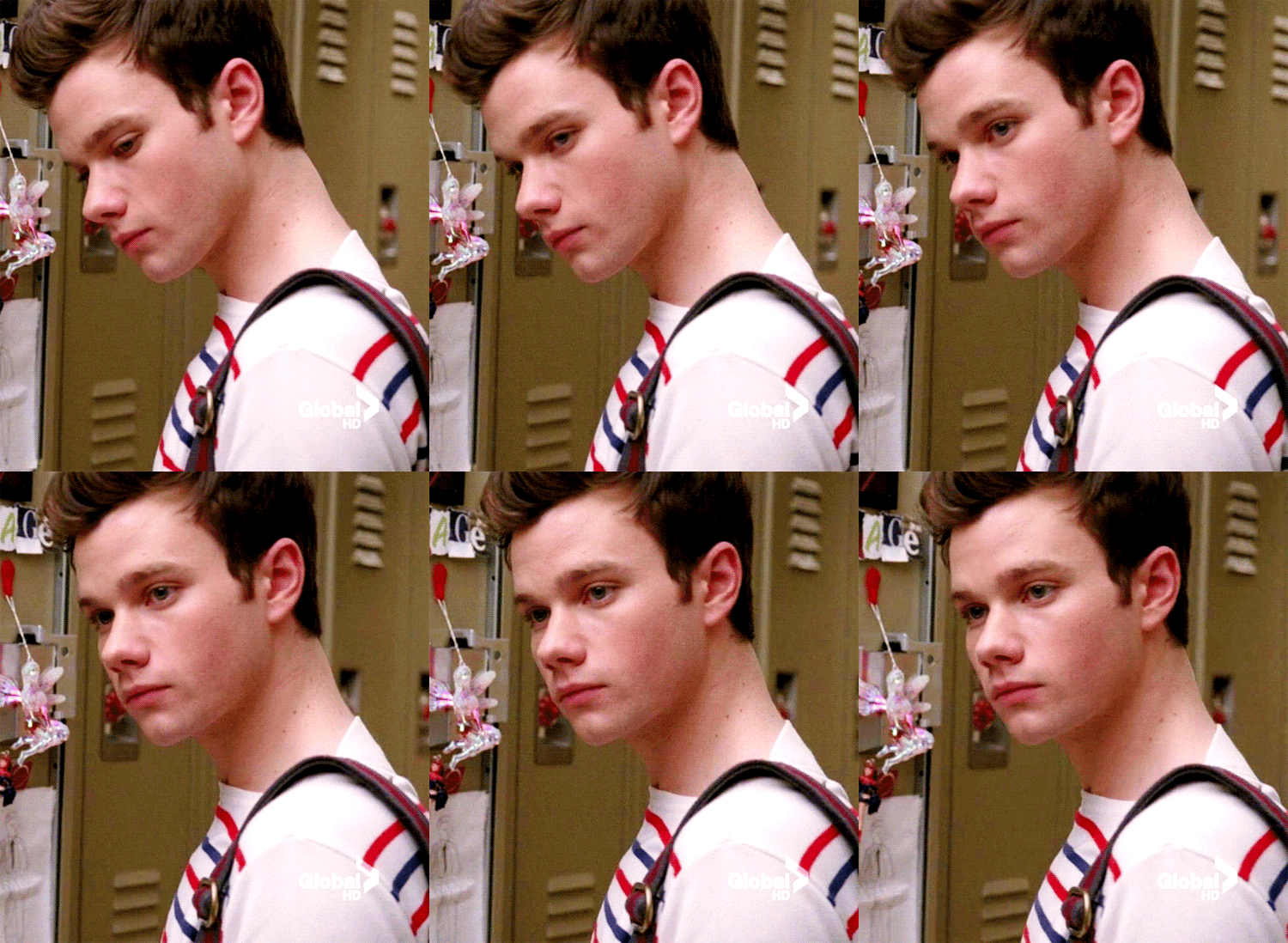
Switzerland: I’ve done this before, but it’s always a little complicated

After a very long trip, I have arrived in Switzerland. It’s a funny thing, because Switzerland and I don’t have the best relationship, but I’m here often enough that it’s familiar, and I can mostly find my way around and be unobtrusive.

Why do I want to be unobtrusive here? Well, because Swiss politics, while vastly different from US politics, have a significant dose of cruelty in them. That cruelty is usually a mix of racism and religious intolerance; remember, this is the country with the political party that brought us the anti-minaret initiative that featured posters in which minarets that looked like missles were spread over the Swiss flag while a woman in niqab looked on.

Other posters from that party, the SVP, which is particularly popular in the area I am visiting, have included things like black sheep being kicked off the Swiss flag by white sheep, and white crows attacking black crows shown trying to rip the Swiss flag apart. I could go on, but you get the idea.

So I was oddly relieved when I saw that the worst the SVP seemed to be dishing out this week was simply a poster that translates to, “More Foreigners = Fewer Jobs.” We all still know what they really mean, but it feels a little less assaultive than usual.
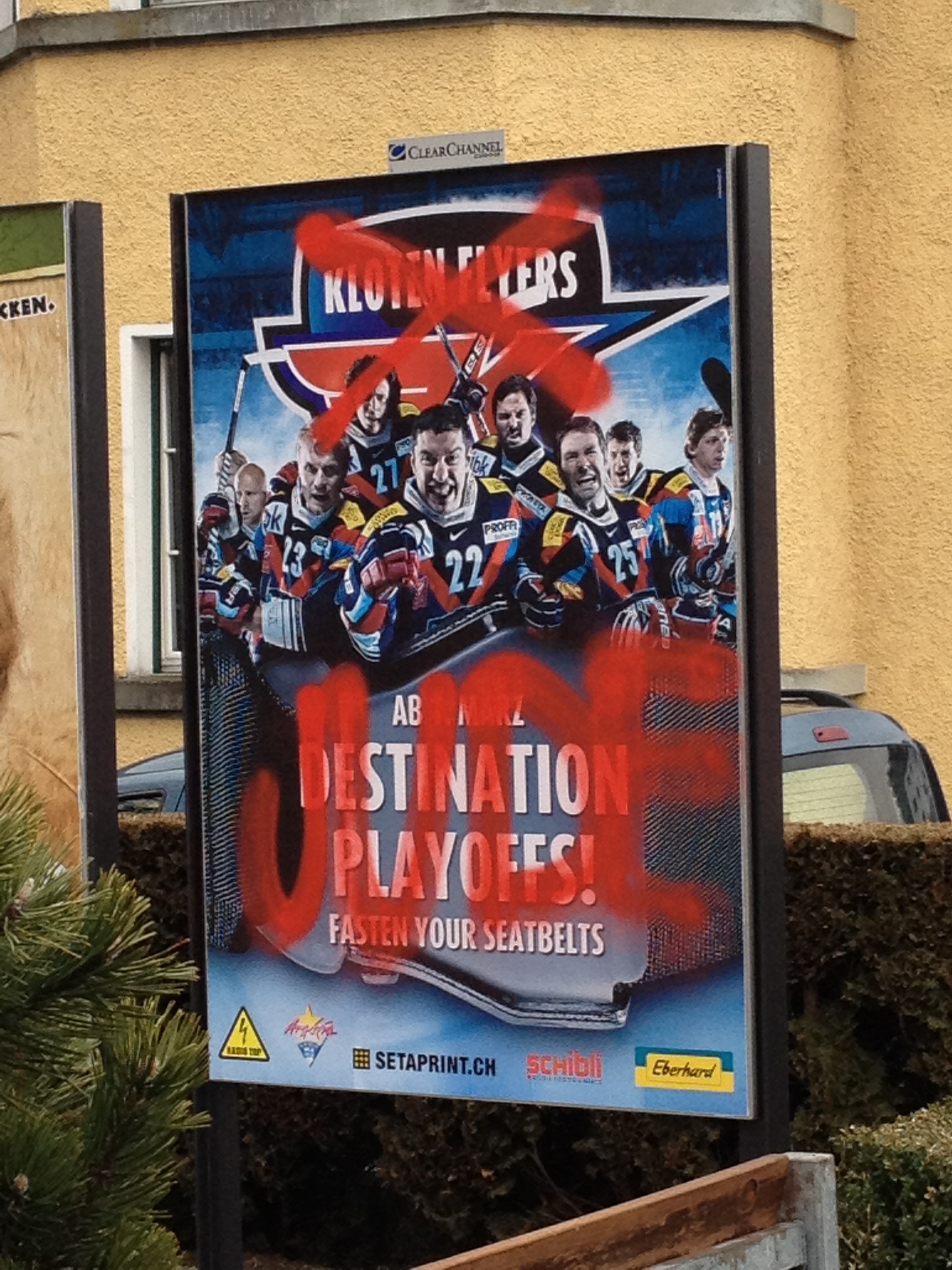
On the other hand, then I found this while going grocery shopping. It’s one of several I’ve found in this town today, all defaced the same way: Jew.

Anti-semitism, of course, isn’t something unique to Switzerland or Europe, but my experience of it here is markedly different than my experience of it in the US, and particularly in New York, where, yes, even with the large Jewish population, I’ve experienced related slurs a handful of times.

Secular Judaism here in Switzerland seems to be a pretty foreign concept, and Judaism is viewed as a clear racial difference with what is to me shocking frequency.

So even when reactions to Jewishness here aren’t overtly toxic, they can feel a little weird. People that I am friends with here are curious about my Jewishness; they ask me, “what is it like?” and they tell me stories about their families and the War.

I don’t mind the stories, because I have the luxury of not minding them; the Jewish side of my family came to the US long before WWII, and I’m a huge history buff. It’s honestly fascinating to me to be given these insights no matter how awkward the reasons.

But I don’t ever really know what to say. I can’t absolve or reward people for actions taken long before my birth, that didn’t impact my family, and that have nothing directly to do with the people telling me the stories.

And for me, who is not religious, trying to explanin what it’s like to be Jewish is just weird (I think it would be weird even if I were religious); it’s like the same way I am also Sicilian. There are words I use, in-jokes, food I like, and a sense of the world my family came from, versus the one I live in. It’s unremarkable, and nothing I can explain.

But here it is different, in a way I also can’t explain despite the efforts of this post. And as terrible as it often is (I have been chased out of stores by old women flapping their hands at me and naming what I am), it’s also interesting, valuable, and terrible to come somewhere where how I am perceived is completely different than how I am perceived at home (I am also, often, asked about my racial makeup here; I am not read as white in the same way as I obviously am at home).

All of that said and without ignoring or minimizing it, this is a beautiful little town. Exquisite, really; it even has a reindeer viewing park thing by the medieval church. I’ll try to get pictures for you.
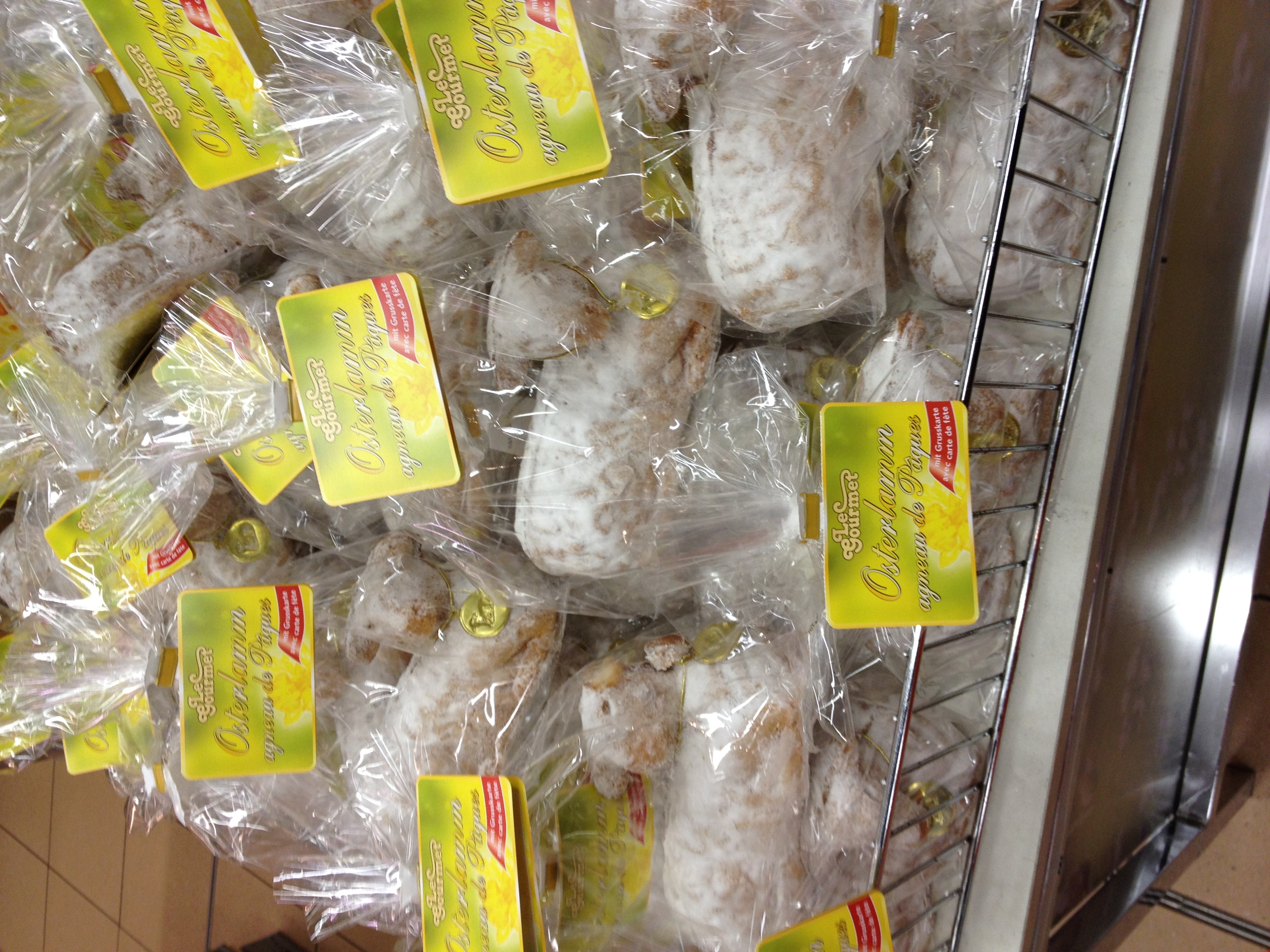
But, in the meantime, a seasonal sight, because I’ve never been here around Easter before and I have been utterly taken with the way the grocery shops are filled with cakes shaped like lambs.

This weekend, I head to Berlin for 48 hours I have desperately wanted to have since I was 16. I can’t wait. I’m also terrified. I’ll try to do some writing about Glee or other pop-culture items this week before that trip, but that particular travel update is probably also going to be entirely about pop-culture because Berlin is where art tells me the entirely of the 20th century happened, and when I was in high school, a song called “Heroes” saved my life.

Glee: Sex, death, the Anubis archetype, and Kurt Hummel

I’ve written before about the ways in which Kurt Hummel from Glee and Severus Snape from the Harry Potter books may be similar, with the critical difference being age and circumstance. We hope that Snape is the guy Kurt won’t have to turn into, because Kurt has, unlike the professor, family support and requited love.

But after an episode in which Kurt has once again has served as William McKinley High School’s chief functionary around death, I can’t help but want to bring up one of my favorite pieces of pop-culture analysis ever, Clunycat’s “Severus Snape and the Anubis Archetype: Smoke and Mirrors.”

It essentially offers us a checklist of items that allow us to see that Kurt also largely fits this Anubis archetype, although he is not so much yet a master of the underworld as Snape is, but a magician with the power (and need) to visit that underworld, and, eventually, leave it not entirely behind.

Traits that Clunycat points out as part of the Anubis archetype that would also apply to Kurt in her well-sourced piece include: intense introversion, being clearly marked out as other, a significant childhood incident, crying easily, and a collection of other traits that the paper notes could be viewed as commonly present amongst those on the autism spectrum.

This last detail I note specifically because there is a significant degree of speculation in Glee fandom that Kurt may be non-neurotypical in this or some other way because of his avoidance of touch, obsession around texture, tendency to fake eye-contact, use of finger spelling, habit of rocking, and several background interactions with Brittany that indicate they may each have a particularly clear sense of how the other processes the world.

Other traits that Kurt possesses that serve the Anubis archetype include his specific functions around death. Kurt, marked by his mother’s death, plans funerals from that of a pet bird (whose death leads to his own relationship blossoming) to that of Sue’s sister Jean. Both situations are striking because of how they hark back to the living. There is the visceral awakening sexuality of the kiss Kurt and Blaine share over Pavarotti’s casket; and there is also that chocolate fountain as a centerpiece at Jean’s funeral.

It’s food for the living that Kurt seems to bring in times of death, and that too is of the Anubis archetype, who serves as a messenger between worlds and a healer; in fact, Clunycat notes that the Anubis archetype heals by “charms and songs,” although that is a particular reference to Odin, another god of death referenced in the piece.

Kurt is also our public gateway between genders, sexualities and physical locations in the world of Glee. He is many types of messenger and he understands chaos, patterns, and intuition. Really, I can’t urge you to read Clunycat’s piece enough, because I’m leaving out literally dozens of connections I can draw between Kurt’s role and nature in the Glee narrative and the themes of this Snape-related article.

But, of course, to talk about Kurt’s role regarding death, we must talk about Kurt in relation to Dave Karofsky in episode 3.14. It’s a difficult episode, and I know there is a great deal of discussion around many aspects of it, including the idea of victim-blaming and whether it was appropriate or not to show Kurt having guilt regarding Dave’s actions and his own non-responsiveness to Dave’s calls, because Dave is not now, nor has he ever been, Kurt’s responsibility.

Without addressing at too much length what I think was a realistic response on Kurt’s part, even if understandably painful, triggering and murky for some viewers, I do want to talk about how this related to Kurt’s role in Glee as magician, as messenger, and as the boy who secretly rules a kingdom in hell and yet will also ultimately escape that place.

Kurt been kind and generous and sort of unable to let go of the Dave situation as he’s tried to make it into a pattern of events that makes sense and isn’t about his own personal worth, and so it makes sense that when Dave tries to kill himself, Kurt will be present for him, not only out of kindness, but also out of a desire to understand.

Kurt is also consistently drawn to death-related situations in Glee and volunteers his way into them when he doesn’t have to: Pavarotti didn’t need a bedazzled casket or funeral, and Jean was someone he essentially didn’t know, but when death shows up, so does Kurt. Sometimes he’s the person who helps us relate to the death that has transpired, and sometimes he’s the person who holds the door as Death exits the room having taken less than he came for (see: Burt’s heart attack; Dave’s survival; even arguably Blaine’s eye).

That Kurt doesn’t visit Dave until 72 hours have passed should be because of the psychiatric hold, but it’s Glee and we do know Dave has had earlier, prior visitors, at least based on what the God Squad tells us it plans to do and all the flowers in the room. So Kurt shows up appropriately late, after a symbolic three-day interval, to usher Dave back into the world of the living through a guided vision of the future. In the presence of death, Kurt once again provides sustenance to the living.

Kurt holds the door between life and death often in Glee, and it’s a door that swings both ways. At least it is for this boy who likes to open the drawers of his dead mother’s dresser to remember her perfume and who covers himself in oils and unguents as if they are the embalming fluids of Anubis’s trade to stave off age when he is still seemingly a child himself.

As Kurt continues to be a master around Death (because he is not a master of death; death can have no master and Kurt is still learning his powers besides), I think he gets an increasingly clear sense of control over Hell (life at William McKinley High School and in Lima). Look at how Kurt and Blaine sometimes express affection in public now; look at how his outfits have begun to reveal flesh; look at how much less rigid physically he is — this is a boy who is coming to life through the act of mediating around death. And with that control over his hell comes a knowledge for Kurt that he does have power in him, that he can get out, and abandon these realms that will also, always, be his home.

The real question for me is the one that Glee will probably never answer, unless its final episode of its final season is drawn like that of Six Feet Under: Who does Kurt grow up to be?

And I don’t mean to ask whether he becomes a fashion designer or a performer (both are roles that emphasize a chameleon-like nature, another essential part of the Anubis archetype) or whether he and Blaine stay together (I believe they do for narrative structure reasons as much as anything else, but that’s another post for another day).

What I mean to ask is this: How does a boy whose childhood has been defined by matters of sex(uality) and death, who has been a guardian of some terribly feared gates, learn to live in the world? And I think part of the beautiful answer, and part of why many of us love Kurt, is that he doesn’t, but that he’ll do it anyway.

Glee: A pause and a brief note about warning cards

One of the things I try not to do here is write too many posts about what I’m going to write about, as opposed to just writing the posts. And wow, what a terrible sentence that is to untangle.

But so much of what I want to write about regarding tonight’s episode of Glee is material that was in the smallest of details.

I want to talk about how the broadness of the show’s borrowed musical form means that much of the writing is done not by the writers but by the costumers and set dressers.

I want to talk about Blaine’s gender identity, again.

And I want to talk about, as I suspected I would have the opportunity to a few weeks ago when tonight’s narrative seemed to be coming down the pike, Kurt’s relationship with Death.

But it’s really hard to do any of those things without first acknowledging that tonight’s episode contained some very powerful and surprisingly visceral content regarding teen suicide. If you haven’t watched it yet, be aware that what is shown is more intense, and arguably graphic, than what I think we’re generally inclined to expect out of Glee.

I’m glad the show made the choices it made around the topic, even when the results of those choices sent messages (if stories send messages at all) that can be considered murky. I happen to like murky stories and while this was what we call “A Very Special Episode,” it still wasn’t an after-school special, so it worked for me. But quite understandably, everyone’s mileage may vary extremely widely on this one.

Because I want this to be a conversation somewhere other than Tumblr, it’s worth noting that the episode in which the show’s two main couples — Rachel and Finn, and Kurt and Blaine — lose their virginities received a warning card about its content that was displayed before the episode began.

The losing of said virginities in that episode, for the record, included a few conversations about the obvious topic, one instance of the word masturbation, some fully-clothed reclining on a bed, a bit of hand-holding, and Darren Criss’s eyelashes.

It was the least graphic thing I’ve ever seen in my life. It was barely a metaphor for sex, no matter how well executed; and it certainly didn’t portray sex, even soft-focus TV-style fake sex.

But tonight’s episode, which contained one of the most shocking representations of suicide I’ve ever seen on screen? No warning card for strong content or suggestion that this might be an episode that parents want to watch with their kids.

I don’t love a lot of the restrictions that exist around television content. I also don’t love a lot of the discussions around the topic, although they are necessary ones; they’re just ones that I find hard to do while also trying to deal with stories largely from their internals, and this is a moment to admit that weakness.

But this lack of a warning card tonight, especially when compared with “The First Time”? Is jarring. What happens in the first ten minutes of the episode is the type of material I am used to seeing warning cards for before episodes of other programs. So why wasn’t it there? And why was it there in the least sexy episode faintly about sex ever? Because I’m used to sex-related warning cards too, but not for content like that presented in “The First Time.”

Obviously, those questions are rhetorical, and we can all guess the answers (or discuss them in comments). But for now, I wanted to acknowledge this before taking some time to sit with the episode, because it brought home the thing that haunts me the most about the struggle for any sort of equality — not everyone gets to see the battle won, and that’s so agonizingly unfair.

In the next couple of days, I’ll write a few posts about some of the gorgeous detail work in “On My Way” that speaks to the themes I’ve been writing about here all season. But tonight, I need to pause, and I kind of need to say that I’m doing so aloud.

Los Angeles: Totally the right kind of tease

New York may be cold, but after five days in Los Angeles, it’s good to be home, even if it doesn’t really feel like I’m here. After all, I leave again on Saturday. At least I have our bed until then.

But Los Angeles is hard for me. Part of that is being from New York; I’m sort of contractually obligated to be discomforted by California. But the problem isn’t that I don’t like LA; it’s that sometimes I do, and it brings out the worst in both my insecurities and my arrogance.

The first time I went out there was in the late 90s to work on production for a commercial. I was staying at a hotel in Beverly Hills during a terrible cold spell, and I spent most of the trip — which ended with me and some friends crashing the Miss California Teen USA pageant and getting up to unrelated shenanigans in an airport hotel — feeling both not pretty enough to be there and yet absolutely fabulous. LA is, because of the sort of nonsense it does to my head, a place I brace myself for.

But mostly, when I go, I ignore it. After all, the yearly trip is for a Doctor Who conference; that’s like the antithesis of LA, right? Even if I am often there to do some business too (and that I did this year, quite pleasantly so).

But this time we rented a car and spent a lot of time running around town in a weirdly food-driven way: we needed supplies for the con; I wanted In-and-Out burger; people hadn’t had French macarons before, and I felt that needed correction — all of which somehow led to several deeply odd mall adventures and some serious mid-day drinking in a Mexican restaurant just shy of Rodeo Drive.

And you know what? I sort of loved it. Because the me who felt not beautiful enough for LA in my 20s realized this time it wasn’t about whether or not I was awesome enough for LA, but it was about letting LA, and all it’s awful ridiculousness, making me feel awesome and invincible.

So I decided to be a little bit shameless and to play along with the city, and it flirted right back. So much so that it’s really a good thing I have this life I am making in New York and that Patty and I don’t know how to drive (although we’ve got to do something about that). Otherwise, there might be some real consequence to all that flirtation.

It was a fantastic and only intermittently melancholy few days, and I wound up nabbing some great details for a piece of original fiction I’m working on. Also, how could I not love just a little a town that has an Exposition Boulevard?

Next stop: Zurich by way of Toronto.

Glee: We’re all monsters here

Like most everyone else watching Glee, for me the big discussion topic in the aftermath of this week’s episode is Dave Karofsky, not that I was particularly surprised by his appearance. I called him as the secret admirer a while ago but wasn’t sure if he would actually be the guy in the gorilla suit. Since he was, this is a great time to talk about how Glee uses costume to define the monstrous.

In regard to Dave’s appearance in 3.13, it’s obvious; I mean, come on, he was dressed like a gorilla. But it’s also notable that we see the moment he takes the mask off. Partly, this is to shock us with the reveal (although from the first scene where Kurt cooed about Blaine being the secret admirer, we all should have seen this coming), but partly this is to show us that Dave is not what he once was. After all, he sheds the monster costume right in front of us, and Kurt, to declare his love.

There’s just one problem. It’s that Kurt’s right; Dave Karofsky is not in love with him. He’s merely transmuted Kurt from the symbol of all his problems to the theoretical solution to them. And so, while Dave is relatively non-threatening at this point (Kurt’s appalled, incredulous, and also saddened on Dave’s behalf, but what he’s not is afraid), the monster isn’t entirely gone. After all, we only see Dave remove the mask, not the rest of the suit, and Dave’s still bogged down in his self-hatred and fear, the resolution of which we’ll be seeing in next week’s episode.

But Dave and his gorilla costume (and seriously, how did he hatch that idea? Kurt likes grand gestures and theatricality, yes, but was this the best Dave could do? Or was it a knowing moment of self-deprecating humor meant as a nod to their history?), are hardly the only monsters in the world of Glee. Because on Glee, nearly everyone wears a costume, and nearly everyone is a monster.

The cheerleaders are monsters. So are the boys in their lettermen jackets. Sue and her track suits are another incidence of costumes as a sign of monstrosity. So are Will and his sweater vests. Tina and her days of terrorizing the rich fantasy life of Figgins with her faintly goth look is yet another fine, and hilarious, example.

And let’s not forget about the Warblers. Lots of people thought they were creepy when they were first introduced; I didn’t get it at the time, but I see it now. Uniforms and costumes worn off-stage are a bad sign on this show, and while I’ve speculated that Dalton has been corrupted from its role as refuge and faerieland since Blaine and Kurt’s departure, perhaps really their brief tenure there was the actual aberration.

Because Blaine’s no less monstrous now that he’s out of Dalton. Look at those ridiculous bow ties — he’s still wearing costumes and performing an identity that is viewed, rightly or wrongly, as threatening by others. He’s just a different type of monster now, and busy finding out what tools come with that role.

But, of course, it’s Kurt who wears some of the most costume-y attire off-stage, and he certainly has been framed as a monster at various times — for being gay, for expressing desire, for wanting friends. And in case you’re worried, this isn’t where I’m going to argue that Kurt is different, that he somehow isn’t a monster, because he totally is.

Because the issue on Glee is rarely whether someone is a monster, but what type. There are greater and lesser demons not only in Hell, but in William McKinley High School and in Lima, OH. Some monsters have great tasks and strange powers; some monsters are cruel, some chaotic, and some necessary; some are just negligible.

Monstrosity in the world of Glee is, essentially, about power. While the show’s overt message is that the kids who are branded losers are actually awesome, the covert message isn’t just that being Other is good, it’s that what scares other people about us is what gives us power, even if we don’t necessarily know how to recognize or harness that power.

It’s there in Figgins’s reaction to Tina; it’s there in the very scary play and threat between Santana and Sebastian; and it’s there particularly in Kurt’s interactions with Dave, because they are both boys who, at various points, have attempted to shed their monstrousness and in doing so, have ceded their power on at least temporary bases.

Kurt attempts to leave his monstrousness behind in “Laryngitis” when he drops the pitch of his voice, wears flannel, sings Mellencamp. But the song is terrible, and only when Kurt reclaims the voice, appearance, and interests that make him so conspicuously Other, so conspicuously monstrous, at WMHS, does he regain his power. While it’s not power he knows how to use, nor power that keeps him safe at that juncture, his ferocity is undeniable when he reclaims it.

Which is why I just can’t get worked about Dave showing up to declare his love for Kurt in 3.13. Yes, it’s inappropriate, and not just because of the past history between Dave and Kurt. The current actions are creepy in and of themselves; Dave’s gestures here are deeply unsettling when you remember that Kurt is being so trusting regarding the secret admirer only because he assumes the messages and gifts are from Blaine. I mean, does Kurt go to sleep with that little plush monkey (an avatar of Dave, we later realize) in his bed because he thinks it’s from Blaine? I’ve got a lot of sympathy for Dave Karofsky, but if I were in Kurt’s shoes, I’d freak out massively when that penny dropped for me.

But even so, in taking off the gorilla mask, Dave cedes his power to Kurt. He is no longer monstrous, and Kurt can hurt him far more than Dave can ever hurt him now. Love makes you vulnerable; in a place like Lima, OH, so does being anything but a monster; Glee draws a sharp line under this when Dave and Kurt’s conversation is overheard by Nick, a bully at Dave’s new school, and Dave runs out of Breadstix.

General speculation is that we’ll see Dave be the victim of anti-gay violence in the next episode. My own feeling is that that violence will be internal (self-harm) and not external (gay bashing committed by Nick) in nature, because of the stories Glee has already told, or at least mentioned, and because there’s been a lot of foreshadowing about gay teen-suicide particularly around queer characters that have committed acts of bullying themselves (Santana and Dave) in previous episodes.

But while I keep trying to figure out what happens next, I also keep coming back to this idea of monstrousness. As hard as the narratives that tell this story are, it’s an idea makes me smile. It says a lot about Ryan Murphy’s body of work (I have got to get back to American Horror Story), and it also says a lot to me about the stories I love; I once remarked, only half-jokingly, that in Harry Potter fandom, Severus Snape taught me everything I thought was horrible and unlovable about myself actually made me hot.

Not all monsters are evil. It’s an important message buried under a tangle of other stuff (there goes Glee and its consent-related narratives, again). Sometimes we’re all monsters, and, yes, that may not be good. But it can be okay, and knowing ourselves is, apparently, always the first step in that journey to own the power of monstrosity and to use it, if not for good, then not for evil either.

For some people and characters, it’s harder than for others; and Dave Karofsky is still at sea.

Administrativa: So I’m about to go on this trip….

I leave for LA on Wednesday night. Then I’m back on Monday, and on Saturday night I fly to Zurich by way of Toronto.

The international part of this travel event also coincides with the big Glee hiatus. While I’ll still have pop-culture things to write about, including a few Glee pieces I have planned, some announcements about my own projects, and a lot of big catching up on Sherlock, Doctor Who, American Horror Story, and Downton Abby, it seems like I should do some travel blogging, especially since I’ll be going to a lot of places I’ve never been to before.

However, that may not be why you’re here, and I certainly have Tumblr or LJ to blather on if need be.

And so a poll, mostly because I like polls.

Glee: Power, union, and alchemy

To be really honest, I was dreading last night’s episode of Glee, not just because it looked terrible, but because I thought there wouldn’t be much in it that I felt qualified to talk about. But, instead of getting an episode that I anticipated would be both poorly structured and really offensive, we got some fairly high-quality knitting.

The knitting is all that stuff that happens that isn’t an event (prom, someone coming out, a proposal, a fight), that makes sure we get from point A in the past to point Z in the future without being totally confused. Yup, it’s that magic stuff called continuity that so many people argue Glee doesn’t have. Me? I think Glee has tons of continuity, but plays such a long-game that it doesn’t always execute on that continuity or prioritize the right bits of that aforementioned knitting.

But in the case of “The Spanish Teacher” I’m almost sure that even if we don’t have a lot to say about this episode now, it will be the episode we go back and revisit both at the end of 3.14 and at the end of the season, when we try to figure out just what it is that Glee‘s been trying to tell us. And what Glee is trying to tell us is a whole lot of stuff about life, death, growing up, and what you can and can’t leave behind.

In “The Spanish Teacher,” the key moments on this theme came from Emma, Sue, and Kurt, all three of whom have consistently been the only people able to act as guides in the underworld that is both WMHS and Lima, Ohio. But in this episode they also each point, not just to the now well-known to us signposts of this hell, but to the paths, long obscured, out. In each case those paths are explicitly about alchemy and about union with the self. This isn’t a new theme for any of the trio, but it’s the first time it’s been highlighted for each of them in the same episode during which they function, oddly, as Maiden, Mother, and Crone.

Let’s start with the Maiden. That’s Emma. She’s a virgin, and no one takes her seriously. The kids are generally boggled by her pamphlets (Mercedes is not a two-timing ho), and Will consistently condescends to her. Yet, not only is she the teacher to receive tenure at the end of the episode (and whose teaching is shown to be effective thanks to that hilariously uncomfortable scene in the locker room), she makes a critical pronouncement to Will mid-episode: “I don’t need you to take care of me.”

The things that make Emma arguably different — her OCD and its connection to her virginity — do not make her a child, and, in fact, give her power. There is power in what she says to Will, not just in the force of her voice, but in the transformative decision (Will’s surrendering of the Spanish teacher position) it sets into motion.

Emma, as Maiden, also has a critical talk with Sue, as would-be Mother. Motherhood and Sue aren’t new topics — she’s often talked about how she is like a mother to her Cheerios and her somewhat maternal interactions with Becky, Jean, Santana have been on display before. But after several scenes of comedy in which Sue ferociously goes after people she feels are putting her not-yet-existent family at risk, Emma confronts her about her desire to use Will as a sperm donor.

This leads us to perhaps one of the most affecting speeches ever performed on Glee, and one I am still unsettled by — Sue Sylvester is not someone I ever want to have cause to identify with. But when she talks, seemingly with enthusiasm at first, about how she walks around day-in and day-out, every hour of every day vibrating with rage, and then explains she never wants her child to experience that feeling, I shattered.

Sue knows exactly who she is, and what of her nature she cannot leave behind; she can, it seems, only seek to contain it, by moving into a new future, in which, as mother, she must protect the imagined child from the truth of herself.

All of which brings us to Kurt, that boy without a mother, who Sue calls out early in the episode when she doesn’t want his sperm saying, “Let the weird end with you.” It’s hardly a reference to Kurt’s homosexuality.

Rather it’s a reference to Kurt’s voice, face, clothes and affect. He is a witch, one of the three weird sisters — not just in the triumverate formed with Emma and Sue, but in his later interaction with Rachel and Mercedes, wherein the three of them pass bowls (cauldrons) back and forth. Kurt mentions that their behavior is “weird” (witchy) before deadpanning about all three of their periods not being due until the end of the month.

Sue, for all her cruelty, has always identified Kurt for exactly what he is. And, like Emma’s awkward but real connection to Sue, Sue has an awkward but real connection to Kurt.

Declared a witch early on, it is Kurt who goes to Finn in the wake of finding out about the engagement to Rachel and says at the end of a long speech, “Your time isn’t up, Finn. It’s just beginning.” Only Kurt, who has always been a master of death, as Crone, could make this declaration to Finn about the nature and duration of his life, at least conceptually. Although, if I’m right, Kurt is far from done mediating others’ relationship with death this season; keep an eye on 3.14.

Ultimately, “The Spanish Teacher” is an episode that tells us Emma is not too innocent to take care of herself; that Sue is not to cruel to mother; and that Kurt is not too removed from the world to fight the passing of things out of it. Each character displays self-knowledge, duality and personal acceptance, while many of those they interact with have not yet made that journey into the magic of union.

The real power of this episode, and these characters, won’t, I think, be clear until we’ve reached the end of both this block (through 3.14) and of this season. However, when we look back to define the themes of this year and the arcs of these characters, “The Spanish Teacher” will be the pivot point from which we should have guessed everything Glee‘s trying to say about power, surrender and the way forward.

Glee: Following up – Blaine and gender; Sebastian, Blaine, Santana and race

Two quick Thursday afternoon followups to some of our recent Glee discussions:

First, the detectives over at CSI Tumblr have been having some fun figuring out what’s on Blaine’s bookshelf. Aside from toy robots and old film-based cameras, they’ve also identified some SAT study guides, a book on the American theatre, and what someone is pretty sure is a history textbook. That isn’t the awesome part though.

The awesome part is not only does he have Mockingjay, he has What If… You Broke All the Rules, a-choose-your-own-adventure book in which the reader is a teenage girl neglected by her parents who must decide which boy or fabulous group of friends to spend her spring break with.

Next to that? Official and Confidential: The Secret Life of J.Edgar Hoover. I don’t need to give you Hoover history here, do I?

The job of set dressers isn’t, really, to be ready for CSI Tumblr, but to make things look good at the level of detail the TV audience is supposed to see things at. That said, HD TV and digital fandom really changes the game, and I love that the folks working on Glee are not only hilarious, but seem to agree with me that maybe Kurt’s not the character we should be asking gender identity questions about. Blaine passes as a lot of things, and maybe that’s not just straight if he wants to; remember the Sadie Hawkins dance?

On a completely separate note, that does however touch on this season’s themes around passing, biyuti has written about Sebastian’s bad behavior and subsequent reactions in the context of race. Because, of course, it’s not just that he says unbelievably offensive stuff to Santana; Blaine’s not white (at least as of this writing, more on that in a moment) either, and while Dalton looks a lot more diverse than the private school I went to growing up, that still doesn’t mean that what’s happening with the power structures in this episode isn’t all about race too.

Meanwhile, for those who haven’t heard (and remember, this is not a spoiler-free blog), the very white Matt Bomer has been cast as Blaine’s brother for an episode airing in April. Considering that Glee‘s canon has glancingly acknowledged Blaine has having a non-white background (Rachel wanting to have his “vaguely Eurasian babies”), a lot of folks are head-tilting at this choice, especially when Glee has often used details of the actors’ personal lives in crafting character backgrounds (i.e., both Jenna Ushkowitz and Tina, the character she plays, are adopted). Stay tuned….

Glee: Gender, violence and power

While most of what I had to say about last night’s episode of Glee remains firmly centered around “Smooth Criminal,” which was just as creepy in context as out of it, I did want to briefly mention how intensely focused the whole episode really was on gendered types of violence and gendered responses to that violence, with most of it being in the realm of the feminine, despite most of the players being men.

The slushie meant for Kurt that Blaine steps in front of contains rock salt, which heats when it comes into contact with water and ice. This implies strongly that Sebastian’s initial goal was for Kurt to experience chemical burns, and it certainly evokes a type of violence generally directed at women by men and that the media tells us transpires because those women do not obey the wishes of those men.

This is violence about damaging the one asset these women are believed to have (appeal to men) and publicly shaming them through the lasting mark of that violence, and in Glee, it hardly represents the first time that Sebastian objects to Kurt both on the basis of the charms he holds for Blaine and for the degree to which he is not straight-acting.

That Blaine’s eyesight is then damaged when he engages in a traditionally masculine act (I’m sorry, Glee is broad, and I have to use a lot of normative gender expectations to take it apart) of protecting a lover, then serves to recode Blaine as the feminine, thanks to the long history of, as an anonymous user pointed out to me on Tumblr, blindness and blinding being used as a metaphor for impotence.

From there, we witness the strongly implied violence of “Smooth Criminal” in which both Santana and Sebastian are using sexuality in their duel, but in which only one of them, Sebastian, is able to successfully imply the perpetration of acts of sexual violence through that performance.

When Sebastian slushies Santana at the end of that number, the same form of violence against women by men seen in “Bad” is again evoked, but he doesn’t even bother with the rock salt this time; Santana isn’t worth the trouble, perhaps because her lesbianism in Sebastian’s eyes already renders her of little use to men, even, or perhaps particularly, to a predatory gay one.

Responses to this violence from the New Directions team is also highly gendered. Multiple people on multiple occasions talk about how the police won’t be interested in, or believe, what was done to Blaine. This includes, most notably, Schue’s attempt to minimize it in a kids-will-be-kids way and move on, and Kurt’s privately furious catharsis which later gives way to a brave-faced comment on rising above, largely because that seems to be the only weapon he has.

Meanwhile, Santana, we later find out, wasn’t actually trying to fight Sebastian on his own terms of overt sexual aggression, so much as she was both literally and metaphorically taking one for the team in order to get him to confess on tape. A woman fights a man by appearing to yield; it gets her close enough to do real damage.

This constant metaphor of rape and response to it in the episode is even underscored by small, seemingly throwaway lines, like Brittany saying, “I don’t know how,” when told to lock the door to the choir room. This is further highlighted by the contrast of Artie, who has been constantly used to explicitly define what masculinity is and isn’t this season, blowing up at Schue for his lip-service sympathy.

But outside of the near explicit implications of Sebastian’s actions, most of the episode’s masculine violence is metaphorical and unrealized from the dancing-fighting of “Bad” to Artie’s fantasy sequence.

Lima, OH is a world where people only dream about conventional forms of power and nearly everyone must accept violation. By bringing back the slushies, Glee‘s original iconic bullying instrument, in this form, Glee tells us that all of this bullying has been serious (and sexual) business all along, and that the worst thing anyone can be in this place is feminine and feminized; the problem, however, is that nearly everyone is. There are almost no men, and remarkably few honorable ones, here; the brutality of WMHS and of Lima don’t allow there to be.

Which is really why the ridiculousness of Quinn getting into Yale feels so good. She’s the character most explicitly punished for the feminine on Glee, and so she’s the first one victoriously out. Kurt, the character next most explicitly punished for the feminine, also has his huge NYADA finalist victory moment in this episode, in a way that, unlike Rachel’s victory letter, is untainted.

Glee has always been a story about a terrible place in which to be a girl, or gay, or disabled, or different in any way. That makes people angry often, largely because the show doesn’t tell us bullying is bad, but merely shows us it is awful and exists largely without correction. But as the adult world encroaches as the stakes get bigger, at least 3.11 reminds us that the powers that be know the only way up is out.

Finally, on an almost, but not entirely, tangential note, I just want to point you to the faerie trinkets that are currently adorning Kurt’s locker. Rae Votta, who also writes stuff about Glee and other pop-culture interests, pointed them out to me last night, and I haven’t stopped thinking about them since. They seem to be references queer, magical, and feminine, as if they are the small tokens by which Kurt, who seems to always be in exile from something (a dead mother, his straight friends, his horrible high school, his gay fantasy land, a still faintly out of reach New York City), always remembers who, and what, he is.

SAG Awards: Chris Colfer and the smartest tuxedo ever

I haven’t written about menswear here since the great customized pinstripe discussion from almost a year ago, but I can’t stop thinking about what a clever choice Vivienne Westwood’s harlequin-evoking tuxedo was for Chris Colfer at the SAG Awards last night (look, the SAG awards are a snoozer, but clothes are fun and since I get to vote in them I do feel faintly obligated to watch).

Aside from the fact that the man knows how to wear a suit and seeing him going a little more daring in that regard was delightful, the more I’ve pondered the various origins of what we think of as the harlequin, the more taken I am with this choice. A trickster, an acrobat, and a being that runs around with a bunch of demons chasing damned souls to hell is some pretty powerful stuff. It’s also some pretty clever and wry stuff when the person sartorially referencing this bit of theatrical history is a young performer and writer who just happens to be gay in what is still a homophobic culture.

Making it all even more delicious is the fact that the Vivienne Westwood suit’s harlequin details only extend from the shoulders to mid-chest, so what we’re looking at isn’t the full garb of the harlequin, but merely the mantle. All clothes are about playing a role, of course, especially clothes worn for the camera at an awards ceremony, but this particular tuxedo, on anyone, is explicitly so.

I haven’t the faintest idea if anyone in Colfer’s camp thought consciously about the motif of the suit, although I imagine all those people are certainly smart enough for it to be a possibility.

Regardless, I can’t stop being tickled by what I read immediately as a playful and intellectual skewering of a weird business and its intersection with an often cowardly culture. Reception is only within an artist’s control to a profoundly limited degree, and I love seeing that celebrated and played with, even if my experience of such is well outside its original intent.