Cthulhu-esque trash day

It is now less than a week until I leave for Gallifrey One. While the weather looks grim (rain, rain, rain, rain), temperatures in the mid-60s sound pretty great to me. That and In-and-Out Burger. I’m half considering going vegetarian from now until I get there just to counteract the extremely unhealthy habits I tend to have there (the LAX Marriott isn’t really a prime zone for gluten-free food, so I wind up eating a lot of burgers without the bun and potato skins).

I’ve mentioned this on LJ, but on the odd chance anyone is here and not there — you’ll be able to pick up Whedonistas in the dealers room, but if you like to purchase a copy of The Book of Harry Potter Trifles, Trivias and Particularities ($15) or Horror Between the Sheets (the Cthulhu Sex anthology) ($12) let me know and I’ll bring copies with me. I’m not bringing spare copies, because it’s too onerous in the luggage.

Meanwhile, in the realm of people advocating for their own professional creative projects, my buddy John Snead is a designer of role-playing games and is currently running a Kickstarter project to fund the development of Eldritch Skies which is in the genre of Lovecraftian SF. Want to know what John could possibly mean by this or how to get the game yourself? Check out the project.

Back in the tentacle-free world, I was struck by this article regarding a discussion at an exclusive private club in New York that devolved into what sounds like Internet debate at its (articulate) worst over a reciprocal agreement with a British club that only allows women to enter when in the company of a man.

Finally, this CFP for Interfictions 0 regarding interstitial work may be of interest to many of you. I’ve been told by involved parties that work from folks who have interstitial relationships with the Academy (i.e., independent and non-traditional scholars) are most welcome to submit.

And now some follow ups on some previous stories:

Remember A Billion Wicked Thoughts? Well, now there are 50 tags, some of which, like mansplaining, that have been selected over 150 times. Proof fandom has a long, angry memory with a bucketload of social science expertise on the side. People should hire us to righteously fuck shit up; we’re really good at it.

Meanwhile, I was interested to note that Fat, Ugly or Slutty has received more click-thrus, by far, than any other item I’ve ever linked to in this blog. Part of that is that issues of how women get treated online is probably more exciting to most readers than the edible cups (no, I will never, ever stop talking about that). But I think part of it is also the provocative name, and, possibly, that rubbernecking impulse we often have on the Internet. If you clicked, why did you?

I’ve also noticed an interesting trend in the spam comments I get (and trash) here. Mostly they are generic things that are like “wow, this website has special content” but with worse grammar and even less specificity. The whole point is to sound flattering enough to get through and then hope someone will click on the URL of the commenter. But the ones I got on my most recent post about bullying? They were of the same level of grammar and specificity (so generic and clearly not about me) and in a shift, largely of the “wow, you are so stupid and whiny about something you could easily fix” variety. Their URL destination? Crappy on-line b-rate war video games. I guess it pays to know your audience; it pays more to have a good spam filter.

I’ll be speaking with Patty in the morning. I’ll let you all know if there are any more cobra status updates.

The Duchess and being mercenary by the year

I have just watched, in the name of research, both Gosford Park and The Duchess. Even as they bracket the time periods which Kali and I are smushing together for the novel, they both speak to it in that they are stories where no one is happy and everyone is constrained by matters of class and gender.

While Gosford Park is, by far, the better film (and I will readily admit I could watch Clive Owen read the phone book), it was The Duchess, which is deeply flawed in its structure (is it about the illicit romance between Georgiana and Gray or is it about the home situation between the Duke, Georgiana and Bess? — the film chooses one, and then when that seems unlikely to be as marketable or as easily a subject for a PG-13 rating, it chooses the other and becomes a bodice ripper before reverting back to its original trajectory), that is sticking with me in a way that is, actually, quite a bit miserable.

This sense of misery is, of course, ludicrous. A film about a vastly confining, misogynistic world I’m perfectly familiar with? Why should I find that troubling, when I not only know a bazillion versions of that story, but am, in fact, often engaged in creating similar stories.

But I suppose this is what is successful about The Duchess and, I suspect, why it was so poorly reviewed — not because of its structural flaws, but because it renders more successfully than many other films the confinement of the women of its story. For the tragedy is not that Georgiana is treated terribly by a man she loves, but merely by a man she is giddy to be chosen by as a child.

It’s the film’s rendering of her feeling of it being some sort of coup that she’s chosen, based essentially on no specificity of her own, to be a Duchess that makes it so effective. Even when I didn’t care about the affair with Gray or lost interest in the not-as-well-rendered-as-it-could-have-been friendship with Bess, I remembered that — those first 15 minutes of the film, that made me so shamefully curious, as I often am, of what it would be like to live in a world where one has but a single, clear, and universally accepted purpose regardless of what you get up to instead.

And yes, yes, I know it would be dreadful. Please don’t give me that obvious lecture. Obviously, it would be stifling. Obviously, I also wouldn’t even be of that class. But I just can’t help but wonder what it would like to have goals simple, clearly-articulated, and pre-chosen for me.

To be honest, I think a lot of women wonder about this; I think we’re often subjected to the suggestion that it’s reasonable for us to doubt the goodness of choice in our lives. And while that suggestion is almost always malicious in its intents, I don’t think the questions the suggestion leads us to ask are inherently bad. I mean, women in Switzerland didn’t even have the national right to vote until the 1970s; the world for my sex can, I think, always be different, in really terrifying ways, in a heartbeat. If it couldn’t, we wouldn’t have all these end of the world films in which women are some sort of chattel within a week and a half of civilization’s breakdowns.

Look, I’m just so fucking scared of medical stuff, you know? And surely there were young women terrified of the idea of childbirth in 1795 and did they just think, they would endure whatever physical miseries were involved with the process so they could have an heir, get a nice check or the house or the piece of jewelry and then be left to their own devices?

I just wonder what it’s like to be so mercenary with one’s body, not one hour or evening at a time (a mode not difficult for modern people to understand, I don’t think), but one year at a time — I mean, a year is an eternity in our digitalness, isn’t it? I have a very good imagination, but that one (marital relations and childbirth out of duty and for the paycheck gift) is truly beyond me, which may be, in fact, why I generally find it easier to write men, at least when working out of the here and now; it is easier for me to pretend that their choices and joys might be things I’m more likely to understand.

true, but not for you

Since posting a blurb about A Billion Wicked Thoughts, the SurveyFail book, finally coming out, I’ve found myself circling back to the whole thing quite a bit. The most obvious reason for this is that I was definitely involved in that disaster.

While most of the Livejournal-based threads are locked now, I know there are screencaps around and there are certainly a number of posts that eloquently and summarize what happened in extensive detail (I’ve tried to link to some of the best throughout this post). I, personally, recall taking the authors to task on LJ for a number of things, including their use of the word tranny and, what seemed to me, their lack of even the most basic understanding of the sex industry — not as good or bad, but as something driven, like most everything else, by the engine of marketing.

All that, though, is ancient history. What isn’t ancient history is the book that has resulted from that mess and the blurb materials that have been floating around (you can see them on the product description at Amazon). If you have the inclination to read through them all you’ll note that, with the exception of the woman they got to write the book’s intro (a likely necessary marketing gesture in itself) all of the blurbs come from men. Sadly, in the realm of science, even (or particularly) science poorly engaged in, this is hardly surprising.

What jumps out at me the most, however, is one particular assertion in these promotional materials that, “Men form their sexual interests during adolescence and rarely change. Women’s sexual interests are plastic and change frequently.

It’s hardly the only “Wait, WHAT????” moment in those promotional materials (“Though the male sexual brain is much more different from the female sexual brain than is commonly believed, the sexual brain of gay men is virtually identical to that of straight men” is another real winner that seems to suggest that people would or should think that gay men are more like women than men; it’s snuck in, in the sentence structure, and it’s misogynist and homophobic), but it’s the one I feel like focusing on today.

While this supposed finding regarding a perceived lack of fixedness in female desire is, in some ways, hardly new (consider, for example the common assertion that queer women on average come out later in life than queer men, indicating to some that there is a change or lack of solidity in female desire taking place there), I’m going to hazard a guess that in the text in question it remains just as unexamined as ever (is this something innate to women or a result of societal pressure that makes it harder for women to own their desire-based identities in a consistent manner?).

But, more than that, in the broader context of the book’s promotional materials and the experience I had and witnessed in the research the authors attempted to engage in on LJ, this quote seems to be saying that women in their desire are mutable not for their own sakes, but for the pleasure and convenience of men. Creepy, ne? Of course, I hope I’m wrong, but I suspect very few people who regularly read this blog or who had experience with the authors would be willing to take that bet.

Now, I’ll admit, that I probably do need to accept more intrinsically that these sorts of books — good or bad — are never, ever going to be about me. I’m not most people. Or most women. I fit into the boxes badly. And that’s before you even get to the queer sexuality and gender. I mean, I’m left handed! Do you know how many studies that disqualifies a person from? To be frank, sometimes it makes me feel more than a little bit unreal.

But the fact (fact: solid, precise, unchanging) also remains that I’m a malleable (malleable: inconsistent and therefore fact-free; haven’t you heard? women are mostly made of lies) person. I am pliable. I am shifting sands and a thousand faces. Mainly because it seems like a bit of a crap deal to me to be one person all the time. And I’ve never been that way for anyone’s pleasure but mine.

It’s one of those things I have to explain more than I’d like: just because I have sex, doesn’t mean I will have sex with you; just because I am water, doesn’t mean I am fluid for you. It’s so basic. I kind of can’t believe — whether I’m a boy or a girl or normal or not — that the world is still full of books (and people) that don’t get that one.

And while we’re on things that are just wildly untrue, can I just note that I have never been cautious like a detective agency? I’ve been reckless like one, though, once or twice. Sherlock fandom, would you care to weigh in on metaphors of detection and sexuality? I bet it would be awesome!

But anyway, what can you do? I, at least, can be entertained by the over forty people who tagged the book with mansplaining, among a couple of dozen (and counting) other unflattering tags.

creepy, icy trash day

It’s finally not snowing or icing in New York, but apparently there’s a storm covering most of the country. Meanwhile, the piles of snow here some of which are several feet high, keep melting and refreezing, making the city look like another world filled with strange flows of melted quartz.

Meanwhile, I had, hands down, the two most terrifying dreams I’ve ever had last night. I’m only starting to be not shaken now, about six hours after I woke up. This is a lesson for you writers: don’t develop magical systems right before bedtime (this is related to a lesson for actors: if you’re playing the Lady in the Scottish play, don’t work on your lines right before sleep or you will dream of murder) or you may have distressing encounters with the powerful, unseen and angry in your dreams. Wow. I can’t really overstate this one.

Speaking of other nightmare items: SurveyFail rides again. For those of you in fandom or who do fan studies, I assume the sentence, “Women enjoy writing and sharing erotic stories with other women. The fastest growing genre of erotic stories for women are stories about two heterosexual men having sex” from the book’s press materials strikes you as it does me: which is, “Yes, but no. In fact, really, really no. Aegjskgjsdfklsg;jgkslg!!!!” Have fun with that. And, fair warning, the part I’ve quoted is, horrifically, perhaps the least offensive of many of their “conclusions.”

I am deep, deep into my Sherlock analysis right now and am having scads of fun with it. You don’t get to have scads of fun with my data yet, but here, have a piece of fanfiction I really love: The Whore of Babylon was a Perfectly Nice Girl. Not recommended for those who don’t get the “Yes, but no” factor in the above paragraph or are purists about the platonic friendship between Sherlock and Watson.

For those of you who don’t generally watch MSNBC, which I know is viewed (mostly appropriately) as part of the newstaintment phenomenon, I just want to pause and recommend the work Rachel Maddow‘s been doing the last couple of days on the targeting of journalists in Egypt. She’s been doing a spectacular job on rounding up the details and explaining why it matters; it’s not just US journalists at risk, and it’s not just Western journalists at risk (no matter what CNN keeps saying). It’s ALL journalists. And bloggers. If you want to learn more about the risks journalists face around the world please visit the Committee to Protect Journalists. No matter what you may think of the current state of the art and science of reporting the news here in the US or elsewhere, the ability of journalists to do their work and survive doing their work, is critical to personal freedom and government accountability everywhere.

Changing gears to the department of crowdfunding: The Witches of Lublin is a radio drama created and performed by a lot of fantastic people, several of whom are friends. It’s currently raising funds to finish production and promotion. It’s a fantastic, feminist story with haunting music and is very much worth your attention. I had the pleasure of participating in one of the early readings of it and it’s been fun to watch it evolve. (If I make the the random Neil Gaiman noise at you, will that make you click? Seriously, Neil’s involved).

On a final, fairly random personal note, it seems like I may get to chop all my hair off for Gallifrey One after all. This is a long, somewhat complex, story, but I’m maddeningly shaggy right now. By Tuesday I find out if I get to hit the barber before I hit LA. We shall see. It’s a mixed thing, either way.

all things imperfect and poisonous

Books are dangerous. And that’s a good thing.

I talk a lot about how stories have shaped me, how they have, in their way, saved my life at various times. It’s entirely true, of course, but it’s also a simplification and so much prettier than the truth. Increasingly, I also think it’s a disservice to stories — stories I love and stories I want to tell. We’ll get to why later.

Right now I want you to know that stories have saved my life.

They’ve also made me cry and made me angry. They’ve made me feel alone, ugly, scared and victimized. They’ve made me ill. They’ve made me fall in love. They’ve taught me how to seduce, how to lie, and oddly (and this is totally true) how to ride a horse. They’ve made me victorious and taught me a thousand names for my otherness.

Stories aren’t comfortable — they are what we can be, what we were, what aren’t, what we desire and what we fear. And it should, I think, go without saying that not all stories are for all people and not all people have the same tastes and needs in stories.

Despite the large amount of fan and pro work I’ve done related to the Harry Potter series, I’m not a huge fan of YA. I don’t usually read it unless pressed by those close to me (who are, as a rule, fans). So I don’t really have an obvious personal investment in the controversy regarding Bitch Magazine‘s list of 100 YA Books for the Feminist Reader. I haven’t read most of the books on the list, and I probably never will.

But how the list got put together and how it seems the list got changed, is deeply troubling to me.

Stories, like words, have a great and terrible power. Some of us want stories that show the world at its best and some of it at the worst of its worst. And both of those types of stories, among hundreds of others, can provide the same value and feed the same personal, individual need for various individuals. It troubles me, deeply, that it seems (again, remember, this is Not My Area of Expertise) Bitch decided that some stories that show the way the world can hurt, simply can’t help. Anyone. At all. Ever. Because for some people, not all people, they were harmful.

Here’s the thing. I write stories about terrible people. Kali and I write stories about terrible people in terrible worlds. We write about colonialism. And racism. And there is misogyny in the plot of the book we’re working on so horrible sometimes it wakes me up in the middle of the night. And we write that stuff not because we advocate it, nor because we want to provide a transparent object lesson in its horrors. We write that stuff because we have a story to tell, not about a fantasy world you will long to live in, but one which, like historical reenactments, seems beautiful until you realize how if you were there it would chew you up and spit you out and grind you into the dirt and never respect you for a second. It is the world not as we wish it were, but as we believe it already unfortunately is.

So our thing? That’s not going to be a story for everyone. And, to be frank, I think we might be concerned if it were. But it’s something we find value in working on from our own personal intersectionalities of privileges, marginalizations and experiences — stuff that we certainly have overlap on in some regards, and stuff which we totally don’t in others.

I ultimately can’t tell you if the books that first were and then weren’t on the Bitch list are good or bad books. Or take, as opposed to show, views that can only cause harm. What I can tell you, is that orthodoxy when approaching the complex intersections of art and social justice, can be really harmful to both art and social justice.

I love, for example, C. J. Cherryh’s Cyteen. Aside from a fabulously constructed narrative that can’t but appeal to a Cold War baby like me, it has helped me internally address female power, concepts of ownership and loyalty, and the consequences of being smarter than the average bear. It’s also a book that has a lot of profoundly ugly moments surrounding consent and sexuality, and it’s not a book that could have told its stories without those moments.

Too, I think of the film of V for Vendetta. While flawed, I find its rendering of Valerie’s Letter near perfection, and, as such, it is profoundly important to me as a queer person. Unfortunately, that sequence is almost impossible for me to watch. Due to my own medicalized childhood, I find it disturbing and personal to the point of inducing a feeling of nausea in me. It hurts me. It harms me. And I value it desperately.

Clive Barker’s Imajica also comes to mind. It is a book I’ve read a dozen times, but also once threw across the room because a private moment in it so reminded me of a private moment in my own life. It is a talisman to me, this story of a man who has forgotten who he is and a third-gendered creature whose true form can only be seen when observed desired by a third party. But, it’s also a book with a troublesome, at best, central Magical Negro trope (that one may or may not consider to be somewhat mitigated by the author’s personal life) and a pretty significant problem with women.

And then, of course, there’s Ender’s Game and everyone who grew up taking solace in it and then had to confront the reality of the beliefs of the man who created it.

Beautiful stories can be told by ugly people. Ugly stories can teach us beautiful things. And everyone’s mileage varies on everything, all the time. I’m someone who likes stories that jab their thumbs into my wounds; all readers certainly aren’t like that or don’t even necessarily have the luxiry of being like that.

But stories, from all sorts of sources and with all sorts of flaws, have saved my life. Sometimes by teaching me I was a fool. Sometimes by teaching me I was wrong. Sometimes by opening my wounds to get the shrapnel out. Sometimes by disappointing me. Or by shaming me. Sometimes, just by reminding me that I’m still here.

Stories that hurt us, and hurt our peers and groupings and compatriots, in ways that are not useful, in ways that are ignorant, cruel, exploitative, hateful, mean-spirited and just plain careless or lazy, are worth speaking out about, always. But I think it is so important that we remember not only that poison comes, unfortunately, in many forms, but also that some poisons have worth for some people in some circumstances precisely because they are poisonous; someone exactly like you may actually feel totally differently about a story you love or a story you hate or a story that caused you pain to no use or fairness.

This is a post, regrettably but necessarily, without a neat conclusion. It can’t have one, because this is not an argument about what Bitch Magazine should or should not have done or an act of advocating for some idea of what is and isn’t appropriate in either responding to art or in conducting social justice. It can’t be, because I am not only speaking solely for myself, but against the perils of orthodoxy.

Stories are complicated. So are people. Maybe that’s because they’re made up of each other.

news selection, narrative, fiction and non-

I have started, stopped, and restarted this post four times. Basically, all I’m trying to do is talk about Egypt, media, propaganda (as a value-neutral political marketing word), and news selection, about how history isn’t just written by the victors but by the editors.

The problem is that I’m exhausted. That the news hasn’t slowed down enough for me to eat a meal away from a screen (honestly, sometimes as many as three live screens) since the Giffords shooting. And I’ve been on the night-shift for the last week, covering Asia and Europe. Then on Friday at about 3am, I spoke to Patty in India who has no news access there, to tell her Egypt was falling.

Fundamentally, the unifying nature of all the stuff I do is that I’m interested in how we tell stories, whether they be fiction or not fiction. I’m interested in (although not exclusively) the space between what we think we’re talking about and what statistical examination of what we’re saying actually shows we’re talking about. When we talk about the news, we call this agenda-setting theory, although many of its basic principles can also be applied to fiction. Time, however, has a much different function when dealing with fiction over non-fiction because fiction is generally happening in a forever-past that is also a constant-now and non-fiction is generally happening linearly and currently.

When you choose what news to read to garner information about the situation in Egypt, you are performing an editorial function on behalf of yourself and engaging in news selection. When it’s easier for you (if you’re in the US) to access The New York Times vs. Al Jezeera, or you are leery of accessing Al Jezeera because of its association in the US with terrorism (which, if you’ve ever left Al Jezeera on for 24 hours like some of us also do CNN, you’d realize is essentially absurdist), you are being impacted by news selection activities from others that ultimately help dictate your own news selection choices. When you read an article or watch a TV report, no matter where it is, there has been news selection that impacts both the language used in that report, the prominence of the placement of that report in the media in question, and the decision to make that report available at all.

News selection is the central manipulation (again, used here, like propaganda above, as a neutral term) through which we understand the world. But, as viewer, we mostly don’t feel like this is the case. What we don’t see as or don’t personally select, we don’t consider; it is often as if the material we do not select never even existed to be chosen or not. So there is the news we see, and there is nothing. Even if we don’t trust the news we see, our ability to be mindful about what didn’t make the selection available to our personal experience is often incredibly low. That’s why agenda-setting theory is so compelling. That’s why the agenda matters so much.

Fiction can be considered in all the same ways (and on the many more detailed levels that also come into play with news-related agenda setting theory, but I’m not sure I’m getting there in this post). Story selection happens much the same way and is conducted by you, by writers, by editors and then by the journalists and pundits of fiction: critics and fan communities. How much screen time did Jack and Ianto’s relationship get in the first two seasons of Torchwood if we count it scene by scene or statement by statement? How much screen time does it get in fandom if I look at the number of fanfiction stories self-described as focusing on that part of the shows narrative? What does the audience member ultimately see? What was in the story or what they were told (or participated in telling others) was in the story?

It works with anything really. Compare how many statements in the Harry Potter books were meant to showcase that bullying was bad to how many statements showed characters you were supposed to view as heroes engaging in bullying without repercussion (another fun one there is to look at what the films say about tragedy vs. the books solely due to character age in the text vs. casting ages in the films).

Or, take a look at Buffy and Angel, do a gut check, and then see if that matches up with the focus the shows ultimately put on life vs. death. The message you extrapolated might be different than the one you were actively being told depending on where else you were getting information-selection on the two series.

The many iterations of Sherlock Holmes, particularly that of the recent BBC series, Sherlock, provides us with a particularly fun one if we look at, on a scene-by-scene or statement-by-statement bass, statements about character’s sexualities and compare those frequencies and shares to what goes on in fandom. Are the canonical characters that surround Sherlock in the narrative (that is, his fictional audience) queering him? Or is that solely an act of fandom (his non-fictional audience)?

News-selection and salience when compared to audience responses can have predictive qualities regarding media influence. They can also highlight, especially with regard to fiction, what are effectively optical illusions of the soul.

The place where this stuff can, and often does, intersect the most vividly is when we have news rounded up, tightly edited and set to music. It’s like the montages of those who died in the last year we get at the Academy Awards or in that “a look back at the year that was” stuff that airs non-stop between December 27 and January 3 because there’s usually little new news in the world when so many people (at least people with the power and resources to agenda set) are on holiday. These things are news selection on top of news selection: a greatest hits of the agenda, framed in narrative styles we more closely associate with fiction.

Mostly, I think of these things as interstitials and station promos that make me tear up if I watch CNN when I’m feeling particularly fragile. But thanks to the Internet, cheap and relatively easy video editing, and a world in which huge numbers of people outside of agenda-setting institutions (unless you choose to count the Internet as one), finally, have the power to be agenda setters for more than themselves, Tamer Shaaban has made this video about the current situation in Egypt. It is exceptional in its use of image, music, rhythm, and framing to connect the viewer not just to the events, but to a selected emotional state about those events. When I first saw it yesterday, it had 10,000 views. At the time of this posting? Nearly 200,000.

History is a type of story we tell. And it is told not just by the victors, and not just by writers, but also by editors. In the world as it is now, we are all, in one way or another, increasingly capable of being those editors, if only for ourselves. And that experience of the world, and our increased of ability to share that experience of the world, both helps us understand stories as they happen, but can, in fact, also help obscure them.

I can, for example, try to aggregate the facts that seem pressing and relevant to me from multiple broadcasts — which is one form of news-selection — or I can tell you that sometimes it seems that history (by which, of course, I also mean narrative, and mythology) focuses to a point always in certain places, like Berlin. And, this week, like Alexandria.

It’s all true, in its way. But is any of it accurate? If news is arguably a showcase for the public events of the human heart, are facts truly certain or viable? And if fiction showcases the truth of our collective longings, what matters more — the stories we’ve actually seen or the ones we’re convinced we did because they were what we wanted, so much and more than anything?

there’s so much snow we can’t even see the trash day

Trash day is going to be kind of serious today, because I’ve got some stuff on my mind, but I hope it will keep you engaged anyway, and there’s some fun stuff too, including updates on a few older stories here towards the end of this post.

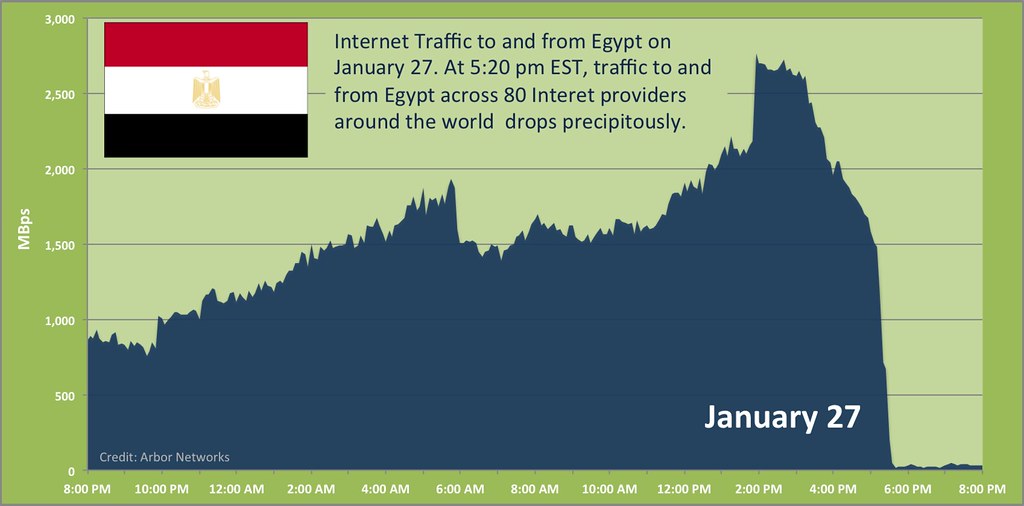
You need to be watching the Middle East right now. First, there was Tunisia. Now, there’s Egypt, which has just shut down all Internet traffic in and out of the country. There are also large protests in Yemen and additional reports of smaller protests in Libya and Lebanon.

The thing about events like these is that they tend happen very, very quickly even if the precipitating conditions are generally long-standing. If protests like this succeed in their immediate goals (i.e., regime change) that also tends happens very quickly. However, you should be careful not mistake the volume of information flying about these things for that happening-very-quickly factor. Journalists struggle with this. Audiences struggle with this, and folks like me who do media and news analysis for fun and profit (seriously, I have professional training and experience this stuff; I’m not just talking about random blogging) struggle with this. Combine that with the disparity between the nature of information flow where the events are happening and where you’re watching from, and it’s hard to know what’s going on, especially now that Egypt is effectively an Internet black-out zone; SMS and mobile service also seems to be out or on its way out, and there are additional reports of land-lines starting to go down. An hour after I first posted this I am now seeing reports of the government cutting water and electricity throughout multiple cities.

Next, LGBT people are still being murdered in Uganda, whether that “Kill the Gays” bill goes through or not. And part of the reason they’re being murdered? US religious activists who, unable to engage their agenda fully in the US, went to Africa to see what they could do there instead. When I wrote about this on my LJ, one of my fandom friends linked me to a fund that supports an LGBT-inclusive church in Uganda that’s run by a Ugandan minister. If you have other suggestions for how people not in Uganda can help address this mess, please leave a comment.

Now that we’ve gotten that stuff out of the way, it’s worth noting that I don’t think of myself as a political or activist blogger, even though I certainly blog about both to varying degrees here and on LJ. But I do think that Sady Doyle has a lot of interesting things to say about the realm of nasty reactions from readers at her Tumblr. I don’t get quite the same types of hate as Doyle does, and I very much suspect I get it from a different audience (although that may have more to do with my origins on LJ, which has a different male/female ratio than some other spaces on the Internet, than anything I actually do or write about), but Doyle nails some trends in nastygrams directed at female-types on the Internet with this:

… I generally think it’s the same for every woman who receives a massive amount of blowback. Either you seem too sure of your own worthiness as a person, or you seem too sure of your opinions; either way, something has gone wrong, because you don’t hate yourself, and we need to fix that for you.

I think anything I have to add to that is probably superfluous today.

Okay, fun things!

It wouldn’t be trash day without linking to something on Kickstarter. This project is already fully funded, but there’s still time to get in on it and get your very own math dice, which I personally think should be a featured element in any sort of Doctor Who table-top role-playing game ever.

And, speaking of Doctor Who, as we do around here: Ride-in Daleks!. Kids only, and alas, I have no kids to put inside Daleks. Maybe the cats though…. would that be wrong?

And we have some updates on some previous stories:

I’m going to get to eat cups! But yet on a more serious, and continuingly relevant, note there was a slight bit of dramarama in comments on that project over on Kickstarter as the deadline neared. Someone showed up to say that the people running the project were bad people, provided no details, and offered an analogy that may or may not have had direct relevance to whatever accusations they were trying to make. I don’t know the Jelloware people, and I don’t know the person speaking out. But I do know if you’re going to say, “Hey, you shouldn’t support these people” you need to say why. And if you don’t? I’m going to refer you back up to the previously quoted remarks from Sady Doyle.

Next, it looks like the Internet stepped-up and Teresa Jusino will be joining us in LA for the Whedonistas launch!

Finally, for those of you following the hawkward situation at the Library of Congress, the bird has been rescued.

the summer of no sleep

It is, it seems, a universal constant that only -children seek or long for family additional to what we grew up with. Or so I have always heard. Certainly, my friends who are only-children (and that’s most of them) have long reported to me about longing for a sibling or two or, most particularly a twin. Despite also being an only-child, this has never been a desire I’ve particularly shared. Certainly, now that I’m older and my parents are also older, it would be nice to have someone with the same loyalties to them to share the stresses of their aging; and I make no secret of the fact that a lot of the aggravations of my childhood would be easier to put to rest if only I had someone to compare notes with regarding the indignities of six, ten or twelve. But I don’t, and it’s not a particularly big deal to me. Considering the richness of the fantasy lives I cultivate, this is, I suspect, somewhat notable.

What I do have, however, is a history of longing for creative family. I could blame this on the fact that my parents are both painters, or on the desire for the instant family of high school drama club that I observed but, despite being the in the plays, rarely felt a part of (although I did, that time someone sat at the piano and someone else plopped down at the drums and we all spontaneously sang “Ruby Tuesday” and later, at the cast party that same year, when we kept tormenting this kid named Jonah who was stoned out of his mind by telling him whales were chasing him). I could blame it too, I am sure, on the backstage narratives of so many musical I grew up with, around and in — shows like 42nd Street and Kiss Me Kate. I could also blame it, however, on the summer I only slept four hours a night, every night, because I thought that was how I was going to change my world.

This was the fault, indirectly, of our host over at InsomniBake. She conned me, despite my having thought I wanted nothing to do with it, into watching Moulin Rouge with her one night on DVD (that tango scene is a gateway drug). I dug it, and, because I have a fannish personality, I acquired a lot of info about it, its process and its creators, fast. I loved the idea that the director made it with his wife and that she (the amazing designer, Catherine Martin) was the one who kept winning awards for it. I loved that it was written with the director’s best friend. I loved that it seemed everyone on the team had some backstory, backstage, connection to everyone else. Over all, as a lifestyle choice, I decided it made artistic family seemed like the Best Idea Ever and somehow that never sleeping and making all the art ever was, inexplicably (oh, there’s an explanation, but it’s too absurd to repeat here), the way to go on making my little fantasy a reality.

When I think about it that way, in terms of how little sleep I had at the time, it all makes a lot more sense that, that was how I wound up with the lover in Texas I wrote stories with and who I wanted to move up to NYC to open a restaurant. Now, that didn’t work out by way of a lot of things, including an ill-advised wedding (not mine) and a very long bus trip to Texas (mine). But The Summer of No Sleep was also how I started writing with Kali (which has also been an evolution of relationships, and, in the interest of full disclosure of my pure loser-ish geekery, I will totally admit that I once dragged her to sit behind a table at a casting call with me and called her my designer just so someone could sit there and share with me the horror of what you deal with when you hold an open call in New York).

Patty and I, meanwhile, don’t particularly create art together. Not for other people, anyway. We do proof reading duty and talk ideas through with each other a lot, though, and we certainly do all that day-to-day art stuff that couples do with each other — the “this scarf or this scarf?” question and making up silly little songs for each other and cooking and telling stories in the dark. That stuff is totally art. Big art, sometimes; important art, always, and it’s nice to have art that isn’t for other people. Almost ten years ago in The Summer of No Sleep, I wouldn’t have really gotten how private art would be good for me, but that’s because I was a fool and in the throes of one of my things. The Rach & Patty Show, audience of mostly just us, is divine.

But I, somehow, wound up with collaborators anyway. The dude in Texas is often one of my first readers. Kali and I have a stack of projects we can’t get enough of. Erica, who I knew for two weeks through an academic friend and Inception: The Musical, jumped on the idea of Dogboy & Justine with an enthusiasm I’ll never stop being grateful for. And now, it seems, I’m doing some scholarly work regarding media with a collaborator as well.

When I look back at The Summer of No Sleep, which I do a lot, because it was very well-lit (that apartment was screwy but had great light) and I wasn’t working, so there was a lot of being in the city and thinking about conquering the world, it all seems very strange. Creative partners. Collaborators. Co-authors — all words that have cause to roll off my tongue a lot these days, because they are practical details in necessary professional and social conversations. But in The Summer of No Sleep they were pretensions, fairytales and fantasies, something the people who were there that summer won’t likely ever let me forget.

It’s not something I mind really. Because I still like the stories — the ones belonging to other people, the ones that were make-believe, the ones that didn’t quite happen to me or happen yet (gosh, I still really need to win the lottery so I can have my very own New York City townhouse in which to make things and have parties, ne?), the ones that got me to Australia and back.

That summer of self-imposed insomnia is a good reminder, too, that the only life you can have is your own. That you shouldn’t, as Dov Simens (I should really write about that 48 hours of madness sometime, but short version: thumbs up) says, compare your insides to anyone else’s outsides. And that you really can’t live a story you yourself aren’t writing, start to finish, with as many damn co-conspirators as needed in whatever configuration it takes.

P.S., Never take a bus from New York City to Austin, Texas. Ever.

truth + fiction doesn’t just = marketing

In the world of fanfiction there’s fictional person fiction (FPF) and real person fiction (RPF). While fanfiction is often viewed with skepticism from people outside of the fan community in general, despite humanity’s long tradition of telling and retelling stories as social currency, RPF is often met, instead, with skepticism from people within the fanfiction community itself, while people outside the community don’t even really seem register it as so specific a category.

And, to be fair, on a pure gut level, sometimes I can find RPF to be really, really weird. But then, I’ve stumbled over stories about a person I went to high school with who is now famous and one about a friend of a friend’s ex that I once had beers with and found to be remarkably unlikeable. RPF, which is arguably about personas and the packaging of fame — when people write RPF they it’s possible (even quite likely) that they aren’t writing about real people’s fictionalized private lives so much as real people’s publicly fictionalized persona’s private lives — sometimes appears to drop under that layer of fictional truth for me, not out of speculation but because Oh my god, I know those people.

I’ve heard all the arguments about the morality or ethics of writing and reading RPF, and it’s not that I don’t think these are fundamentally important conversations on some level (and yes, I’ve thought long and hard about “Well, how would you feel if someone did it to you?” The answer? “Well, like I’d probably have a lot more important things to be doing than reading wank about me on the Internet if I were known enough for that to be going on.”). It’s just that I’m not that interested in those discussions of how not to be an asshole. Not being an asshole is good, but I’m not all that qualified to tell anyone how to do that, despite various attempts I fully admit to having made. Besides, from a thinky thoughts perspective, on this one I’m really, really much more riveted by — and useful to — talking about the critical implications around RPF.

Perhaps the most irritating aspect of RPF-related discussions is the degree to which people dismiss it as, “Oh god, more creepy porn on the Internet.” I think it’s pretty toxic how often both fan community participants and critics dismiss sexualized-content for irrelevancy because it contains sex. Our collective libidos are, among other things, narrative tools, and chucking a lot of fanfiction into the sex bucket and saying it’s not worth looking at from a critical position for that reason isn’t just one of those high-/low- culture false divides moments; it’s a sloppy misuse and abuse of data. The stories people feel compelled to tell and witness and share, whether or not they’re well-written, or whether or not you’re personally interested in them, or whether or not that represent masturbatory material for some people, represent a cultural map that it’s foolish to dismiss (even if I won’t read anything published on fanfiction.net either — I never said I wasn’t a snob).

Now let’s be clear, not all fanfiction, and, I find, particularly not all RPF, is porn. And even when it is, that porn is usually there in service to the idea of the backstage story (which if you’ve been following the development of Dogboy & Justine you know is a particular fascination of mine). And, conversely, not all RPF is fanfiction (e.g., works created on a not-for-profit basis by enthusiasts). Note the erotic anthology StarF*cker, which is fiction about sex and real famous people, but very much not part of the fanfiction ethos. In the less sex, but still definitely RPF department, what do you think Primary Colors was? Or the forthcoming O (not to be confused, amusingly, with The Story Of O)? RPF. Totally, totally RPF.

And that doesn’t even begin to cover how pervasive this trend has become; Steve Erickson, for example, doesn’t just use both historical figures and himself as a fictional characters in his novels, but also included personal encounters with Sally Hemings (a particular obsession of Erickson’s; she shows up in his novels too) in Leap Year, his arguably non-fiction book on the 1988 presidential campaign season. Other examples include the Aaron Sorkin Jed Bartlet advises Obama piece from the last campaign season and an article The New York Times also did on the real people as fictional characters in novels phenomenon, although I’m having trouble finding the link (please leave comment if you’ve got it!).

RPF is a real, saleable thing, both in its smutty and not smutty versions. None of which necessarily makes it less uncomfortable for many readers (or, even, in the abstract for non-readers). Nor should it. Part of the charge of reading RPF, sexualized or not, is, I think, that it is so profoundly unsettling and messes with our boundaries regarding what is real and what is true (two of my favorite categories for making Venn diagrams about stories). Another part of the charge is, I think, the violative nature of reading something and realizing that a particular fantasy, daydream or fear you have harbored is shared, is part of our collective story in the dark. It is the guilty that can bring the pleasure when it comes to RPF.

In the midst of hanging about on Twitter the night Countdown went off the air, there was a tweet saying that AC360 was going to do a bit on the Countdown thing, which got fairly widely misinterpreted as “Olbermann’s going to be interviewed on Cooper’s show.” Which, in the world of the Internet, or at least the people I talk to on the Internet, led me to make a crack about how Olbermann/Cooper would make certain corners of the Internet very happy, which led someone to reply with, “Have you read this?” and a link.

Obviously, I read some RPF. I’ve written some RPF (some of which you’d even be able to track back to me with ease). Some of that I have mixed feelings about. Some of it I don’t. But there’s ton’s of RPF I won’t touch with a ten-foot pole for no other reason than it squicks me. It doesn’t mean the story is morally or ethically wrong (for me or anyone else) or not well-executed; it just means that for whatever reason, sometimes one I can’t even put my finger on, there are some RPF places I don’t want to go unless I have to for some sort of scholarly/critical thingy. For me, pundit slash, as the world of RPF about political talk show hosts is called, is one of those no-go zones for me. I’ve no idea why, but so it is. This surely seems like a perfectly rational choice to many of you.

But I had a headache, and I was in a bad mood, and people on Twitter were like “You have to read this story called ‘The 28th Amendment,'” and I recalled that, that Barack Obama/Rahm Emanuel piece from Yuletide a few years back was one of the smartest meditations on ambition I had ever read, even if I did find parts of the story really, really uncomfortable. So I decided to give the rec from Twitter a go, and that’s how I fell down the rabbit hole of pundit slash on a Friday night, and why I’m writing this post and have a linky or two to share with you now.

One of the biggest problems for me as a (critical) reader of RPF is that I often feel like people who are trying to use RPF for commentary don’t know how to write a story, and people who just want to write a (hot) story, don’t necessarily know how to add criticism into the mix. That both those things should happen in RPF aren’t, of course, anyone’s requirements but my own, but hey, my journal, my pickiness. What’s so remarkable about “The 28th Amendment” (which imagines a The Handmaid’s Tale-esque religious police state in the US under a President Huckabee with our intrepid pundits (Jon Stewart, Stephen Colbert, Rachel Maddow, Anderson Cooper, Keith Olbermann and more) on the run), is that it knows how to do both. While I reflexively read it with an editorial eye (and there were things in there I would have changed or didn’t ring plausible for me even in the suspended-disbelief of the narrative, although it’s hard to say whether that was related to personal comfort or actual editorial consideration), the fact is, it was a well-told story that got under my skin for reasons that I am fairly sure were broader than liberal-paranoia and the fact that I read all sorts of stuff that freaks other people out on the Internet all the time.

Maybe, I decided, pundit slash wasn’t totally squicky. Maybe I should read more! So I started digging around on An Archive of Our Own and found a remarkable number of charming fictions about Rachel Maddow being a cool person to have drinks with, a BDSM-AU about various pundits, several high school AUs (a particular favorite of my partner’s), and an essentially general audiences Doctor Who/Rachel Maddow crossover. It’s a beautiful world out there on the Internet. Or something.

One of the views I have particularly little patience for is the idea that fanfiction isn’t real writing, that it is somehow “practice” for the “real” work you are obligated to aspire to do. Sure, writing fanfiction is one way to learn some craft skills, but to me original fiction and fanfiction are profoundly different endeavors that I engage in for profoundly different reasons. To me, fanfiction is something of an acting exercise: that is, how do I execute, in text, on a character whose blueprint has already been provided to me by a writer/director? While original fiction utilizes some of those acting tools, but also the structural components of the writerly and directorial eye. And I think it’s absurd to tell anyone they have to aspire to anything, especially when I’ve had so much experience turning something I love into a job — sometimes it’s still fun when you do that, and, sometimes, it really, really isn’t.

But I do think that people playing in the RPF sandbox — whether they be part of fan communities or not — would benefit from looking at the bigger picture. If you read Primary Colors, it’s absurd to snark on the existence of RPF in fan communities even if you’ve never read fanfiction and never plan to (because, guess what? In a way, other than that money was involved, you already have). And if you’re writing RPF and think it has to stay in the land of fanfiction but wish it didn’t? Well, sometimes it doesn’t have to stay there. And you should know that too (and I say this, particularly, to people writing historical RPF — have you read The Baroque Cycle? History is a playground! Although please, if we can avoid any more plays about six great minds from different time periods having a dinner party in Hell, I would love you forever).

Fiction appeals to many of us, often, because of the pieces with in it that could be or feel true, no matter how impossible or unlikely for us or for anyone. There is a reason, after all, why so many adults confess to still feeling at the back of wardrobes when they encounter them for the door to Narnia. So it makes just as much sense, really, no matter how discomforting it may be, that there is this not insignificant impulse to put not just truth in our fiction, but fiction in our truth. RPF is a corner of both the fanfiction and generalized fiction space that illuminates, with a sometimes queasy-making light, just why we read fiction and just how far away truth can seem.

Meanwhile, I’ve got a killer story sitting on my hard drive about once-was but no-more Ziggy Stardust David Bowie and Lady Gaga and matters of persona, mentorship, love and desire. Anyone want to buy it?

Snow-covered trash day

It’s really hard coming up with random adjectives for the weekly (good kind of) trash day. I just want you to know that. But it did snow here again last night. I don’t know if this is New York’s snowiest winter on record, but it sure does feel like it.

In personal news (let’s face it, it’s all personal news), I got to talk to Patty this week, in an entirely non-emergency situation. She’s doing great, and we’ll get to speak again this weekend. I’m not sure she entirely believes me about the snow, though — the winters she’s been here have been mild (the last bad one she was in Oman) and my capacity for dramatic narrative has never been low.

Last night Kali and I had one of the longest, and probably most hilariously inane, conversations we’ve ever had. I had to, for no discernible reason, know something about the sexual history of our main character, Arkady (whom I’ve written about in passing before, weirdly, in the context of DADT) before the start of the novel. She and I disagreed on a relatively minor point, but I needed to know, I needed us to be in agreement, and I needed to be convinced. 86 emails later, it’s finally okay, and I now know something that will probably never, ever even be mentioned in the book. Art: it’s not about efficiency.

And, on the subject of art, a friend of mine is making fantastical space terrariums with live plants. She says there are more coming soon. Explore the stars… in a jar!

Meanwhile, someone I’ve never met wrote something super sweet about Dogboy & Justine on their LJ today. This is why crowd funding matters for all participants (by the way, at least one of the projects I talked about supporting last week has achieved its funding goal!). I was particularly tickled that she framed her plans in regard to James Marsters. Because of the wonders of the alphabet, when we’ve both done the guest thing at the same con, we’ve tended to wind up right next to each other in the program book. That is, if my buddy Marrus doesn’t get between us. The whole thing always amuses me immeasurably.

And, speaking of cons, if you’ve been poking around at my relatively bare (I’m in scheduling limbo!) appearances page, you know that I’m participating in a book-launch event for Whedonistas at GallifreyOne next month. One of the authors who is supposed to be joining us, Teresa Jusino, is asking for help in getting there, as her original plans didn’t anticipate financial troubles before the trip. This is Teresa’s first easy-to-find hard-copy publication, so this is a pretty big deal for her. Check out her post and her stuff if you get a chance.

Speaking of hard copies, the first installment of Hold Something came, and I was the lucky winner of the bonus item this time. Weirdly, I knew it would be me when I saw Christian’s post, but we have a thing. Not a thing thing, but an affinity thing. Just… it’s a thing! Anyway, I won’t get reading time until this weekend, but it’s gorgeously produced, and I already know that Christian tells stories I want to hear.

On an entirely different note, my former roommate (and one of the people instrumental in getting Patty and I together so swiftly what with her exciting declaration of moving to China) has launched a blog called InsomniBake. She can’t sleep and so documents attempts to make a variety of treats often under weird and unideal conditions. Recipes, midnight musings, successes and failures. Apparently the blog’s pretty hot right now… you know, buzz and all that, but to tell the truth, I’ve not yet found the time to check it out myself, so I’m tasking you all with it to assuage my guilt.

Tonight, some web work and Sherlock analysis and then early to bed, as I’ve got to go to Costco before a script meeting tomorrow.

Finally, a late addition: Apparently, there’s a hawk in the main reading room of the Library of Congress and its somewhat peculiar presence is being blogged. Look, I care. Now you can too.