Glee: The Rules for Boys

While I not-so-secretly suspect that large portions of last night’s viewing audience were only there to see the trailers for 3.05 (called “The First Time,” for anyone who might not know the basis for my suspicions) and to see if Fox would let a bunch of supposed teenagers sing about being drunk and having a menage a trois in the 8pm time slot, one of Glee‘s best recurring themes was also on display, and that was the rules for boys.

It’s most overt when Finn explains to Rory that “dudes don’t ask dudes to be their friends.” But that remark isn’t just about explaining America’s social habits to the over-eager, adorably scamming foreign-exchange student. Nope, it’s about defining the masculinity that all our male characters have to navigate. Without it as background noise — even if it’s arguably background noise we all know — the passing plotlines around Kurt, Blaine, Dave Karofsky, and the soon-to-be-introduced Sebastian don’t mean anything, not to gay audiences, but to the straight ones who don’t necessarily have a reflex to think about the world as they create it for us.

Finn’s speech to Rory, in fact, goes a long way to explain the friction between him and Blaine in the choir room, because that is not just about Finn’s insecurity and his desire to remain the glee club’s vocal leader and captain-type dude. It’s about Finn’s homophobia, which, no, is not gone, despite the fact that he loves Kurt and does truly see him as his brother.

Because Finn and Kurt’s drama didn’t entirely neutralize because Finn got over his generalized homophobia, it neutralized because Kurt became his brother and the incest taboo made Finn forget about his still existent homophobia as it applied to Kurt. He no longer felt fear of Kurt’s sexuality, because Kurt as sibling became more important to him — and more gross in a sexual context — than Kurt’s being gay.

Blaine, to a given extent, was probably shielded from Finn’s homophobia by that. We see them being friendly around the prom episode, and we have to assume that dealt with each other a lot over the summer. However, Blaine’s transfer removes the incest taboo shield when it comes to Finn’s ability to deal with homosexuality amongst his male peers. Blaine goes from just being his brother’s boyfriend to the dude Finn goes to school with, basically moving him out of the protection accorded to him by his pseudo-family status. And so, aside from the leadership/solo issue and Finn’s insecurity, what does Blaine do that upsets Finn so much? He spends all his time effectively asking everyone, INCLUDING OTHER DUDES, to be his friend.

That breaks the masculine (read: heterosexual) code Finn describes to Rory, and also amplifies the level of competitive threat Finn feels from Blaine, because part of the non-verbalized homophobia in play here, and in the passing plotline around West Side Story, is that gay dudes aren’t leaders, despite the way Blaine was first introduced to us at Dalton (but remember, Dalton was faerie land — not real, and only being reintroduced to provide us with more faeries gay boys).

So here’s a place where Blaine’s ability to pass makes him more threatening to someone like Finn, rather than less, not just as competition, but in the context of Glee’s constant reminder of the fear of “the predatory gay.”

I expect this link between dude friendship rules, predation, and homosexuality are going to get an even bigger focus when Sebastian joins the narrative next episode. How will Blaine, who is so needy, respond to a gay man who works the passing and masculinity thing differently than he does, breaking the guy friendship rules that Blaine is often oblivious to himself?

How will Kurt (who is very aware of those rules, schooled in them as he was by Finn regarding not just himself, but Sam) respond to witnessing that? And, most importantly, how will their straight male friends interpret it?

Will it be about breaking the dude code? Will there be concern for friends who might be facing relationship drama? Or will they back away from what they will perceive as threatening predatory gay culture stereotypes they are not sufficiently insulated from by Kurt’s kinship with Finn because there are just too many other players involved?

National Coming Out Day

October 11 is National Coming Out Day in the US (it’s the 12th in the UK), and since I’ve been out (and really, really out online) for a long time, today, what I’m thinking about is those times when I’ve not been.

Like two nights ago when I played the pronoun game at an awards banquet thingy when someone took “partner” to mean “husband” and it just seemed too awkward to correct them. It’s hard, I’ve always found, in small talk with strangers, even if you’re comfortable being out, to have to say, “Oh, by the way, you’re wrong.”

I’m lucky enough to run into situations like this rarely, but they always linger with me, long and strange.

And the world is changing so fast; I don’t always even know how to keep up.

When I met my guitar teacher, for example, she asked if I’m married, and I said, “Oh, no, I’m gay,” which actually didn’t make sense as an answer in New York State anymore (unless we’re actively talking about non-assimilation, which is a great convo, but was not the one at hand). Anyway, she’s surely forgotten about it, but I think about it from time to time; how it marks my age; and how my age has marked me.

So, on the odd chance you were one of the few people who didn’t know: I’m queer. Queer is my preferred word because it lets me get the genderqueer stuff and the attraction stuff and the fact that I feel like bisexual is too binary a word for me (but I’m really interested in gender, it’s not an afterthought, so apparently pansexual is wrong too? I don’t know, I’m not great at keeping up with the ever expanding QUILTBAG terminology) and the probability that I really can’t pass all into one neat little syllable.

I’ll also take gay, lesbian, bisexual, pansexual, whatever, because they’re all varying degrees of accurate and I know queer isn’t a comfortable word for everyone. Mostly, it’s like my pronouns — if you’re not using it as an insult, with that nasty little hitch in your voice — we’re good. As ever, in case anyone still needs to know this, don’t use queer for people who don’t self-identify as queer, and please, it’s an adjective, not a noun.

Meanwhile, coming out is a privilege and should be a choice (political figures who actively support anti-gay agendas and who later turn out to be queer, being a common, but not universal, exception to this belief).

Additionally, coming out is complicated. For a lot of us, it involves not a sentence, but paragraphs, about sexual preference, romantic attraction, personal history and gender presentation and identity; and if we pass for whatever reason(s) (which is this whole mess of a thing filled with advantages and disadvantages and all sorts of complicated stuff), it can feel even harder to speak up.

Coming out can also often involve not just speaking personal truth, but often, countering assumptions or offering reassurances (No, mom, you didn’t make me gay). This can be everything from tiring to amusing to heart-breaking to just plain weird.

Of course, coming out also carries real, serious risks — homophobic violence still exists around the world (including even in my precious New York City) and in most US states you can still be fired from your job for no other reason than being or being perceived as being LGBT.

However, in spite of that (and perhaps because of it) if coming out, if being out, is a thing you feel you can do, it’s probably a good thing, not just for yourself, but other people in your community. Secrets are, I think, a dangerous currency, easily stolen.

National Coming Out Day has a lot of purposes. It says we are not silent. It says we are not invisible. But it also says you are not alone.

And that’s true regardless of whether you’re out or not.

This blog welcomes anonymous and pseudonymous comments that are non-abusive in nature. That’s true every day, but that’s especially true today. If you want to make this random little corner of the Internet a place you can be out in today, you are welcome to do so, but if you just want to keep reading along, that’s cool too. Either way, we’re honored to have you.

The New Yorker Festival: Chris Colfer

Last night I went to see Chris Colfer interviewed at the New Yorker Festival. It was the first time I’ve actually managed to get to said festival — I always either have trouble getting tickets or the timing is such that I’m traveling. This time, I just barely made it, as I’m leaving for Europe tonight.

At any rate the experience was both lovely and odd, but neither really in the way I expected. As others have noted, the questions were largely a rehash of topics Colfer has covered extensively before, and, despite the moderator being knowing about how everyone in the audience were largely well-informed fans and Colfer himself answering many questions with the preface of “For the two of you in the back who don’t know this,” little was done to target the discussion to either the actual audience or to Colfer’s upcoming projects (he as a movie he wrote and starred in coming out, a middle-grade book deal, and a pilot in development).

Whether this was a matter of the moderator not knowing that catering to a young audience (it was largely teens) or a fannish audience (like I said, we were in the know) doesn’t mean watering it down, I’m not really sure. Either way, it’s worth noting that neither audience actually likes easy, neat, harmless content, but really loves new ideas and process discussion to chew over. But we weren’t given that, and it was really a disservice to everyone.

That said, Colfer was delightful. He’s verbally playful and well-prepared for questions both awkward and boring (He assumed an audience question prefaced as being awkward to be the usual “what’s it like to kiss Darren Criss?” Instead, it turned out to be about Colfer’s choice of cologne, and while none of it was less inappropriate for all that, Colfer’s navigation of that mess sure was a lot funnier than it could have been for those of us cringing in our seats).

The expressiveness of his face was also fascinating to watch as he got stuck watching clips of himself at various points in the evening. I think I learned more about performance from that than anything that actually got said during the entire program.

But evenings like this, when you’re in fandom and like to write about pop-culture, are rarely just about the content on stage. They’re about the people you see and the friends you have drinks with after. So I was glad to chat with three different groups of people I knew before the thing started, catch up on a bit of gossip, and have a lengthy, meaty discussion afterwards on the construction of fame.

For those of you who missed the event, there are quotes, audio and pictures all over Tumblr and Twitter. I would say some of the paraphrasing conveys a different tonal quality on certain issues than I got from the experience, but if you’re among those who have been wound up about recent Glee spoilers in the last week — spoilers that were heavily yet coyly acknowledged by Colfer, who isn’t just playful with words, but dirty with them — I would say, oddly, to trust. I think they know how deftly they have to tread in what’s coming, and I think the effort will at least be valiant.

My upcoming time-zone shift and work schedule mean I may be a little behind on things until I return in two weeks, although I am planning a bit of meta regarding Kurt Hummel’s clothes, one of the leaked performances in 3.03 and the 3.05-related excitement. So when I get to that some time this coming week (after 3.03 has aired), please remember this is a spoiler rich zone.

Pan Am & The Playboy Club: Romancing a future that’s already happened

The other day I finally caught up with the first episodes of both The Playboy Club and Pan Am, both of which have seemed to be destined to be Mad Men but about women. Certainly, both shows are trying to cash in on the interest in that stifled and stylized world, and neither have in conception struck me as likely to do it very successfully.

On viewing, The Playboy Club seems more in the mold of Mad Men at first glance. It’s dark and no matter how central women are to the story, it’s really feels like a story about men and their clothes, haircuts and ordering of the world. Selling it as a story about women because of the bunnies and the women at the supposed center of the plot seemed besides the point, despite several central female characters I should theoretically care about. Frankly, I was bored.

That said, the show is doing some interesting things odd to the sides, even if I found the female rivalry plots overplayed and the mob drama of no emotional interest. The lesbian bunny is an interesting choice. Being a bunny wasn’t sex work, but queer women in sex work is a real thing, and certainly this is as close to that story as we’re going to get on network TV. If any straight people want to tell me how the Mattachine Society plot line read to them, I’d love to know. For me, it was the first time I really sat up and paid attention. Did I feel the hope and the fear because it was my people? Or was that when the show snapped into some better pacing?

Pan Am, on the other hand, is a much larger bucket of weird. It’s a lot less subtle, and really, as much as I’m all over it, the sweeping movie soundtrack music and the completely pornographic shots of airplanes before every commercial break are a little much. I love that stuff, but really, I can only take so many emotional climaxes about our past imagined future in 48 minutes. And there are lots of moments that feel like heightened reality (particularly in the repeated row of marching stewardesses routine) in a show that, in its domestic dramas (here again, another confrontation between two women who have slept with the same man), is also trying to be delicate. That it also seems to have two subplots involving international spying just adds to the possibly delicious ridiculousness.

Of the two shows, Pan Am managed, I thought, to be a greater love letter to the era and showcased the rivalries between women with a greater subtlety. But both shows’ emotional tones feel so off — The Playboy Club is too full of despair for a first episode and Pan Am is a little too up about a future that’s already happened. For me, they really only worked as companion pieces, bracketing the world as it was and is.

Pan Am was definitely more fun to watch, and I suspect it will last longer. But I really want to see where the Mattachine Society plot on The Playboy Club goes, although right now, I’ll be surprised if the show survives the season.

Anyone got any bets?

Glee: Let’s talk about “Glitter Bombing”

Glitter bombing is not a Glee-ism. It’s actually a recent but recurring political act, with real world history, usually carried out by activists against anti-gay politicians. In fact, the only instance of glitter bombing not related to LGBTQ issues on the Wikipedia page is in its “in fiction” category — and that is Schuester’s use of the tactic in “The Purple Piano Project.”

I wanted to point this out, because most of the discussion I’ve seen of Schuester doing this revolves around either his immaturity or the wackiness of Glee, but without the non-fiction political context, I don’t think that’s a meaningful conversation.

The thing is, I can’t quite figure out what Glee was trying to do with this. Was this another case of Schuester thinking he’s doing the right thing and not? Let’s face it, Sue may say all sorts of appalling things to Kurt, but she also gave him solos, stuck up for him on the atheism thing, and doesn’t seem to hold his queerness against him any more than she holds anything against anyone.

Schuester, on the other hand, spends a huge amount of time being exasperated by Kurt’s queerness (something which previews for next week’s episode suggest will be back), trying to be supportive, and basically just doing things (when he does anything at all) that aren’t about Kurt but are about himself.

So one easy argument is that Schuester is being incredibly appropriative in an incredibly inappropriate way.

The other possibility is one about how Glee defines queerness. By using Glitter Bombing to defend the arts, Schuester suggests that the arts are inherently queer, that his glee club is inherently queer. And not just because it’s more filled with LGBTQ people than he knows.

Certainly, there are a lot of people on Glee besides Kurt, Blaine, Santana, Brittany and Karofsky, with arguably queered sexuality. Tina and Rachel are both othered at various points for liking sexual activity. Artie, through both words and deed, points out that his wheelchair doesn’t getting in the way of his sexual abilities. The women Puck desires are not an expected or necessarily accepted part of his sexuality in the WMHS environment. The intersection of Emma’s OCD and her demi-sexuality has been a near constant topic. And I certainly know more about Schuester’s sex life than I ever wanted to (remember his ex-wife?).

Glee is very insistent that everyone is not just the underdog, but really weird and possibly revolting to someone out there. Sometimes the show is awkward about it; sometimes it’s hilarious. Often it’s both. And, when we look at the ways in which it uses songs (stretch those lyrics, stretch them!), it’s easy to assume they’re just stretching the meaning of Glitter Bombing here to this larger underdog story. On some level, everything on Glee is a metaphor about LGBTQ-ness, and all the LGBTQ content on Glee is also just a subset of a larger story about a broader sense of queerness.

But, at the end of the day I don’t think that’s what is actually happening around this particular act. I do think this is one of our first hints that Schuester is going to remain ineffective, boggled and cruel through obliviousness when it comes to Kurt (and the other LGBTQ kids he’s aware of), because he, like pretty much all the characters on the show, is too wrapped up in his own drama to engage other people in a useful way. Schuester taking Glitter Bombing, screwing it up on behalf of the arts, and then finding a way to mess up the equilibrium of any number of the LGBTQ characters? It seems like a given at this point, and last night’s episode warned us that that’s coming loud and clear.

Torchwood: Miracle Day — Redefining heroism for the Whoniverse

I finished Torchwood: Miracle Day last night, and I find myself more satisfied by the idea of it, than with the series itself. Honestly, that’s largely a matter of pacing. Children of Earth had particularly stellar pacing, and Miracle Day did not.

A lot of that, especially in early episodes, was the by-product of having to introduce the show to a whole new audience. But even then, I thought most of the slowed down pacing was less committed to helping us understand Jack and Gwen and the idea of Torchwood and more to the creeping horror of the Miracle. This would have been perfectly fine, it if weren’t a relatively simple concept to grasp, one that would have been more terrifying, immediate and less distracting in its allegory, at high speed.

But a five or seven episode Miracle Day would have been a different animal, one that could never have contained Jane Espensen’s brilliant episode 7. And let us be clear, I’m not a fan of the episode for the gay romance or Barrowman’s ass (which is, I think, a criticism that gets lobbed, not entirely fairly, but not entirely unfairly either at a lot of fandom and at a lot of female viewers in particular); I’m a fan of the episode for its inherent Romanticism and its narrative about loss — two central traits of the larger Whoniverse which appeared with a poetry in Miracle Day in a way that they actually didn’t in Children of Earth, despite that being the stronger of the two series.

Without episode 7, Miracle Day would also not be a story about Jack. It’s the knitting to his arc, one which many people in fandom have been writing very eloquently about coming full circle in this series (please post links if you’ve got them). Certainly, as one of those fans with a deep commitment to the Face of Boe story, to see Jack finish this series with his immortality intact and a real sense of peace and wonder with the world again, I was relieved. I was also satisfied, when Gwen shoots him to prevent him from being a suicide.

Giving up one’s life for the cause is, essentially, how heroism is defined in the Whoniverse. Jack, when we first meet him, is mortal, screws some stuff up, and is ultimately willing to give up his life to fix it. He doesn’t. Then, later, when he’s willing to give up his life to save his friends, something intervenes and he becomes immortal, robbing this con-man who had become a better man of the ability to execute on heroism as defined by the Whoniverse. This has dogged him through each and every one of his failures across the programs; all he can do is sacrifice others, and that is, we are told, the act of a coward.

When Gwen steps up to be complicit in the death he has volunteered for, she is not just expressing love for Jack, and helping (seemingly) to return to him his heroism. She is actively altering the structure of what it means to be a hero in the Whoniverse; she is taking the gun out of Adelaide Brooks’s (“Waters of Mars”) hand and saying she doesn’t have to do the right thing alone. Gwen, in letting her father go and in being willing to kill her friend, who she loves once again, tells us that maybe Jack was not a coward when Ianto died and perhaps, unsettlingly, not a monster when he sacrificed Steven.

These are some pretty fascinating and powerful ideas, littered across an intriguing landscape filled with atheistic play with religious metaphor (something I don’t think Russel T. Davies could avoid if he tried), that culminate in Jack, whose life was in many ways made smaller by his immortality (he wound up confined this this earth full of its restrictive morals about love and sex), witnessing it possibly make someone else’s life (Rex’s) larger.

Miracle Day is, in its parting shots, a return to the wonder that was Torchwood in the largely monster-of-the-week incarnation that defined its first two seasons.

But satisfying in my brain, and satisfying in front of my eyes are two different things, sadly. And of all the series, this may be the one I am the least likely to rewatch in its entirety for anything other than scholarly purposes. Aside from finding its pacing off-puttingly awkward, its attempt to unify the original show’s queer sensibility with a perception of American masculinity and viciousness was at best inexplicable and extraneous and, at worst, arbitrarily offensive.

On the other hand, I still hope there is more. I will always want to follow Jack’s story, because Jack’s story is always. I want more detail and elegance around the Families and the idea of their plan as Writing the Story.

Finally, Jilly Kitzinger? Most fun villain, EVER.

Torchwood: Miracle Day – Finally Getting to America

Once upon a time I had a letter published in the New York Times in response to a piece they did on Russel T. Davies. In it, I noted that Torchwood felt like a show about people like me, just with more aliens.

What I meant by “people like me” wasn’t necessarily obvious. Because it wasn’t the show’s queer content so much as the smart-people-with-complex-friendship-and-romantic-networks-who-are-in-over-their-heads factor. But sure, the queer content helped, of course.

While I was one of the people who loved Children of Earth (so much so that academic research related to events in it took over a year of my life), Miracle Day, the current series, has been a bit of a struggle for me.

That’s been natural, I think. Aside from having to adjust to new characters and settings, there’s the sense of frustration that’s unavoidable as the show’s founding conceits are introduced to a new audience while us long-time fans are waiting for the plot to advance. But some of that has also been a frustration at tonal shifts that have been the result of the show’s coming to America.

Despite a team of US and UK writers, much of the show’s American content has felt like an impression of America from outside itself run through a damaged lens. This has come off less like commentary and more like just not understanding the nuances of life here: from our homophobia to our paranoias (justified and not) around the healthcare debate. It’s largely been a cartoon America, drawn hastily, with the wrong tools, and it’s been distracting.

These problems, however, are nothing compared to the ones Miracle Day very deliberately sets up for itself. Nazi allegory, even heavy-handed Nazi allegory, is nothing new in SF/F, of course. But it sets the bar high – how do you rise above the crowd with this trope? And how do you do it without being, well, assholes? (context, part 1: I’m half Eastern-European Jewish) While it can be harder and harder for many of us to remember, WWII and its atrocities are still events within our collective living memory.

I’ve been mixed on the show’s handling of this. Episode 4, for example, filled me with a near constant (and perhaps useful and strategic) rage. It reminded me of too many TV movies from the 80s, where people with AIDS were tattooed and put in camps. It was allegory upon allegory, and combined with the character of Oswald Danes, convicted pedophile, going in amongst metaphoric plague victims like Jesus, made some pretty unpleasant connections to some of the more revolting corners of our collective imaginations related to disease and queerness and the corruption of children. I was not comfortable, and I was unsure if the show had a remotely good reason for putting me in such discomfort.

Episode 5, however, knocked me over. Even as the Nazi allegory became even more aggressive to a degree that was perhaps insulting to the audience’s intelligence (yes, I can see that they are setting up camps), I was engaged. And I was perhaps most engaged when Oswald Danes gave his speech about us becoming angels, paralleled with the show’s examination of humans as monsters. I don’t know where Miracle Day is going with this (or if it was just a pretty speech) but at that moment I hoped, and perhaps still do, that part of the mystery to be revealed will have humankind as, in fact, the Nephilim – maybe we have been the supernatural and the monstrous all along.

But through all of this, Miracle Day hasn’t necessarily felt like it was a show about people like me. The interpersonal relationships were sketched too quickly; the casual queer content felt like a sloppy mockery of US homophobia and added nothing to the narrative; and while everyone was smart and in over their heads, they weren’t trying their best. Watching it, I felt, I guess, lonely.

And then, Episode 7 came along (after 6 mitigated some of my reservations about the Nazi allegory, because there’s a specific and legitimizing power when a UK citizen calls out another one on helping to set up camps in their own country), and it was everything I had hoped and wanted Torchwood to be since I first watched Season 1.

It was not just the content (Jack backstory, although where in Jack’s timeline it’s hard to tell), and it certainly wasn’t the sex, but the tone. Here was Torchwood once again understanding that what this show has always been, at its very best, is a romance, not because of Jack’s many relationships, but because of Jack’s many losses and the debt/reward relationship the show, and its source, Doctor Who, has always focused on between mortality and the wonders of the universe.

But it was, for me, also more personal than that. Now, I’ll grant you, fictions I love are always personal for me, and Torchwood has a very special place in both my personal and professional lives. However, that still didn’t mean I expected Episode 7 to take place in Little Italy in New York City or to hear gay slurs that I had previously only heard from my relatives (context, part 2: I’m half-Sicilian).

So it may have taken seven episodes, but my weird show about dysfunctional people trying to save the world with not enough resources while distracted by interpersonal dramarama is back. It’s even in America; one I recognize, finally, because my family came through Ellis Island too and sometimes uses some pretty terrible words.

I’ll do a real analysis of Miracle Day and its various references, allusions and allegories when it’s over. But right now, I’m a little too busy being grateful and stunned.

It is really early in the morning on trash day

I cannot believe it’s already Friday, although that’s to the good, because I have a bucket of random things to tell you. Other than that part where our house (still) smells like burnt cookies because of a microwave incident with a desert item from a local restaurant.

First, to get my own crap out of the way — yes, there with be a non-Kindle ebook edition of Bitten by Moonlight via B&N/Nook, and I should have a link for you within a couple of weeks.

Next, New York, in a lot of ways, sucks. It’s expensive; it involves huge amounts of contact with other human beings when you’re not in the mood; the subway gets filled with water in the most disgusting and mysterious of ways. Even as someone born as raised here who loves this place, sometimes it still makes me furious. But, that said, we put up with all the utter crap that can be living here because that’s just the toll for awesome.

So seeing a fabulous gig in a tiny space for free with a bunch of my random friends at six in the afternoon in the middle of a spectacular electrical storm? That’s why I’m willing to pay what I pay for rent. Anyway, it was most awesome, and I’m sort of keeping it close, but I’m dying for Charlene Kaye to record her new song about aliens. It was one of those moments that are why you go to see live music, where everyone in the room is transfixed and transported together. Weirdly, it also reminded me of something about binary stars someone wrote about a bazillion years ago at a Guitar Craft workshop I was at. Also, there was a hilarious moment involving a Justin Bieber song; I feel morally obligated to tell you that.

Meanwhile, I haven’t promoted a crowd-funded project in a while, but I’ve got one for you today. It’s for UK-based (I believe you can donate from anywhere; I just have to figure out the site so I can throw in my own contribution), queer, feminist opera company Better Strangers Opera. Yes, you read that right. I’m far, far from any sort of expert on opera, but I do love it and it’s saved me with its beauty in some pretty dark moments. The Crowdfunder project will help stage “Ah! Forget My Fate: A Complete History of Women in Opera (Abridged!),” which the creators describe as “part chamber opera, part cabaret” saying “it offers a pithy and poignant overview of the duplicity, the daring and the many deaths of women throughout the operatic tradition.”

In other news, after many logistical snafus, it seems like Patty and I are on for the Diner en Blanc experience, which is NEXT WEEK. Which means we need to hurry ourselves up with getting supplies. So glad we live near Ikea. And anyway, it’s another excuse to buy the Swedish pegboard furniture version of gluten-free raspberry cheesecake.

Finally, I am still behind (one episode and soon to be two) on Torchwood and writing about it for you. Now that “Sanquali” and promotion there of is out the door, I’ve got a lot of other things that need my attention: edits on a book chapter, collaborative projects ahoy, a trio of journal articles (so not even kidding, and you wouldn’t believe the timeline) and whatever is next all by my lonesome.

But, all is not all work and and no play! If you’re at the Dances of Vice “Under the Sea” prom thing this weekend (OMG, what am I going to wear? Well, my tux, if it is neither pouring rain nor above 80), do say hi. And if you have any restaurants recs for when we’re in San Francisco at the end of the month, let us know (although poor Patty, I think I’m making us go to In-and-Out Burger the second we get off the plane).

trash day in a whole new borough

The new house is fantastic, even if it’s still filled with boxes, even if the new couch isn’t here yet, even if the new cable service is completely screwed up (a technician is coming on Monday), and even if we totally can’t find an accent chair we agree on. The fact remains, however, that while we’re no longer exhausted, we don’t quite have the energy to get everything solved. It’s perhaps only now, that so much of the weight of the last month and a half has lifted that I get how really bad and exhausting it’s been. It’s going to take a while to get back to ourselves, but we’re getting there, I think.

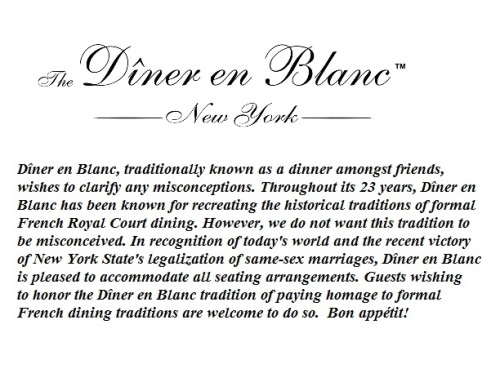
For those who missed it, the Diner en Blanc matter has had a positive resolution, in that there is no longer an additional burden on queer couples wishing to register for the event. Am I still less than pleased with the phrasing or the suggestion that our existence inherently mars the tradition of a social occasion? You bet. We’ve always existed, and seating arrangements have only really become the end of the world in a world with so many other lost formalities.

I do a lot of things where this stuff comes into play, social and historic dance among them. Patty and I have registered for gender balanced balls with me as the man, worried about how it would go, and then it’s always been fine and without remark. Always. But one still has to go through the explaining your situation politely and being told no and then they worry and plan for what to do when you sneak around the rules anyway and it isn’t fine. The worst part, really, is that I get it — in dance you need a good balance of leads and follows; in historic dance you arguably want to recreate what you are romanticizing about the past.

But the past totally contained people like us, even if the terminology was different. Yes, the level of knowledge and response to homosexuality was varied from social circle to social circle, but that’s not actually particularly different to today, although the word “out” and most terms currently used for sexual, romantic and gender identity are anachronisms in historical discussion. But the fact is LGBTQ people have always been invited to dinner parties, and so the idea that we’re interrupting tradition, when tradition is just history, and history is filled with queerness — well, it’s a little tiring.

That said, Diner en Blanc did the right thing in the end, even if clumsily, and we’ll be attempting to register today.

I should also note that today is photography day for “A Day in Gay America.” So get out your cameras.

Meanwhile, I’m very briefly off to Boston tomorrow to see one of my creative collaborators perform, with the hopes of getting back to a possibly dry NY early Sunday so that Patty and I can picnic in our new backyard.

Finally, I owe you some writing about Torchwood. Through episode 3 I was bored, episode 4 made me angry, and episode 5 made me wonder if they were up to some seriously sneaky (and brilliant) stuff in the midst of all their heavy-handedness. I am almost afraid to wait until after tonight’s episode to write about it, simply because any answers that come our way in the episode may make it less interesting (and my theories less clever, but if you’re long-time fans of the show, I think/hope this is all going somewhere that’s weird, gnostic, about the nephilim and “what’s moving in the dark,” and will addresses just what sins of his past Jack is alternately trying to mitigate or forget about). But I did say I would give it through episode 6 to comment at any length and so I shall.

Thanks to everyone who has picked up Bitten by Moonlight. I’ll try to post an excerpt from “Sanquali” and talk a little bit about the process of writing the sort of thing I never write (Italian AU werewolf lesbians!) this weekend.

Diner en Blanc: some accomodations aren’t that accomodating (now with a positive resolution!)

Tomorrow, registration for New York’s first Diner en Blanc begins, and I want to go, badly. It seems like a manifestation of so many things I adore: the power of cities and the cheerful clinging to things passing out of the world just a little too quickly.

Today, I received an email explaining how the registration process for the event will work. It contains the following sentence: “In order to avoid any discrimination toward homosexual couples, you will be able to register up to 2 tables at a time (2 men/2 women).”

At first, I could not parse its meaning, but after discussing it with friends and reading the rules, it seems to indicate the following:

Women must be seated on one side of tables; men on the other. Thus, a single individual may register up to two tables, so if they are gay, they can register themselves and their partner, and then two individuals to gender balance them.

This does not, however, prevent discrimination, as the email suggests. Rather, it places an undue burden on gay couples to find beards for the sake of gender balance. Our gayness is welcome, but only if it looks all nice and neat from afar.

Additionally, who decides what gender I am? Regardless of how I feel about my gender, the reality is I rarely pass as male in the US (I almost always do in Europe, it’s sort of weird), and since we’d be registering on my credit card would my very feminine legal name cause me not to get invited back as per the rules?

And I’m just genderqueer and ornery. How’s it going to go for trans people who don’t have legal name changes yet or who the organizers feel can’t pass? Will they not be invited back?

Diner en Blanc seems like a GORGEOUS thing, and I feel like I am most probably jeopardizing my potential participation in it by raising these questions. But an event that strikes me as about the ghosts of finer things should be not about the world as it was (and is) often cruel, but about the world as we have always wished it to be.

At the end of the day, I have to believe that people like me are part of our collective daydream; sometimes, in fact, it has seemed as if it is only in daydreams that we exist. So I certainly hope the organizers can figure out a way towards making our participation as easy and full of grace as the event itself strives to be. Because the current solution isn’t actually much of one at all.

EDITED TO ADD (8:40pm 8/11): An email from Diner en Blanc announces a resolution to the problem. A discussion of what formal dining traditions should be anywhere in this modern age, however, is probably merited.