Glee: When want is wrong

Perhaps the most amazing thing about the reference to lesbian bed death in Glee’s Whitney episode last night was that it didn’t fill me with rage.  In fact, it was actually pretty funny, served an interesting function regarding gender in the narrative, hinted at a number of off-screen details, and was something of another shout-out to fan concerns about how much time Kurt and Blaine don’t spend sucking face on our screens compared to the ongoing car crash of PDA in Finn and Rachel’s relationship.

In case anyone reading this first heard of lesbian bed death from Kurt Hummel (an idea so hilarious to me, that I beg you to confess in comments if this is the case), let’s talk about that dreaded phrase, which does get used both within and outside of the lesbian community, even though Kurt does get the definition more or less right. 

The idea is that sex leaves relationships between women and that the blame there sits with presence only of women in those relationships.  More specifically, lesbian bed death as a phrase is a symptom of people not necessarily believing that what women do in bed with each other is sex. How, many people wonder, can desire be maintained with out male sexual assertiveness, or, to be really direct, the presence of a penis?

This is absurd, mostly (and we’ll get to that mostly in a minute — it’s important regarding Kurt and Blaine). For one thing, the presence of sex ebbs and flows in all relationships for all sorts of reasons; anyone who’s been in a long term relationship knows this. 

And it’s hardly surprising that Kurt and Blaine haven’t had a lot of time for making out or anything else when Blaine’s been injured; the situation with Dave Karofsky happened; Kurt’s preoccupied with NYADA; the Finchel marriage drama has exhausted everyone; Quinn was seriously injured; and Blaine’s been super emo about a ton of things, including the stress of having his brother around. So really, Kurt and Blaine are experiencing a normal adult couple thing like the teenagers they still are. 

That Kurt is worried enough about the situation to apparently Google around to find the phrase lesbian bed death is hilarious though, and really shows one of the ways he’s been growing up about sex and relationships.  And yes, I firmly believe Kurt found this one on the Internet. 

Because Kurt explaining it to Rachel means she wasn’t the source; and if Santana were the source (the only other source that makes sense), that would have been all over the school long before Kurt and Rachel have their little chat. Who else at WMHS would have likely shared that phrase with Kurt?

But as absurd and offensive as the lesbian bed death idea is, one thing that can actually be hard about relationships between women, at least in my own experience, is that a lot of us receive significant training to never, ever be sexually assertive.  Certainly many of my female friends who are attracted to women lament situations in which no one is willing to make the first move before the relationship starts, and no one feels fully confident initiating sexuality once it does.  Obviously, this isn’t just a lesbian problem, but it is a real thing we do talk about.

Which brings us to Kurt and Blaine, gender, and that fandom favorite of “who’s the top?”  While that who’s the top conversation has always been a mess — confusing terminology about sexual positions and terminology about BDSM activities with ideas about sexual assertiveness (the whole thing is just a morass) — that conversation happens for a reason: among other things, people want to know who takes the sexual lead between these two boys who are both private and shy about their sex life, even, it seems, with each other.

Because Kurt is associated by others with the feminine so often, people have generally, stereotypically, expected him to want his partner to take the lead.  When Blaine showed up in season 2, that suspicion seemed confirmed, until Blaine started talking about never being anyone’s boyfriend and Sadie Hawkins and then demonstrated his desire not just for approval, but to be courted.  And once that happened, things got murky.

The murkiness, frankly, has been good, because relationships are complex and as a random Tumblr meme says, asking who’s the boy (or girl) in a gay relationship is like asking which chopstick is the fork. It’s not really a question that makes sense, unless a particular couple wants it to because of dynamics they enjoy.

But the murkiness has also suggested the possibility that neither Kurt and Blaine seem to feel particularly comfortable initiating sexuality between them.  Other than the first time Kurt and Blaine kiss, most of Blaine’s attempts at being sexually assertive end in disaster (Jeremiah) or involve alcohol (Rachel, Kurt at Scandals).  When Kurt tries to discuss whether Blaine wants him in “The First Time,” he’s utterly uncomfortable once that hilarious discussion of masturbation begins.

But none of this is really surprising. 

Just as women are often trained not to express their sexual desires or make the first move, gay teens (and especially gay boys who don’t have the advantages of the level of platonic touch that is socially acceptable between women) are also trained not to show desire.  It’s not safe, polite, or well-received. It is an insult to want.

How many times has Kurt been scolded for having a crush or pursuing so much as a conversation with another boy because of how it will reflect on that boy?  And Blaine arguably had the actual desire to make the first move beaten out of him with what happened at the Sadie Hawkins dance.

That Kurt and Blaine are experiencing anxieties around sexual activity as generally discussed in the context of women makes perfect sense, and shouldn’t actually be feminizing at all.  Yet, because of the way gender comes into play around both characters so often (especially considering the evolution in Blaine’s choices regarding female empowerment songs — first he’s having kept woman fantasies (“Bills, Bills, Bills”) and now he’s telling Kurt he can pay his own way (“It’s Not Right, but It’s Okay”)) a perfectly reasonable problem they’re encountering for a number of not unexpected reasons becomes once again about Glee‘s ongoing examination of how queer men are, and sometimes are not, perceived as men by both themselves and the world around them.

Ultimately, what’s hard about this for me as a queer viewer with a female body and a female partner, isn’t actually that dread reference to lesbian bed death.  What’s hard is that lesbian sexuality is used so often not as a subject unto itself, but a side note to explicate the sexualities of others. 

I joke a lot about how I connect so much with the Kurt and Blaine storyline in part because Patty is so the Kurt to my Blaine (go on, ask me about the time she went to eight stores looking for a limited edition McQueen-inspired nail polish that was sold out everywhere). But I also connect to their storyline because of their chemistry (which I’m only really starting to see between Brittany and Santana) and because their anxieties are often mine.

The lesbian bed death comment underscored that, because it underscored the doubts Kurt and Blaine have both been trained to have on how acceptable their desire is.  Those doubts are what made Sebastian interesting to Blaine earlier in the season, and Chandler interesting to Kurt now.  Open expression of want is hard to look away from when you’ve been told you’ll never hear it and that you shouldn’t engage in it yourself.

Homophobia has a lot of costs — many of them big, public, frightening and violent.  But “Whitney” also shows us one of the small costs of bullying, violence, homophobia, and misogyny in its treatment of Kurt and Blaine by showing us just how hard it is to carry on a relationship when you’re still learning that it’s okay to love and it’s okay to want and it’s okay to have.

It’s remarkably deft.  Now if Glee would just acknowledge that lots of girls of every stripe — cis, trans, and metaphorical — like and have sex too, we’d be golden.  But that can probably really only happen once characters graduate and start escaping Lima; at WMHS femininity (which is generally defined as performativity) is always punished, early and often. 

Just ask Quinn Fabray who has to put her gender on every day. Or Rachel “man hands” Berry who is punished for not being enough of a girl precisely because she is a girl. And how about Mercedes Jones who gets called lazy for being the size and shape typical of far more American women than not? Or Blaine who so often seems almost guilty over how he constructs and is rewarded for a masculinity he doesn’t seem to feel? And what about Kurt Hummel, who never asked for grace and sorrow and a kingdom of dead things he didn’t choose to pull him from the world of men.

Looking at it that way, lesbian bed death, even as it sort of explains it all, is really the least of the reasons no one at WMHS really enjoys being a girl.

Struck by Lightning: Once upon a time there was a boy

Chris Colfer’s Struck by Lightning is an odd little gem of a film that suffers more than a bit from being excessively clever, too personal, and uncertain about its relationship with magical realism. But it’s this unevenness that’s made it linger for me — not because of the film it could have been, but because of the way its flaws make it feel so true.

Which isn’t to say SBL isn’t laugh-out-loud hilarious.  It is, and I lost a lot of lines to audience laughter.  While some of that was the nature of a highly responsive audience, the screening being both the premiere and filled with fans, I think that’s going to happen once the film is in general release too.  I’m going to have to see it again just to catch some of the zingers that I missed.

But it’s its quiet moments that work best. Like his acting, Colfer’s script is at its most adept when it’s listening and forcing you to live with the spaces in things; sometimes stuff is so terrible, there’s really nothing to say.

Scenes between Carson (Colfer) and his mother (Alison Janney) and Carson and his grandmother (Polly Bergen) are some of the best, although Carson has two big angry blowups at school that are somewhat agonizing to watch. They’re the righteous tantrums most of us who were bullied outsiders in high school probably fantasized about having, but instead of being moments that lead to change and victory they’re just met with a sort of stunned and exhausted silence.

Moments like that make watching the film feel profoundly personal but deeply murky; the temptation to decide the film contains truths about either Colfer’s life or our own is high and unpleasant, and a central conversation about the nature of ambition (someone has to be wildly successful, why shouldn’t Carson dream and work for it to be himself?) is both immensely truthful and feels weirdly naive. It’s a moment that should inspire a younger viewer and perhaps inspire regret in an older one, but it’s also awkward; because of who is in the scene it also reminds of us just how often we don’t like people who want things, or get them.

Ultimately, SBL has a great deal of compassion for people who do horrible things: a cheerleader who is cruel, a mother who sabotages; as well as for people it paints as cowards: the boys who won’t come out, the father who explicitly tries to forget his first family by neglecting to mention them to his second. It also gives us, briefly, the internal voices of the cardboard cutouts that were often the avatars of horror in many people’s high school experiences and makes them as human and lost as anyone else’s.

SBL also gives us a story about friendship that could have been ruined by veering down a “weird girl has crush on outcast boy” path. That alone is remarkable, but in keeping with a film that’s all about desire, but — for all it’s discussed — is almost never about sex.

Ultimately SBL is a very funny film about the beauties of sadness, desire and anger.  It’s neither a perfect film, nor a happy one, but it is a little victorious regardless of whether you choose to have a Watsonian or Doylist experience of it. Despite, or perhaps because of, that it also lingers like a burn and raises one particular question that can’t help but feel terrible to me: what would have happened to Carson if he hadn’t gotten out of Clover in the way he did?

Glee: Authenticity, Play and Adulthood

No matter how low the expectations or interest level many of us had for the promise of Glee doing disco, the fact is what seem like the biggest throwaways on Glee are often the episodes that matter the most. Some of this is because these episode are often the knitting — closing up plots and setting others in motion — but a lot of it is actually because Glee is a better show when it’s sneaky, and this ridiculous episode is mostly very, very sneaky.

Because at its heart, “Saturday Night Gleever” is about authenticity and arguing about authenticity.  It has to be, because it’s about disco, and that’s what disco makes us do. Because while Will Schuester can talk, relatively correctly, about Saturday Night Fever being the story of a working class guy finding himself, that argument ignores the degree to which disco was, and continues to be, criticized for being more contrived and less inherently meaningful and authentic than the musical and social periods its sandwiched between. 

By encouraging the kids to explore disco, Schuester is providing another not-getting-it teaching moment even if the kids don’t really have the conscious reference points to even know why they’re saying, “disco sucks.”

But no one on Glee has ever had to actually know what’s going on for the show to tell its story (remember, Blaine has no idea what he’s doing… and neither does anyone else), and so it’s absolutely a story about authenticity we get. Most obviously, that shows up in the Wade/Unique plotline which gives America some vague introduction to trans or genderqueer issues without actually using those words and just hinting, somehow, that this is something other than drag.  (I am, as an aside, desperately curious as to how that read to an America that knows about drag but otherwise hasn’t gone beyond binary at all.  Can anyone help me? because I have no idea).

Kurt’s mystified and uncomfortable, but that’s honest too — he didn’t handle bisexuality well either and queer identities outside of his own have always been difficult for him, which makes all the lovely, playful cuts to him and Blaine dancing together during key lines of “More than a Woman” immediately following the discussion about Wade’s/Unique’s identification particularly interesting.

In fact, Kurt’s reaction to Wade and Unique’s performance is also fantastic in how it recalls us to Kurt’s initial reaction to Rory’s falsetto (he was annoyed, because Rory was playing at what Kurt can’t avoid). It also helps explicate some of Kurt’s probably likely feelings behind his own part in the “disco sucks” moment.  After all, it’s a genre which Unique finds a way to own without it being play but something more fundamental, while Kurt is probably stuck feeling irritated, at least if New Directions is as clueless on the difference between falsetto and a countertenor as much of fandom seems to be.

But as Kurt grapples with authenticity around identity and voice (which is a bit shocking since he’s always been our beacon of authenticity), let’s remember that authenticity is also on display for Santana, who wants what she wants at any price; Finn, who wants to stop being told what he wants because he doesn’t want to pay the price of adulthood; Brittany, who isn’t actually playing a game at all (she’s really the way she is, and she can show us the MRI if we don’t believe her); Rachel, who really only wants Finn to find his dream so it can confirm hers; Mercedes, who just wants to be done with WMHS; Schue who who really is a bit like a grown up Jesse St. James because he can’t hear anyone talking over the sound of his own issues (as he demonstrates himself to be an authentically bad ally to Santana and all the WMHS queer kids); and, of course, Blaine who just really, really wants to be liked as much as he likes everything around him.

But while the glee club is on a quest to find itself, most of what we’re witnessing is play, with numbers segueing in and out of heightened realities, dream sequences, and random fantasy moments. Very little of it is real, but that’s hardly surprising, because the kids are mostly still kids, and aren’t out in the wider world yet. 

But the things the kids are playing at with all sincerity — Santana’s devotion to Brittany; Blaine’s ridiculous heart-eyed trust for Kurt in particular — are there not just to make us coo with delight (it was an often adorable episode), but to set us up for all the grown-up stuff that’s about to come crashing in on them in a way that shares at least some similarities with the Finchel storyline.

Grownup relationships in the grownup world are hard. And while the Finchel problem comes from wanting to be too grownup too soon without doing the grownup work of communication and knowing the self (which is to say the Finchel relationship may be showing us a real thing that happens but remains internally inauthentic), the Klaine and Brittania problems are going to come from that “no one can touch us” thing both couples think they’ve got going on. 

Freedom, distance from Ohio, and other people like them — pretty much everything that the gay kids pin their It Gets Better dreams on — are all also about come with their own headaches, betrayals and questions about the self. I suspect those issues, which will also help set up some of the season four themes, will be on full display in the next two episodes. 

From here on out, odds are nothing is funny, and the characters who know themselves will continue to school those who don’t, much as Wade/Unique does to Kurt. Authenticity will win the day (we’re looking at you, NYADA auditions), but some people will graduate still not realizing just how much they’re lying to themselves (hey there, Finn) while others will increasingly be shown to have it even less figured out than already revealed (oh Blaine, if only Cooper was your biggest demon).

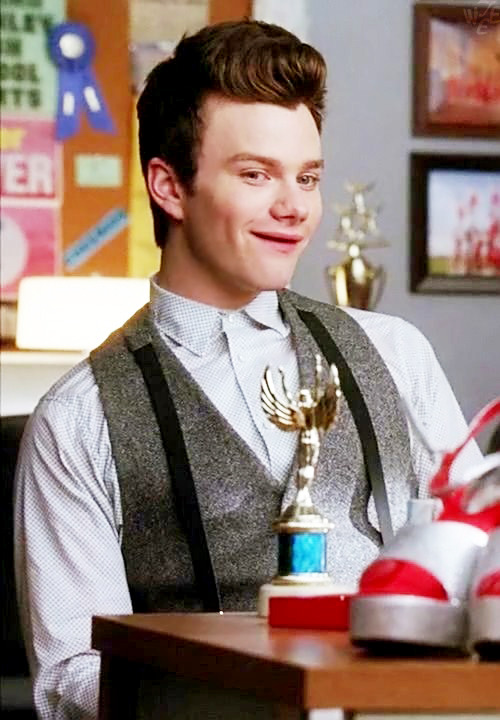
Mostly though, for an episode with lots of delicious detail and micro-continuity glory that will probably matter more to the arc in retrospect once the season ends than we realize now, this episode was just painfully, painfully fun and has fandom asking all the best questions — like just what (or who) was Kurt thinking of when he eyed those sparkly platforms Sue wanted sent to Wade/Unique?

But all long-legged fantasies aside, fandom’s right, of course, that those platforms matter. Look at the composition of the shot, with the cheerleading trophy showing a female figure with wings (evoking faerie, again) in front of the glittery shoes.

Because let’s remember, the ruby slippers only became such for the film, and that Kurt’s always enraptured with his possible idendities in Oz. If home isn’t a place (and there’s no place like it), as Rachel tells Finn, but a person, isn’t the most fundamental home oneself? There’s that authenticity question again, this time sparked by Kurt’s sense of play even about serious things, that reminds the audience in a small, graceful and almost kind way that the people we pretend to be matter too.

(p.s., I use Wade/Unique throughout this piece because the character presents us with two identities and is dealt with throughout the script as such. It may be that we should be using Unique and female pronouns at all times; it may be that Wade/Unique is bi- or other gendered in a way where that might not be the best answer either, and I don’t feel comfortable making that decision when it’s intentionally unclear in the script, and I suspect the character and the related identity questions will be back soon, possibly with more clarification.  And yes, as usual, I have a theory).

Glee: Someone wants your thinky thoughts

Since this has been showing up in my mailbox and comments for the last 24 hours, I thought I’d spread the word for the interested on this call for submissions for a scholarly anthology related to Glee.

The Fox television series Glee is nothing short of a phenomenon—hit show, sell-out concerts, extensive merchandising, chart-topping hits (eighth in digital sales), and a very passionate fandom. Glee is also simultaneously celebrated and disparaged for its tackling of timely cultural topics, such as bullying, coming out as gay or lesbian, and teen pregnancy. Much of this blurring of praise and derision centers on the program’s representations of gender and sexuality issues, like those previously mentioned.

This collection aims to illustrate how multiple fields of study inform, shape, challenge, and/or complicate gender and sexuality representations on Glee.

The varying types of diversity represented by the characters featured on Glee, as well as the ensemble cast portraying them, provides the opportunity to examine representations of gender and sexuality from multiple perspectives.

Deadline for abstracts is May 15, and the full call can be found at the Lambda Literary site.

8: Realer than real

I’ve been watching the big star-studded benefit performance of 8 in bits and pieces since it was performed and broadcast on the Internet. I’ve been fighting not just against time zones and travel but a series of remarkably spotty Internet connections to do so.

Obviously, the piece is interesting to me for what it is as its core – mostly actual text from the Prop 8 hearings. While the transcripts are accessible to the public, video of the proceedings has not been and really, who reads transcripts like this anyway? Sure, we all know someone who does, but the fact is most of us just don’t.

What’s really interesting to me about 8 – other than that it exists and that the cast of this particular performance involved enough A-listers (among others) to command some serious attention, is the way it straddles the line between fact and fiction, and the way it reminds us, constantly, about both. 8 is relentlessly knowing about its content and the context of the stars who have performed in it.

I also know that it being a staged reading can throw people. Why don’t the actors know their lines better? and Ugh, I can hear them turning pages. I’m by and large no fan of staged readings myself. They’re a useful vehicle for some material and often enjoyable, even if I personally prefer a more immersive experience when I got to the theater.

However, in the case of 8, I love that it’s a staged reading, because it reminds us, at every moment, that these are the words of real people, not characters, that we are hearing, and that the documents exist for us to find life and truth in. It also means that every moment on stage reminds us that this is what we were not allowed to see.

8‘s casting is also fascinating and chilling. I’m only talking about the recent benefit performance in Los Angeles right now, but watching Jane Lynch (who is openly gay) portray, with a truly ferocious anger that’s as frightened as it is frightening, a leader in the anti-equality movement is just about one of the most wrenching and exhausting things I’ve ever seen.

And while it’s humorous in its way, Lynch in such a role is also a sneaky nod to the suspicion that many of us have that at least some vehemently anti-gay individuals may be struggling with their own experience of same-sex attraction and taking it out on the rest of us.

So 8 is a weird animal. It’s largely a preaching to the choir show that tells us nothing we didn’t already know, at least in the abstract. Were there any surprises in Chris Colfer’s performance as Ryan Kendall, a witness in the case who was enrolled in reparative therapy by his family? No. But did I feel shocked and unable to breathe during those two and a half minutes he was on stage anyway? Yes.

On some level, 8 may be a more effective tool than the video of the actual proceedings we’ll never get. Because 8 is not just an act of information, but of protest, and it makes the courtroom environment as vibrant and dramatic as most people expect from TV but quickly learn it rarely is in non-fiction life after an experience or two of jury duty.

8 will go on to have performances with celebrity casts in other cities in all probability, as well as be performed in smaller cities and towns and colleges as an act of information, protest and fundraising, much as The Laramie Project and The Vagina Monologues have been and continue to be. There is also talk of it being turned into a film.

What I’m curious about is what 8 can do beyond preaching to the choir (and raising money). Do you know anyone who has watched it and gone from silent support of equality to activism or contribution? And more than that, have you seen it change anyone’s minds? I’m really curious to know people’s personal experiences with it.

Meanwhile, if you haven’t seen the Los Angeles performance yet, it is currently available online for the next few days only. I’d urge you to check it out, even if you are already deeply familiar with this case and its issues.

Berlin: Sex, death and pop-culture — not in that order

For better or for worse, I came to Berlin not particularly wanting to deal with WWII and Holocaust remembrance. With only 48 hours in the city, it seemed worse to do it in a slipshod way than to not do it at all. Besides, I tend to think those things are more for people who aren’t aware of them than for people who unavoidably are.

But what I discovered is remembrance is unavoidable in Germany and in Berlin melds with the city’s location in pop-culture in a way that’s both seamless and weird. Because this is not just a city that’s engaged, constantly, in the act of remembrance, but a city engaged, constantly, in a reenactment of itself as it was before, between and after the wars.

This reenactment is both a performance for tourists and a performance for its own residents. Berlin has been wrenched out of time by its own history repeatedly, and it seems even the people who live here are constantly trying to catch up to moments that were stolen from the city.

So no one told me the Brandenburg Gate would be like Hollywood Boulevard, with people in costume charging fees for tourists to take pictures with them. From Mickey Mouse to Berlin’s bear mascot, to a number of military reenactors in uniforms of multiple nations (the exception, of course, being anything from the Third Reich), it’s all out there.

But perhaps the most inappropriate (but to be frank, I laughed out loud, it was so brilliant in its inappropriateness) was the dude dressed like a Stormtrooper. You know, like from Star Wars? But if you don’t get it, go Google. I’ll wait. The street dance team doing a routine to the Chariots of Fire theme was also pretty amazing in terms of Berlin’s bizarre intersection with the pop-culture world.

But for all the milling around and weird party atmosphere of the Gate, it’s still impossible not to notice things like the Room of Silence tucked up off to the side or the Eagle atop the chariot atop the Gate, or all the signs pointing to all the things you might possibly want to see: like the Reichstag, or any number of Holocaust memorials, including the Memorial to Homosexuals Persecuted Under Nazism.

That memorial itself is in the Tiergarten, right on the edge, and it wouldn’t be hard to find, except the sign is at a funny angle and I didn’t know what I was looking for. I actually found it by accident, thought I hadn’t, and only figured it out when I doubled back.

Why couldn’t I figure it out the first time? Well, the Memorial has been graffitied with the words, Smile. You Are Beautiful. That’s much better than all the times the glass on the side of the memorial that allows you to view film of same-sex couples kissing has been smashed.

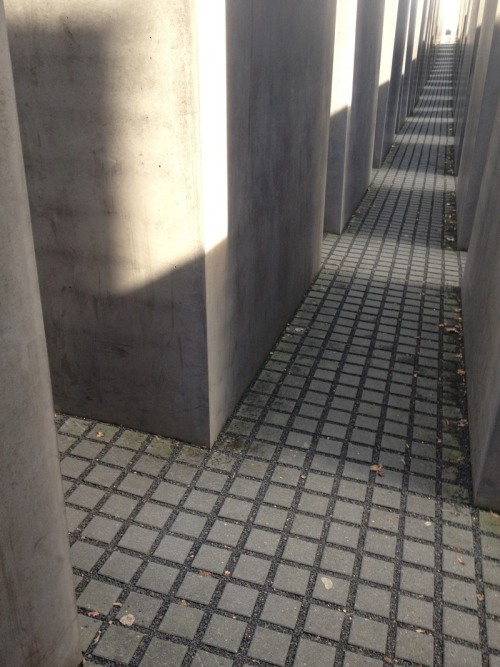
The seal having been broken on my attempt to avoid memorialization and my realization that this is a topic I should care about, not just as a Jewish person and a gay person, but as a person who is deeply engaged with communal ritual around death and that ritual being used as acts of claiming, I also visited the Memorial to the Murdered Jews of Europe, which I also saw referred to as the Field of the Stelae. It’s a brilliant memorial, in that it is striking and evocative not just of death and remembrance, but of a sense of fear and oppression. When you get deep down into the field, you never know when someone will come around a corner; you never know what will happen.

But here’s the thing about the stelae — people play there. They leap from stone to stone. Children run and screech and play hide and seek in it. Lovers use it like a maze and chase each other for kisses. And it may seem wrong if you’re not there to see it, but it feels like a great good thing, at least to me.  But it is weird.

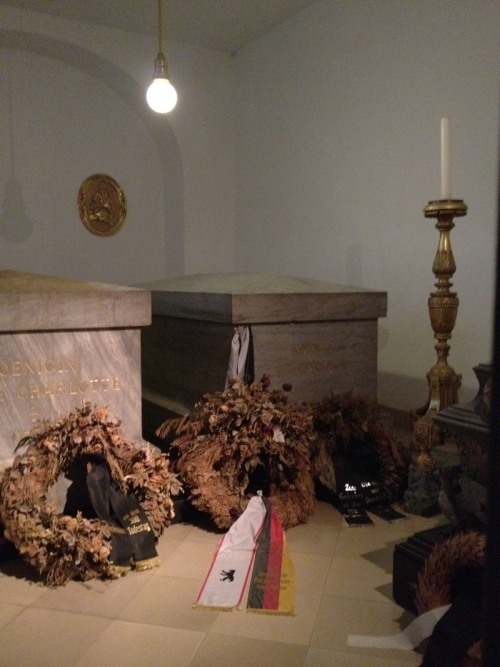
Eventually, after wandering several markets, the National Memorial for the Victims of War and Tyranny, and the crypt at the Berliner Dom (I have been to the Santa Maria della Concezione dei Cappuccini in Rome, and I have never been in a city more of the dead than Berlin), I was fresh out of cope and went back to my hotel before my 9pm reservation at the Kleine nachtrevue.

The Kleine nachtrevue views itself as traditional German cabaret, burlesque and erotic artistry. While I can’t speak to its authenticity, I can speak to the fact that the audience was about 80% German, mixed in terms of gender and sexual orientation, and that burlesque in Germany involves a hell of a lot more nudity (seriously, I saw a great deal of vulva last night) than it does in the US. Performances ranged from comedic strip teases to fully naked, ritualistic ballets.

There was also singing, lip-synching, gender illusion, BDSM content, and trans bodies on stage. Everyone was charming, I got adopted by a random hen party from Glasgow, and the first number of the night was to “Roxanne” from Moulin Rouge. Sometimes the world rewards you for being exactly who you are and this was one of those moments. Other pop-culture references in the performances included everything from Benny Hill to David Bowie to the Rocky Horror Picture Show.

At the end of the night the whole audience sang along in German-accented English to “Falling in Love Again.” And there was nothing, nothing at all, that felt incongruous between the beginning of my day and the end of it. Smile. You Are Beautiful.

My flight out is at nine tonight, and after I write this I’m going to go see more things and watch more people. If you get a chance to come to this place, you should. It’s hard, but Berlin knows that it’s hard, and it will hold your hand through the worst of it and tell you, you are doing so well. Promise.

Glee: Being a girl is something that happens to you

If you follow me on Tumblr, you know I’ve had a not so secret desire to write a post here entitled “Kurt Hummel is Totally Having a Baby” ever since we were treated first to his crack about he and the girls not getting their periods until the end of the month. It was something which was only moderately funny until it was followed up in the Valentine’s Day episode with his shout of “tin roof rusted” during “Love Shack.” If you don’t hang out on Urban Dictionary, or aren’t of a certain age, I am here to inform you that, that particular non-sequitor has come to mean unexpectedly pregnant.

But what in the world could this particular bit of hilarity (which arguably started with Sue’s rejection of Kurt’s sperm during the opening salvos of her baby quest) possibly mean other than another excuse for me to argue that Glee, which is often criticized for continuity problems, has some of the best, if most peculiarly detail-oriented, continuity on television?

Odds are, probably nothing, but it did get me thinking about the ways in which ideas of obstruction and control are structured around gender on the show. Because in the world of William McKinley High School and Lima, Ohio, women — or more accurately, femininity — is punished early and often, usually by events that, rightly or wrongly, come as abrupt surprises to the affected parties. For the women, and the femininely associated of Glee, it’s tin roof rusted time all the time.

Quinn is probably the woman on the show most severely and obviously punished this way. While the possibility of pregnancy and the risks of texting while driving are arguably obvious to those of us sitting at home watching TV, they’re not necessarily obvious to a 17-year-old girl living in an environment where she’s sure the greatest thing she will ever accomplish is captaining the Cheerios while she dates, among others, a guy who thinks he got her pregnant via a hot tub.

Quinn’s pain may not really have external sources, but it seems so to her, and it certainly takes her by surprise over and over again.

Santana is another woman who gets hit hard by surprise. In her case, it’s in the form of outing, not just because Finn fights back when she starts in on him, but because what Finn says gets overheard and amplified in a way no one could predict. It’s not that it’s all over school, or all over town; it’s that it’s all over the congressional district.

Kurt, too, who is identified with and identifies with (but not, seemingly, as) the girls he socializes with, also experiences misery from unexpected sources: even when he seems used to the dumpster-related bullying of the pilot, he’s still startled when Dave slams him into lockers, knocks that cake topper from his hand, and, of course, kisses him. There’s little there, in his father’s heart attack (which positions him as an even more obvious care-taker), or in his election to the post of Junior Prom Queen, Kurt could possibly see coming (unless Kurt’s an Ugly Betty fan, in which case he should have totally had a clue).

Blaine, despite the passing narrative that surrounded him early in the season, and which I suspect we’re not done with yet, also has this femininely associated experience. Not only is there the Sadie Hawkins backstory, but the turn Sebastian’s predatory actions take is one he literally doesn’t see coming, and both sets of events clearly position Blaine as someone terrible things no one can prepare for happen to. That’s what it means on Glee to be a girl.

These sorts of events, and others (Brittany experiences “alien invasion;” Sunshine gets sent to a crack house; Beiste has her boyfriend stolen by Sue; and Rachel, even when nothing is wrong, is often convinced she is being actively obstructed by external forces she cannot effectively respond to) along with the agency feminine and femininely-associated characters are often denied on the show through circumstance, tells us something incredibly grim. But it is something that, I think, is in keeping with the idea of despair that the show has painted around the concept of Lima as a place to escape from, even as it claws at your ankles in every moment you’re busy trying to get out: to be a woman is to have things done to you and the only choices you have aren’t about changing those things, but merely about how you respond to the consequences.

And so we see Quinn beg, borrow, and engage criminally around access to her daughter. We watch Santana blackmail Dave into creating a quasi-safe closeted space for them both. And we watch Kurt bend not bow to circumstance, over and over again; often by keeping secrets and accepting, no matter how angrily, that pain is something he’s going to have to necessarily live with.

Really, it’s one more way in which Glee talks about consent issues without really talking about them, and it contrasts pretty markedly with how the pain the men on Glee experience is shown.

Because, while it certainly doesn’t make the pain less, the level of surprise when it comes to masculine pain on Glee, tends to be low (although this is not nearly as constant as the degree to which the female characters get hit with surprise!).

Puck gets sent to juvie because of his own choices; Will Schuester faces career dilemmas; Finn Hudson is in agony about a football scholarship he had to know he was never a shoo-in to get; Mike is in pain about parental disapproval that is anything but news to him.

But pain, and a lack of hope, for the guys of Lima is expected, and things only ever go really pear-shaped and get really scary when the unexpected befalls them, because its horror compounded: pain plus the suspicion and taint of stereotypical femininity — helplessness — implied by the mode of its arrival.

Certainly, we can look at what happens with Dave in “On My Way” and his response to it as particularly emblematic, not only of this dichotomy, but of the transitional and liminal spaces the show’s gay male characters often occupy in regard to these gendered modes of punishment, while the queer female characters remain firmly placed amongst the feminine, which is both an interesting comment on where women are in the privilege hierarchy and also frustrating for me as a gay woman who is not consistently femininely-identified.

As a guy who is both closeted and could pass as straight even if he weren’t, when Dave gets hit with the public, wide-spectrum discovery of his homosexuality, he loses the privileges not just of heterosexuality in the world, but masculinity in the structure of Glee. Things happen which he does not anticipate, he is beset by external forces, and his situation goes explicitly from that of someone who formerly executed his pain upon others, to someone things happen to.

The scenario is arguably as feminizing to him as the word scrawled on his locker in pink spray paint. After all, the public response to his homosexuality arguably convinces him of the thing his internalized homophobia and closely linked misogyny had probably been suggesting to him for a long time — that to be a gay man, isn’t to be a man at all (something not true, but seemingly true even to some of the most enlightened in Lima).

Dave responds to this by attempting to reclaim masculinity and control in the only way he can imagine at that moment — he dresses in a suit (reversing the change from monster to individual complex human in his revelation to Kurt, by explicitly recostuming himself, this time with masculinity) and trying to kill himself.

It’s a grim narrative, not just for Dave, but for everyone trapped in the stories Glee is telling. Those with feminine associations have come to expect that terrible things will happen to them to the point that they almost shrug many of these occurrences off; while those with masculine associations have become convinced that the worst thing in the world is to be a girl. And it’s a belief which isn’t just about misogyny in the world of Glee‘s Lima, OH, but also, seemingly, about common sense, which is what makes the cycle of belief illustrated so insidiously difficult to break.

As the senior class of 2012 at WMHS gets ready to graduate, I feel like I need a score card for who says in despair, “I knew this would happen” and who says in shock, “I don’t understand how this could have happened.”

In the second column? I’m expecting a check mark for Rachel Berry when she doesn’t get into NYADA.

Glee: A pause and a brief note about warning cards

One of the things I try not to do here is write too many posts about what I’m going to write about, as opposed to just writing the posts. And wow, what a terrible sentence that is to untangle.

But so much of what I want to write about regarding tonight’s episode of Glee is material that was in the smallest of details.

I want to talk about how the broadness of the show’s borrowed musical form means that much of the writing is done not by the writers but by the costumers and set dressers.

I want to talk about Blaine’s gender identity, again.

And I want to talk about, as I suspected I would have the opportunity to a few weeks ago when tonight’s narrative seemed to be coming down the pike, Kurt’s relationship with Death.

But it’s really hard to do any of those things without first acknowledging that tonight’s episode contained some very powerful and surprisingly visceral content regarding teen suicide. If you haven’t watched it yet, be aware that what is shown is more intense, and arguably graphic, than what I think we’re generally inclined to expect out of Glee.

I’m glad the show made the choices it made around the topic, even when the results of those choices sent messages (if stories send messages at all) that can be considered murky. I happen to like murky stories and while this was what we call “A Very Special Episode,” it still wasn’t an after-school special, so it worked for me. But quite understandably, everyone’s mileage may vary extremely widely on this one.

Because I want this to be a conversation somewhere other than Tumblr, it’s worth noting that the episode in which the show’s two main couples — Rachel and Finn, and Kurt and Blaine — lose their virginities received a warning card about its content that was displayed before the episode began.

The losing of said virginities in that episode, for the record, included a few conversations about the obvious topic, one instance of the word masturbation, some fully-clothed reclining on a bed, a bit of hand-holding, and Darren Criss’s eyelashes.

It was the least graphic thing I’ve ever seen in my life. It was barely a metaphor for sex, no matter how well executed; and it certainly didn’t portray sex, even soft-focus TV-style fake sex.

But tonight’s episode, which contained one of the most shocking representations of suicide I’ve ever seen on screen? No warning card for strong content or suggestion that this might be an episode that parents want to watch with their kids.

I don’t love a lot of the restrictions that exist around television content. I also don’t love a lot of the discussions around the topic, although they are necessary ones; they’re just ones that I find hard to do while also trying to deal with stories largely from their internals, and this is a moment to admit that weakness.

But this lack of a warning card tonight, especially when compared with “The First Time”? Is jarring. What happens in the first ten minutes of the episode is the type of material I am used to seeing warning cards for before episodes of other programs. So why wasn’t it there? And why was it there in the least sexy episode faintly about sex ever? Because I’m used to sex-related warning cards too, but not for content like that presented in “The First Time.”

Obviously, those questions are rhetorical, and we can all guess the answers (or discuss them in comments). But for now, I wanted to acknowledge this before taking some time to sit with the episode, because it brought home the thing that haunts me the most about the struggle for any sort of equality — not everyone gets to see the battle won, and that’s so agonizingly unfair.

In the next couple of days, I’ll write a few posts about some of the gorgeous detail work in “On My Way” that speaks to the themes I’ve been writing about here all season. But tonight, I need to pause, and I kind of need to say that I’m doing so aloud.

Glee: Following up – Blaine and gender; Sebastian, Blaine, Santana and race

Two quick Thursday afternoon followups to some of our recent Glee discussions:

First, the detectives over at CSI Tumblr have been having some fun figuring out what’s on Blaine’s bookshelf. Aside from toy robots and old film-based cameras, they’ve also identified some SAT study guides, a book on the American theatre, and what someone is pretty sure is a history textbook. That isn’t the awesome part though.

The awesome part is not only does he have Mockingjay, he has What If… You Broke All the Rules, a-choose-your-own-adventure book in which the reader is a teenage girl neglected by her parents who must decide which boy or fabulous group of friends to spend her spring break with.

Next to that? Official and Confidential: The Secret Life of J.Edgar Hoover. I don’t need to give you Hoover history here, do I?

The job of set dressers isn’t, really, to be ready for CSI Tumblr, but to make things look good at the level of detail the TV audience is supposed to see things at. That said, HD TV and digital fandom really changes the game, and I love that the folks working on Glee are not only hilarious, but seem to agree with me that maybe Kurt’s not the character we should be asking gender identity questions about. Blaine passes as a lot of things, and maybe that’s not just straight if he wants to; remember the Sadie Hawkins dance?

On a completely separate note, that does however touch on this season’s themes around passing, biyuti has written about Sebastian’s bad behavior and subsequent reactions in the context of race. Because, of course, it’s not just that he says unbelievably offensive stuff to Santana; Blaine’s not white (at least as of this writing, more on that in a moment) either, and while Dalton looks a lot more diverse than the private school I went to growing up, that still doesn’t mean that what’s happening with the power structures in this episode isn’t all about race too.

Meanwhile, for those who haven’t heard (and remember, this is not a spoiler-free blog), the very white Matt Bomer has been cast as Blaine’s brother for an episode airing in April. Considering that Glee‘s canon has glancingly acknowledged Blaine has having a non-white background (Rachel wanting to have his “vaguely Eurasian babies”), a lot of folks are head-tilting at this choice, especially when Glee has often used details of the actors’ personal lives in crafting character backgrounds (i.e., both Jenna Ushkowitz and Tina, the character she plays, are adopted). Stay tuned….

Glee: Gender, violence and power

While most of what I had to say about last night’s episode of Glee remains firmly centered around “Smooth Criminal,” which was just as creepy in context as out of it, I did want to briefly mention how intensely focused the whole episode really was on gendered types of violence and gendered responses to that violence, with most of it being in the realm of the feminine, despite most of the players being men.

The slushie meant for Kurt that Blaine steps in front of contains rock salt, which heats when it comes into contact with water and ice. This implies strongly that Sebastian’s initial goal was for Kurt to experience chemical burns, and it certainly evokes a type of violence generally directed at women by men and that the media tells us transpires because those women do not obey the wishes of those men.

This is violence about damaging the one asset these women are believed to have (appeal to men) and publicly shaming them through the lasting mark of that violence, and in Glee, it hardly represents the first time that Sebastian objects to Kurt both on the basis of the charms he holds for Blaine and for the degree to which he is not straight-acting.

That Blaine’s eyesight is then damaged when he engages in a traditionally masculine act (I’m sorry, Glee is broad, and I have to use a lot of normative gender expectations to take it apart) of protecting a lover, then serves to recode Blaine as the feminine, thanks to the long history of, as an anonymous user pointed out to me on Tumblr, blindness and blinding being used as a metaphor for impotence.

From there, we witness the strongly implied violence of “Smooth Criminal” in which both Santana and Sebastian are using sexuality in their duel, but in which only one of them, Sebastian, is able to successfully imply the perpetration of acts of sexual violence through that performance.

When Sebastian slushies Santana at the end of that number, the same form of violence against women by men seen in “Bad” is again evoked, but he doesn’t even bother with the rock salt this time; Santana isn’t worth the trouble, perhaps because her lesbianism in Sebastian’s eyes already renders her of little use to men, even, or perhaps particularly, to a predatory gay one.

Responses to this violence from the New Directions team is also highly gendered. Multiple people on multiple occasions talk about how the police won’t be interested in, or believe, what was done to Blaine. This includes, most notably, Schue’s attempt to minimize it in a kids-will-be-kids way and move on, and Kurt’s privately furious catharsis which later gives way to a brave-faced comment on rising above, largely because that seems to be the only weapon he has.

Meanwhile, Santana, we later find out, wasn’t actually trying to fight Sebastian on his own terms of overt sexual aggression, so much as she was both literally and metaphorically taking one for the team in order to get him to confess on tape. A woman fights a man by appearing to yield; it gets her close enough to do real damage.

This constant metaphor of rape and response to it in the episode is even underscored by small, seemingly throwaway lines, like Brittany saying, “I don’t know how,” when told to lock the door to the choir room. This is further highlighted by the contrast of Artie, who has been constantly used to explicitly define what masculinity is and isn’t this season, blowing up at Schue for his lip-service sympathy.

But outside of the near explicit implications of Sebastian’s actions, most of the episode’s masculine violence is metaphorical and unrealized from the dancing-fighting of “Bad” to Artie’s fantasy sequence.

Lima, OH is a world where people only dream about conventional forms of power and nearly everyone must accept violation. By bringing back the slushies, Glee‘s original iconic bullying instrument, in this form, Glee tells us that all of this bullying has been serious (and sexual) business all along, and that the worst thing anyone can be in this place is feminine and feminized; the problem, however, is that nearly everyone is. There are almost no men, and remarkably few honorable ones, here; the brutality of WMHS and of Lima don’t allow there to be.

Which is really why the ridiculousness of Quinn getting into Yale feels so good. She’s the character most explicitly punished for the feminine on Glee, and so she’s the first one victoriously out. Kurt, the character next most explicitly punished for the feminine, also has his huge NYADA finalist victory moment in this episode, in a way that, unlike Rachel’s victory letter, is untainted.

Glee has always been a story about a terrible place in which to be a girl, or gay, or disabled, or different in any way. That makes people angry often, largely because the show doesn’t tell us bullying is bad, but merely shows us it is awful and exists largely without correction. But as the adult world encroaches as the stakes get bigger, at least 3.11 reminds us that the powers that be know the only way up is out.

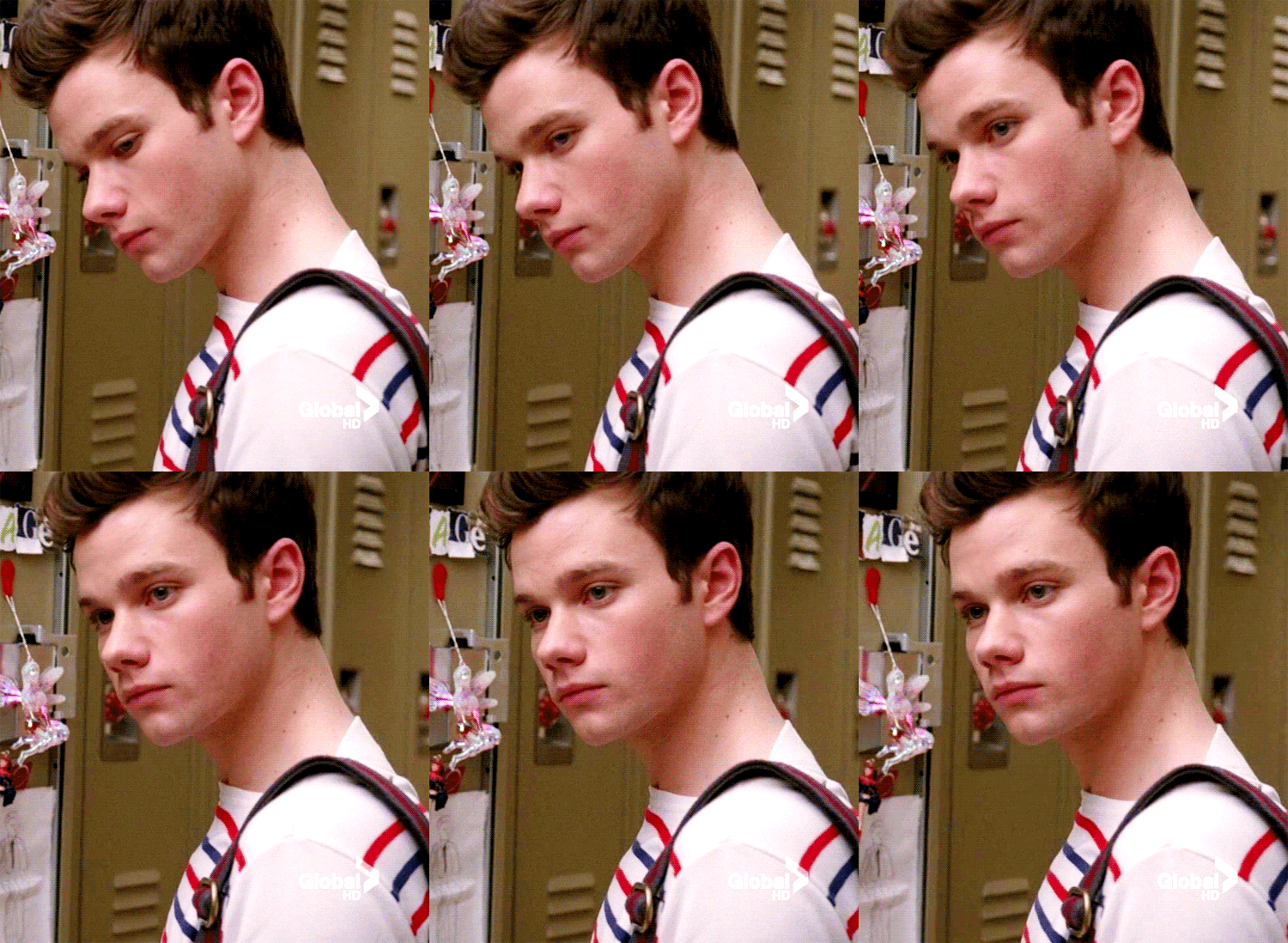
Finally, on an almost, but not entirely, tangential note, I just want to point you to the faerie trinkets that are currently adorning Kurt’s locker. Rae Votta, who also writes stuff about Glee and other pop-culture interests, pointed them out to me last night, and I haven’t stopped thinking about them since. They seem to be references queer, magical, and feminine, as if they are the small tokens by which Kurt, who seems to always be in exile from something (a dead mother, his straight friends, his horrible high school, his gay fantasy land, a still faintly out of reach New York City), always remembers who, and what, he is.