the vicious middle

When I was five I was invited to a birthday party for Sandra, a girl in my kindergarten class.

At it, I recall her giving out these brightly colored, chewy, things with a sugar shell. I have no idea what they were, but they were the most satisfying things in the world to sink my teeth into. Each girl got one candy, and when she got to me, she cut one in half and gave me half.

“Because you’re half,” she said.

It’s not the first time I can recall being bullied. But it’s the first time I can recall having no recourse. (When it happened in nursery school my friend Eric and I hatched a plan that led to us slamming the perpetrating kid’s arm in a toy refrigerator and doing a lot more damage than we had intended). That lack of recourse came from three main things:

1. I had no allies.
2. I had no one below me in the hierarchy through which to define a status for myself.
3. Sandra wasn’t wrong. Or, at least, she didn’t feel wrong to me. I was younger than everyone else. And smaller. And poorer. And less pretty. And more awkward. And I could never remember my vowels in the right order.

I think of this story from time to time. It’s definitely my go-to story for the “look, I’ve never really been sure I’m okay for the world” thing that I, like most people, walk around with.

But today I thought of it because of CNN’s mention of a new study that shows the more popular a kid is the more likely they are to bully unless they are are the very top of the popularity ladder. Sounds dead-on to me. How are hierarchies determined but through enforcement? The only people who wind up not playing are those who have nothing to enforce (those at the absolute bottom) or no need to enforce (those at the absolute top).

It occurs to me that this idea of the vicious middle can be extrapolated to a lot of things outside of the classroom. I’m sure it can be extrapolated to fandom, although I’m disinclined to try to map that out because I’m pretty sure those of us who play in those sandboxes can imagine the sort of reception that would get. But I’m also sure we can extrapolate to lots of other interactions where things transpire that are, or at least involve (in a larger context and agenda) elements of, bullying.

Sexism on the Internet is one, and the stuff documented at Fat, Slutty or Ugly (a website dedicated to showing the hateful crap female gamers are dealt pretty much constantly) is a great example. Here were have a place where a dudes who feel like they’re not at the top of the social hierarchy (because nerds and gamers are just two of many subcultures that, let’s face it, still get treated like crap for some pretty arbitrary and uncool reasons) and so when women (uncommon in the community by popular belief if not actual fact) show up, those men enforce what social position they believe they do have by being abusive to the theoretical interloper women, lest the tables get turned and the nerd dudes wind up one more peg down the board.

The current congressional Republican crusade against abortion rights (sure, they dropped the whole appalling thing about what’s “real” rape, but now we have the bill that says it’s legal to let a woman die rather than provide her with emergency care if that care would harm the pregnancy should that outcome be more personally comfortable for the medical personnel involved) also feels like this to me. This is true in the structural sense of the CNN-reported study — think about these congresspeople: big fish who aren’t big enough fish, who are striving, striving, striving, to stand out enough to be somebody with a name school children are obligated to remember and study; there is so much of the worst types of ambitious in politics, and it might hurt less if I were less sympathetic to that sort of pothos.

But this type of political behavior, conducted in this way on this issue, is also like bullying in the raw emotional content output and its subsequent reception, as when Sandra told me I was half.

Because I am half.

I am half to those people in Congress, half to those gamer boys I complained about in a Sassy article in 1991, half to girls who were mean to me because if they were better than me maybe boys would be better to them.

It’s all heartbreaking.

It’s also all terrifying.

Because all of us, sometimes (most times), are in that vicious middle. And hierarchy enforcement through bullying is second nature to most of us by the time we’re five or six or seven. And for a lot of us, it’s not just about unlearning a bad and unnecessary behavior, but unlearning behaviors that often have been necessary, because they kept us alive when we didn’t, and often, couldn’t fit in.

One of the theories that has come about in reaction to the findings of CNN-reported study is that the way to end bullying isn’t by addressing bullying with those who do it or those who are targeted, but with the bystanders and witnesses, the kids who aren’t in it today, but could be on either side of that equation tomorrow.

This is the part at the end of the blog post where I tell you not to be an asshole and better yet, to speak up if you see some crap going down, but I know that 9 times out of 10 you can’t. I can’t. We can’t. It’s so hard. We don’t even know what to say. We’re scared — at work, on the Internet, at school, at home — of making ourselves a target, or rushing to the defense of someone whose company we don’t actually enjoy, or losing what little bits of status we think we’ve managed to scrape together.

But bullying isn’t a habit and a mechanism and a tool that can be overcome just by deciding not to bully and doing our best to stick with it, if we’re then silent when we witness bullying. Bullying is a social action, one that doesn’t involve two or three people, but actively includes the surrounding social community (even when the bullying transpires in secret) in order for the hierarchy enforcement to have efficacy and thus enable more bullying.

Stopping bullying effectively requires herd immunity, which I’m pretty sure means we have to keep talking about it, all the time, until all of us who were ever told we were half, have one voice.

queer rage and the grocery toll

I shop at Whole Foods not infrequently, and while I shouldn’t have to justify this to you, I suspect I’ll be asked to, so let’s get it out of the way: I have celiac disease, and, for better or worse, I eat some packaged products; this means that there are limited places where I can acquire many of those products, and some are only available at Whole Foods. It’s also convenient one of my work spaces.

Unfortunately, getting in to the Whole Foods generally means my passing a gauntlet of people asking if I have a moment for gay rights. They’re raising money for HRC (the Human Rights Campaign), and I find the whole thing extremely angry-making.

First things first: My gay dollars don’t go to HRC anymore. Why? Because HRC can’t even stand to put its cause in its name. Because HRC has repeatedly backed off on defending the rights of trans people for the sake of expediency. Because HRC represents assimilation that is neither relevant to nor possible for me. Because HRC seems to be actively uninterested, not just in the issues trans people face, but also in the issues that women and people of color in the queer community face. There are better places for my gay dollars (and we’ll talk about what they are later).

Next: I resent a social interaction in which I am effectively framed as uncaring and bigoted to a group of which I am actually a member because I don’t feel like engaging with street solicitation. For me, this is just an irritation that I may well be blowing out of proportion. For a queer person in the closet (and yes, they exist, even in New York), it’s particularly and uniquely cruel.

Additionally: I dislike the implication that because I’m shopping somewhere like Whole Foods (and, again, in my case for medically necessary reasons that I shouldn’t have to justify to you), I’m obligated to have a discretionary funds for whatever cause has camped out in front of their door.

Obviously, I want people to give dollars to queer-rights (and other) causes. And, I have a significant amount of empathy for people that do that street solicitation job, having once worked for NYPRG for a couple of miserable weeks when I was 17. But between my feelings about HRC, my dislike of the guilt thing, and my genuine concern for people not prepared to be out as queer or queer rights supporters, the whole thing just ticks me off. And that’s before we get to some of the tactics the solicitors use to get attention (don’t tell me to smile, don’t flirt with me, don’t block my path — how dare you? — it’s predatory and nasty and it’s targeted at women far more than men).

Mostly though, I’m just really sick of doing the “I gave at the office,” dance (normally I give from home, but I have remembered to do various donations at work, so hey).

Queer rights organizations I support and who don’t put me in an awkward, crappy position when I’m trying to buy food I can eat? Lambda Legal and The Trevor Project are at the top of the list. I’ve also given money to DADT-repeal groups and equal marriage rights groups in multiple states, as well as local, NYC LGBTQ community organizations.

Which brings me to another part of why I’m angry that has nothing to do with Whole Foods and HRC: I spend a lot of money fighting for my rights. I shouldn’t have to do that.

There are a lot of basic fiscal costs to being gay that have been well-documented including those of taxes, inheritance and benefit costs due to a lack of federal marriage equality; the financial stresses related to employment and housing discrimination (which is perfectly legal in most states); medical costs related to medical professionals who are unhelpful or unfamiliar with dealing with LGBT clients (and let’s not even talk about the costs of medical transition for those seeking that — it’s a fortune and almost never insurance covered). And, in case it’s not obvious, these financial stresses impact the different subgroups within the LGBT community differently, making these issues even more complex and complex and critical. So are we clear now that no matter how much people talk about affluent queer people because of the DINK theory (dual-income no kids), that the fact remains being gay costs money and actually leaves many queer people (and particularly trans people) struggling with poverty?

And if we’re going to talk about costs, let’s not forget these damn activism dollars! I’m glad to have the extra income to put money into these causes. But I hate it. I hate having to do it. I hate how often I find myself tossing another 5 or 10 or 20 or 50 dollars at something or else there will be no counter-voice to more commercials on TV about how I’m a terrible person or actively working to destroy a world I don’t even understand (I grew up in NYC, among artists, I don’t even understand the things I’m supposedly dangerous to). When I give money it shouldn’t have to be about survival and with this sense that it’s never enough (and don’t get me started on having to give money to politicians who don’t actively support or admit to supporting my equal rights because the alternatives are just so awful).

Look, I’m not a big fan of the “born this way” theory, possibly because I’m so queer in terms of my attractions and gender that it’s hard to know what “this way” means; and I sure as hell shouldn’t have to be medicalized (and “born this way” is medicalizing. We never talk about how straight people are “born like that” — they’re normal, I come with celiac disease and gayness. Not cool!) to have my rights. But I gotta tell you, run the numbers, and then tell me why anyone would say, “Hey, I’ll be gay! I can live a carefree life of expensive vacations and fabulous houses!”

Yeah, they wouldn’t, and that’s despite the shiny happy picture of affluent normative queerness that HRC wants me to sponsor when I’m trying to buy groceries.

true, but not for you

Since posting a blurb about A Billion Wicked Thoughts, the SurveyFail book, finally coming out, I’ve found myself circling back to the whole thing quite a bit. The most obvious reason for this is that I was definitely involved in that disaster.

While most of the Livejournal-based threads are locked now, I know there are screencaps around and there are certainly a number of posts that eloquently and summarize what happened in extensive detail (I’ve tried to link to some of the best throughout this post). I, personally, recall taking the authors to task on LJ for a number of things, including their use of the word tranny and, what seemed to me, their lack of even the most basic understanding of the sex industry — not as good or bad, but as something driven, like most everything else, by the engine of marketing.

All that, though, is ancient history. What isn’t ancient history is the book that has resulted from that mess and the blurb materials that have been floating around (you can see them on the product description at Amazon). If you have the inclination to read through them all you’ll note that, with the exception of the woman they got to write the book’s intro (a likely necessary marketing gesture in itself) all of the blurbs come from men. Sadly, in the realm of science, even (or particularly) science poorly engaged in, this is hardly surprising.

What jumps out at me the most, however, is one particular assertion in these promotional materials that, “Men form their sexual interests during adolescence and rarely change. Women’s sexual interests are plastic and change frequently.

It’s hardly the only “Wait, WHAT????” moment in those promotional materials (“Though the male sexual brain is much more different from the female sexual brain than is commonly believed, the sexual brain of gay men is virtually identical to that of straight men” is another real winner that seems to suggest that people would or should think that gay men are more like women than men; it’s snuck in, in the sentence structure, and it’s misogynist and homophobic), but it’s the one I feel like focusing on today.

While this supposed finding regarding a perceived lack of fixedness in female desire is, in some ways, hardly new (consider, for example the common assertion that queer women on average come out later in life than queer men, indicating to some that there is a change or lack of solidity in female desire taking place there), I’m going to hazard a guess that in the text in question it remains just as unexamined as ever (is this something innate to women or a result of societal pressure that makes it harder for women to own their desire-based identities in a consistent manner?).

But, more than that, in the broader context of the book’s promotional materials and the experience I had and witnessed in the research the authors attempted to engage in on LJ, this quote seems to be saying that women in their desire are mutable not for their own sakes, but for the pleasure and convenience of men. Creepy, ne? Of course, I hope I’m wrong, but I suspect very few people who regularly read this blog or who had experience with the authors would be willing to take that bet.

Now, I’ll admit, that I probably do need to accept more intrinsically that these sorts of books — good or bad — are never, ever going to be about me. I’m not most people. Or most women. I fit into the boxes badly. And that’s before you even get to the queer sexuality and gender. I mean, I’m left handed! Do you know how many studies that disqualifies a person from? To be frank, sometimes it makes me feel more than a little bit unreal.

But the fact (fact: solid, precise, unchanging) also remains that I’m a malleable (malleable: inconsistent and therefore fact-free; haven’t you heard? women are mostly made of lies) person. I am pliable. I am shifting sands and a thousand faces. Mainly because it seems like a bit of a crap deal to me to be one person all the time. And I’ve never been that way for anyone’s pleasure but mine.

It’s one of those things I have to explain more than I’d like: just because I have sex, doesn’t mean I will have sex with you; just because I am water, doesn’t mean I am fluid for you. It’s so basic. I kind of can’t believe — whether I’m a boy or a girl or normal or not — that the world is still full of books (and people) that don’t get that one.

And while we’re on things that are just wildly untrue, can I just note that I have never been cautious like a detective agency? I’ve been reckless like one, though, once or twice. Sherlock fandom, would you care to weigh in on metaphors of detection and sexuality? I bet it would be awesome!

But anyway, what can you do? I, at least, can be entertained by the over forty people who tagged the book with mansplaining, among a couple of dozen (and counting) other unflattering tags.

all things imperfect and poisonous

Books are dangerous. And that’s a good thing.

I talk a lot about how stories have shaped me, how they have, in their way, saved my life at various times. It’s entirely true, of course, but it’s also a simplification and so much prettier than the truth. Increasingly, I also think it’s a disservice to stories — stories I love and stories I want to tell. We’ll get to why later.

Right now I want you to know that stories have saved my life.

They’ve also made me cry and made me angry. They’ve made me feel alone, ugly, scared and victimized. They’ve made me ill. They’ve made me fall in love. They’ve taught me how to seduce, how to lie, and oddly (and this is totally true) how to ride a horse. They’ve made me victorious and taught me a thousand names for my otherness.

Stories aren’t comfortable — they are what we can be, what we were, what aren’t, what we desire and what we fear. And it should, I think, go without saying that not all stories are for all people and not all people have the same tastes and needs in stories.

Despite the large amount of fan and pro work I’ve done related to the Harry Potter series, I’m not a huge fan of YA. I don’t usually read it unless pressed by those close to me (who are, as a rule, fans). So I don’t really have an obvious personal investment in the controversy regarding Bitch Magazine‘s list of 100 YA Books for the Feminist Reader. I haven’t read most of the books on the list, and I probably never will.

But how the list got put together and how it seems the list got changed, is deeply troubling to me.

Stories, like words, have a great and terrible power. Some of us want stories that show the world at its best and some of it at the worst of its worst. And both of those types of stories, among hundreds of others, can provide the same value and feed the same personal, individual need for various individuals. It troubles me, deeply, that it seems (again, remember, this is Not My Area of Expertise) Bitch decided that some stories that show the way the world can hurt, simply can’t help. Anyone. At all. Ever. Because for some people, not all people, they were harmful.

Here’s the thing. I write stories about terrible people. Kali and I write stories about terrible people in terrible worlds. We write about colonialism. And racism. And there is misogyny in the plot of the book we’re working on so horrible sometimes it wakes me up in the middle of the night. And we write that stuff not because we advocate it, nor because we want to provide a transparent object lesson in its horrors. We write that stuff because we have a story to tell, not about a fantasy world you will long to live in, but one which, like historical reenactments, seems beautiful until you realize how if you were there it would chew you up and spit you out and grind you into the dirt and never respect you for a second. It is the world not as we wish it were, but as we believe it already unfortunately is.

So our thing? That’s not going to be a story for everyone. And, to be frank, I think we might be concerned if it were. But it’s something we find value in working on from our own personal intersectionalities of privileges, marginalizations and experiences — stuff that we certainly have overlap on in some regards, and stuff which we totally don’t in others.

I ultimately can’t tell you if the books that first were and then weren’t on the Bitch list are good or bad books. Or take, as opposed to show, views that can only cause harm. What I can tell you, is that orthodoxy when approaching the complex intersections of art and social justice, can be really harmful to both art and social justice.

I love, for example, C. J. Cherryh’s Cyteen. Aside from a fabulously constructed narrative that can’t but appeal to a Cold War baby like me, it has helped me internally address female power, concepts of ownership and loyalty, and the consequences of being smarter than the average bear. It’s also a book that has a lot of profoundly ugly moments surrounding consent and sexuality, and it’s not a book that could have told its stories without those moments.

Too, I think of the film of V for Vendetta. While flawed, I find its rendering of Valerie’s Letter near perfection, and, as such, it is profoundly important to me as a queer person. Unfortunately, that sequence is almost impossible for me to watch. Due to my own medicalized childhood, I find it disturbing and personal to the point of inducing a feeling of nausea in me. It hurts me. It harms me. And I value it desperately.

Clive Barker’s Imajica also comes to mind. It is a book I’ve read a dozen times, but also once threw across the room because a private moment in it so reminded me of a private moment in my own life. It is a talisman to me, this story of a man who has forgotten who he is and a third-gendered creature whose true form can only be seen when observed desired by a third party. But, it’s also a book with a troublesome, at best, central Magical Negro trope (that one may or may not consider to be somewhat mitigated by the author’s personal life) and a pretty significant problem with women.

And then, of course, there’s Ender’s Game and everyone who grew up taking solace in it and then had to confront the reality of the beliefs of the man who created it.

Beautiful stories can be told by ugly people. Ugly stories can teach us beautiful things. And everyone’s mileage varies on everything, all the time. I’m someone who likes stories that jab their thumbs into my wounds; all readers certainly aren’t like that or don’t even necessarily have the luxiry of being like that.

But stories, from all sorts of sources and with all sorts of flaws, have saved my life. Sometimes by teaching me I was a fool. Sometimes by teaching me I was wrong. Sometimes by opening my wounds to get the shrapnel out. Sometimes by disappointing me. Or by shaming me. Sometimes, just by reminding me that I’m still here.

Stories that hurt us, and hurt our peers and groupings and compatriots, in ways that are not useful, in ways that are ignorant, cruel, exploitative, hateful, mean-spirited and just plain careless or lazy, are worth speaking out about, always. But I think it is so important that we remember not only that poison comes, unfortunately, in many forms, but also that some poisons have worth for some people in some circumstances precisely because they are poisonous; someone exactly like you may actually feel totally differently about a story you love or a story you hate or a story that caused you pain to no use or fairness.

This is a post, regrettably but necessarily, without a neat conclusion. It can’t have one, because this is not an argument about what Bitch Magazine should or should not have done or an act of advocating for some idea of what is and isn’t appropriate in either responding to art or in conducting social justice. It can’t be, because I am not only speaking solely for myself, but against the perils of orthodoxy.

Stories are complicated. So are people. Maybe that’s because they’re made up of each other.

news selection, narrative, fiction and non-

I have started, stopped, and restarted this post four times. Basically, all I’m trying to do is talk about Egypt, media, propaganda (as a value-neutral political marketing word), and news selection, about how history isn’t just written by the victors but by the editors.

The problem is that I’m exhausted. That the news hasn’t slowed down enough for me to eat a meal away from a screen (honestly, sometimes as many as three live screens) since the Giffords shooting. And I’ve been on the night-shift for the last week, covering Asia and Europe. Then on Friday at about 3am, I spoke to Patty in India who has no news access there, to tell her Egypt was falling.

Fundamentally, the unifying nature of all the stuff I do is that I’m interested in how we tell stories, whether they be fiction or not fiction. I’m interested in (although not exclusively) the space between what we think we’re talking about and what statistical examination of what we’re saying actually shows we’re talking about. When we talk about the news, we call this agenda-setting theory, although many of its basic principles can also be applied to fiction. Time, however, has a much different function when dealing with fiction over non-fiction because fiction is generally happening in a forever-past that is also a constant-now and non-fiction is generally happening linearly and currently.

When you choose what news to read to garner information about the situation in Egypt, you are performing an editorial function on behalf of yourself and engaging in news selection. When it’s easier for you (if you’re in the US) to access The New York Times vs. Al Jezeera, or you are leery of accessing Al Jezeera because of its association in the US with terrorism (which, if you’ve ever left Al Jezeera on for 24 hours like some of us also do CNN, you’d realize is essentially absurdist), you are being impacted by news selection activities from others that ultimately help dictate your own news selection choices. When you read an article or watch a TV report, no matter where it is, there has been news selection that impacts both the language used in that report, the prominence of the placement of that report in the media in question, and the decision to make that report available at all.

News selection is the central manipulation (again, used here, like propaganda above, as a neutral term) through which we understand the world. But, as viewer, we mostly don’t feel like this is the case. What we don’t see as or don’t personally select, we don’t consider; it is often as if the material we do not select never even existed to be chosen or not. So there is the news we see, and there is nothing. Even if we don’t trust the news we see, our ability to be mindful about what didn’t make the selection available to our personal experience is often incredibly low. That’s why agenda-setting theory is so compelling. That’s why the agenda matters so much.

Fiction can be considered in all the same ways (and on the many more detailed levels that also come into play with news-related agenda setting theory, but I’m not sure I’m getting there in this post). Story selection happens much the same way and is conducted by you, by writers, by editors and then by the journalists and pundits of fiction: critics and fan communities. How much screen time did Jack and Ianto’s relationship get in the first two seasons of Torchwood if we count it scene by scene or statement by statement? How much screen time does it get in fandom if I look at the number of fanfiction stories self-described as focusing on that part of the shows narrative? What does the audience member ultimately see? What was in the story or what they were told (or participated in telling others) was in the story?

It works with anything really. Compare how many statements in the Harry Potter books were meant to showcase that bullying was bad to how many statements showed characters you were supposed to view as heroes engaging in bullying without repercussion (another fun one there is to look at what the films say about tragedy vs. the books solely due to character age in the text vs. casting ages in the films).

Or, take a look at Buffy and Angel, do a gut check, and then see if that matches up with the focus the shows ultimately put on life vs. death. The message you extrapolated might be different than the one you were actively being told depending on where else you were getting information-selection on the two series.

The many iterations of Sherlock Holmes, particularly that of the recent BBC series, Sherlock, provides us with a particularly fun one if we look at, on a scene-by-scene or statement-by-statement bass, statements about character’s sexualities and compare those frequencies and shares to what goes on in fandom. Are the canonical characters that surround Sherlock in the narrative (that is, his fictional audience) queering him? Or is that solely an act of fandom (his non-fictional audience)?

News-selection and salience when compared to audience responses can have predictive qualities regarding media influence. They can also highlight, especially with regard to fiction, what are effectively optical illusions of the soul.

The place where this stuff can, and often does, intersect the most vividly is when we have news rounded up, tightly edited and set to music. It’s like the montages of those who died in the last year we get at the Academy Awards or in that “a look back at the year that was” stuff that airs non-stop between December 27 and January 3 because there’s usually little new news in the world when so many people (at least people with the power and resources to agenda set) are on holiday. These things are news selection on top of news selection: a greatest hits of the agenda, framed in narrative styles we more closely associate with fiction.

Mostly, I think of these things as interstitials and station promos that make me tear up if I watch CNN when I’m feeling particularly fragile. But thanks to the Internet, cheap and relatively easy video editing, and a world in which huge numbers of people outside of agenda-setting institutions (unless you choose to count the Internet as one), finally, have the power to be agenda setters for more than themselves, Tamer Shaaban has made this video about the current situation in Egypt. It is exceptional in its use of image, music, rhythm, and framing to connect the viewer not just to the events, but to a selected emotional state about those events. When I first saw it yesterday, it had 10,000 views. At the time of this posting? Nearly 200,000.

History is a type of story we tell. And it is told not just by the victors, and not just by writers, but also by editors. In the world as it is now, we are all, in one way or another, increasingly capable of being those editors, if only for ourselves. And that experience of the world, and our increased of ability to share that experience of the world, both helps us understand stories as they happen, but can, in fact, also help obscure them.

I can, for example, try to aggregate the facts that seem pressing and relevant to me from multiple broadcasts — which is one form of news-selection — or I can tell you that sometimes it seems that history (by which, of course, I also mean narrative, and mythology) focuses to a point always in certain places, like Berlin. And, this week, like Alexandria.

It’s all true, in its way. But is any of it accurate? If news is arguably a showcase for the public events of the human heart, are facts truly certain or viable? And if fiction showcases the truth of our collective longings, what matters more — the stories we’ve actually seen or the ones we’re convinced we did because they were what we wanted, so much and more than anything?

practical intersectionality

In the course of a hellish commute today, I took part of my journey by taxi. My cab driver was from Guinea and we spoke at length about Egypt, Tunisia, Palestine, Israel and the legacies of colonialism. For a stressful (and expensive) morning, this was pleasant, engaging and interesting. We ranged over other topics too — how much the weather in New York has sucked this winter, his son’s student loans, working in the media, where we had traveled, and why it costs more to fly to Senegal from the US than to Australia, despite the flight to Senegal taking half the time.

And then, somewhere, in the ranging of topics, he says to me that when in Morocco last year he met a man from Saudi Arabia who said he would not travel to the US because “Men marry men there; even the animals do not do that.”

The animals, of course, actually do, do that, even if they are short on wedding planners. But it’s the classic now what? moment, isn’t it? I had no way of knowing whether or not he approved of the Saudi man’s perspective. And I had no way of knowing if he did, whether it was a topic he was open to discussion about. And I had no idea what my obligations were both in assumption and in action — it’s extra tricky in a cab, particularly, because not only am I a guest (albeit a paying one) in someone else’s space, I’m in a car with a stranger, and that’s not necessarily the best time to be outing oneself or fighting for social justice (Seriously, years ago, I demanded a cab pull over and let me out after the cab driver issued a string of slurs about people of Chinese descent after trying to hit a pedestrian crossing the street legally in front of us. The cab driver then locked the doors from his control panel, wouldn’t stop the vehicle for me to get out, and started threatening me until I held up my mobile and said I was calling the cops; the experience was sincerely frightening and I am now very reluctant to try to change anyone’s mind from the backseat of a taxi).

So I said, effectively nothing. I nodded and went Mmmmhmmmm.

The cab driver continued, “I said, yes, they do there, and he said he would not go.”

And then he changed the topic because I clearly had nothing to say.

And I still don’t know if I failed because I didn’t press for an answer and abandon the vehicle due anti-gay sentiment from the driver, or if I failed because I assumed a threat where there was only an ally. I just know that I’m pretty sure that I messed this one up somewhere along the way, and that even the correct choice (which may or may not have event existed) might not have been the wise one.

It’s intersectionality and ambiguity like this that makes my heart hurt. And it’s awful when the only consolation is that this is the sort of stuff that, ultimately, none of us are really that good at. I’d like to be better at it, but I’m not even sure if, in scenarios like this, it’s possible to be.

there’s so much snow we can’t even see the trash day

Trash day is going to be kind of serious today, because I’ve got some stuff on my mind, but I hope it will keep you engaged anyway, and there’s some fun stuff too, including updates on a few older stories here towards the end of this post.

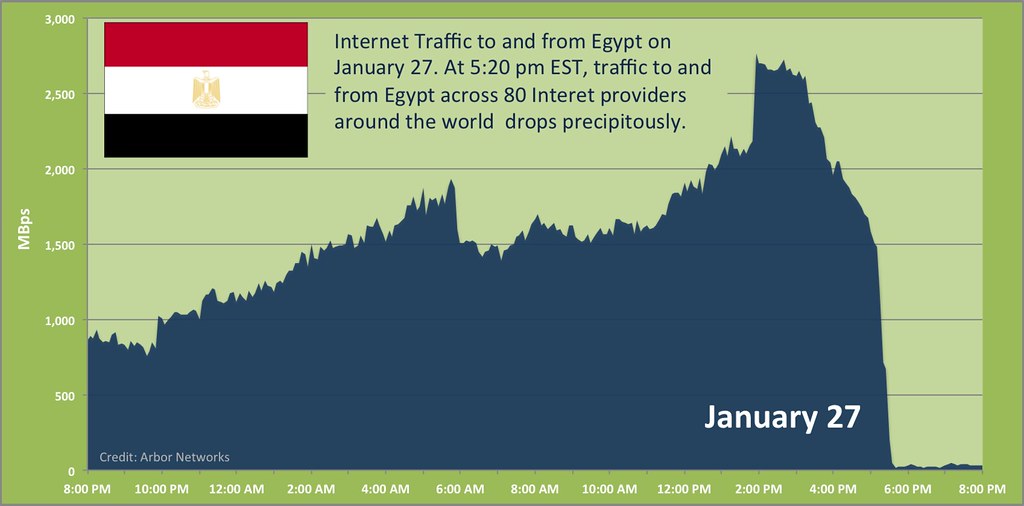
You need to be watching the Middle East right now. First, there was Tunisia. Now, there’s Egypt, which has just shut down all Internet traffic in and out of the country. There are also large protests in Yemen and additional reports of smaller protests in Libya and Lebanon.

The thing about events like these is that they tend happen very, very quickly even if the precipitating conditions are generally long-standing. If protests like this succeed in their immediate goals (i.e., regime change) that also tends happens very quickly. However, you should be careful not mistake the volume of information flying about these things for that happening-very-quickly factor. Journalists struggle with this. Audiences struggle with this, and folks like me who do media and news analysis for fun and profit (seriously, I have professional training and experience this stuff; I’m not just talking about random blogging) struggle with this. Combine that with the disparity between the nature of information flow where the events are happening and where you’re watching from, and it’s hard to know what’s going on, especially now that Egypt is effectively an Internet black-out zone; SMS and mobile service also seems to be out or on its way out, and there are additional reports of land-lines starting to go down. An hour after I first posted this I am now seeing reports of the government cutting water and electricity throughout multiple cities.

Next, LGBT people are still being murdered in Uganda, whether that “Kill the Gays” bill goes through or not. And part of the reason they’re being murdered? US religious activists who, unable to engage their agenda fully in the US, went to Africa to see what they could do there instead. When I wrote about this on my LJ, one of my fandom friends linked me to a fund that supports an LGBT-inclusive church in Uganda that’s run by a Ugandan minister. If you have other suggestions for how people not in Uganda can help address this mess, please leave a comment.

Now that we’ve gotten that stuff out of the way, it’s worth noting that I don’t think of myself as a political or activist blogger, even though I certainly blog about both to varying degrees here and on LJ. But I do think that Sady Doyle has a lot of interesting things to say about the realm of nasty reactions from readers at her Tumblr. I don’t get quite the same types of hate as Doyle does, and I very much suspect I get it from a different audience (although that may have more to do with my origins on LJ, which has a different male/female ratio than some other spaces on the Internet, than anything I actually do or write about), but Doyle nails some trends in nastygrams directed at female-types on the Internet with this:

… I generally think it’s the same for every woman who receives a massive amount of blowback. Either you seem too sure of your own worthiness as a person, or you seem too sure of your opinions; either way, something has gone wrong, because you don’t hate yourself, and we need to fix that for you.

I think anything I have to add to that is probably superfluous today.

Okay, fun things!

It wouldn’t be trash day without linking to something on Kickstarter. This project is already fully funded, but there’s still time to get in on it and get your very own math dice, which I personally think should be a featured element in any sort of Doctor Who table-top role-playing game ever.

And, speaking of Doctor Who, as we do around here: Ride-in Daleks!. Kids only, and alas, I have no kids to put inside Daleks. Maybe the cats though…. would that be wrong?

And we have some updates on some previous stories:

I’m going to get to eat cups! But yet on a more serious, and continuingly relevant, note there was a slight bit of dramarama in comments on that project over on Kickstarter as the deadline neared. Someone showed up to say that the people running the project were bad people, provided no details, and offered an analogy that may or may not have had direct relevance to whatever accusations they were trying to make. I don’t know the Jelloware people, and I don’t know the person speaking out. But I do know if you’re going to say, “Hey, you shouldn’t support these people” you need to say why. And if you don’t? I’m going to refer you back up to the previously quoted remarks from Sady Doyle.

Next, it looks like the Internet stepped-up and Teresa Jusino will be joining us in LA for the Whedonistas launch!

Finally, for those of you following the hawkward situation at the Library of Congress, the bird has been rescued.

truth + fiction doesn’t just = marketing

In the world of fanfiction there’s fictional person fiction (FPF) and real person fiction (RPF). While fanfiction is often viewed with skepticism from people outside of the fan community in general, despite humanity’s long tradition of telling and retelling stories as social currency, RPF is often met, instead, with skepticism from people within the fanfiction community itself, while people outside the community don’t even really seem register it as so specific a category.

And, to be fair, on a pure gut level, sometimes I can find RPF to be really, really weird. But then, I’ve stumbled over stories about a person I went to high school with who is now famous and one about a friend of a friend’s ex that I once had beers with and found to be remarkably unlikeable. RPF, which is arguably about personas and the packaging of fame — when people write RPF they it’s possible (even quite likely) that they aren’t writing about real people’s fictionalized private lives so much as real people’s publicly fictionalized persona’s private lives — sometimes appears to drop under that layer of fictional truth for me, not out of speculation but because Oh my god, I know those people.

I’ve heard all the arguments about the morality or ethics of writing and reading RPF, and it’s not that I don’t think these are fundamentally important conversations on some level (and yes, I’ve thought long and hard about “Well, how would you feel if someone did it to you?” The answer? “Well, like I’d probably have a lot more important things to be doing than reading wank about me on the Internet if I were known enough for that to be going on.”). It’s just that I’m not that interested in those discussions of how not to be an asshole. Not being an asshole is good, but I’m not all that qualified to tell anyone how to do that, despite various attempts I fully admit to having made. Besides, from a thinky thoughts perspective, on this one I’m really, really much more riveted by — and useful to — talking about the critical implications around RPF.

Perhaps the most irritating aspect of RPF-related discussions is the degree to which people dismiss it as, “Oh god, more creepy porn on the Internet.” I think it’s pretty toxic how often both fan community participants and critics dismiss sexualized-content for irrelevancy because it contains sex. Our collective libidos are, among other things, narrative tools, and chucking a lot of fanfiction into the sex bucket and saying it’s not worth looking at from a critical position for that reason isn’t just one of those high-/low- culture false divides moments; it’s a sloppy misuse and abuse of data. The stories people feel compelled to tell and witness and share, whether or not they’re well-written, or whether or not you’re personally interested in them, or whether or not that represent masturbatory material for some people, represent a cultural map that it’s foolish to dismiss (even if I won’t read anything published on fanfiction.net either — I never said I wasn’t a snob).

Now let’s be clear, not all fanfiction, and, I find, particularly not all RPF, is porn. And even when it is, that porn is usually there in service to the idea of the backstage story (which if you’ve been following the development of Dogboy & Justine you know is a particular fascination of mine). And, conversely, not all RPF is fanfiction (e.g., works created on a not-for-profit basis by enthusiasts). Note the erotic anthology StarF*cker, which is fiction about sex and real famous people, but very much not part of the fanfiction ethos. In the less sex, but still definitely RPF department, what do you think Primary Colors was? Or the forthcoming O (not to be confused, amusingly, with The Story Of O)? RPF. Totally, totally RPF.

And that doesn’t even begin to cover how pervasive this trend has become; Steve Erickson, for example, doesn’t just use both historical figures and himself as a fictional characters in his novels, but also included personal encounters with Sally Hemings (a particular obsession of Erickson’s; she shows up in his novels too) in Leap Year, his arguably non-fiction book on the 1988 presidential campaign season. Other examples include the Aaron Sorkin Jed Bartlet advises Obama piece from the last campaign season and an article The New York Times also did on the real people as fictional characters in novels phenomenon, although I’m having trouble finding the link (please leave comment if you’ve got it!).

RPF is a real, saleable thing, both in its smutty and not smutty versions. None of which necessarily makes it less uncomfortable for many readers (or, even, in the abstract for non-readers). Nor should it. Part of the charge of reading RPF, sexualized or not, is, I think, that it is so profoundly unsettling and messes with our boundaries regarding what is real and what is true (two of my favorite categories for making Venn diagrams about stories). Another part of the charge is, I think, the violative nature of reading something and realizing that a particular fantasy, daydream or fear you have harbored is shared, is part of our collective story in the dark. It is the guilty that can bring the pleasure when it comes to RPF.

In the midst of hanging about on Twitter the night Countdown went off the air, there was a tweet saying that AC360 was going to do a bit on the Countdown thing, which got fairly widely misinterpreted as “Olbermann’s going to be interviewed on Cooper’s show.” Which, in the world of the Internet, or at least the people I talk to on the Internet, led me to make a crack about how Olbermann/Cooper would make certain corners of the Internet very happy, which led someone to reply with, “Have you read this?” and a link.

Obviously, I read some RPF. I’ve written some RPF (some of which you’d even be able to track back to me with ease). Some of that I have mixed feelings about. Some of it I don’t. But there’s ton’s of RPF I won’t touch with a ten-foot pole for no other reason than it squicks me. It doesn’t mean the story is morally or ethically wrong (for me or anyone else) or not well-executed; it just means that for whatever reason, sometimes one I can’t even put my finger on, there are some RPF places I don’t want to go unless I have to for some sort of scholarly/critical thingy. For me, pundit slash, as the world of RPF about political talk show hosts is called, is one of those no-go zones for me. I’ve no idea why, but so it is. This surely seems like a perfectly rational choice to many of you.

But I had a headache, and I was in a bad mood, and people on Twitter were like “You have to read this story called ‘The 28th Amendment,'” and I recalled that, that Barack Obama/Rahm Emanuel piece from Yuletide a few years back was one of the smartest meditations on ambition I had ever read, even if I did find parts of the story really, really uncomfortable. So I decided to give the rec from Twitter a go, and that’s how I fell down the rabbit hole of pundit slash on a Friday night, and why I’m writing this post and have a linky or two to share with you now.

One of the biggest problems for me as a (critical) reader of RPF is that I often feel like people who are trying to use RPF for commentary don’t know how to write a story, and people who just want to write a (hot) story, don’t necessarily know how to add criticism into the mix. That both those things should happen in RPF aren’t, of course, anyone’s requirements but my own, but hey, my journal, my pickiness. What’s so remarkable about “The 28th Amendment” (which imagines a The Handmaid’s Tale-esque religious police state in the US under a President Huckabee with our intrepid pundits (Jon Stewart, Stephen Colbert, Rachel Maddow, Anderson Cooper, Keith Olbermann and more) on the run), is that it knows how to do both. While I reflexively read it with an editorial eye (and there were things in there I would have changed or didn’t ring plausible for me even in the suspended-disbelief of the narrative, although it’s hard to say whether that was related to personal comfort or actual editorial consideration), the fact is, it was a well-told story that got under my skin for reasons that I am fairly sure were broader than liberal-paranoia and the fact that I read all sorts of stuff that freaks other people out on the Internet all the time.

Maybe, I decided, pundit slash wasn’t totally squicky. Maybe I should read more! So I started digging around on An Archive of Our Own and found a remarkable number of charming fictions about Rachel Maddow being a cool person to have drinks with, a BDSM-AU about various pundits, several high school AUs (a particular favorite of my partner’s), and an essentially general audiences Doctor Who/Rachel Maddow crossover. It’s a beautiful world out there on the Internet. Or something.

One of the views I have particularly little patience for is the idea that fanfiction isn’t real writing, that it is somehow “practice” for the “real” work you are obligated to aspire to do. Sure, writing fanfiction is one way to learn some craft skills, but to me original fiction and fanfiction are profoundly different endeavors that I engage in for profoundly different reasons. To me, fanfiction is something of an acting exercise: that is, how do I execute, in text, on a character whose blueprint has already been provided to me by a writer/director? While original fiction utilizes some of those acting tools, but also the structural components of the writerly and directorial eye. And I think it’s absurd to tell anyone they have to aspire to anything, especially when I’ve had so much experience turning something I love into a job — sometimes it’s still fun when you do that, and, sometimes, it really, really isn’t.

But I do think that people playing in the RPF sandbox — whether they be part of fan communities or not — would benefit from looking at the bigger picture. If you read Primary Colors, it’s absurd to snark on the existence of RPF in fan communities even if you’ve never read fanfiction and never plan to (because, guess what? In a way, other than that money was involved, you already have). And if you’re writing RPF and think it has to stay in the land of fanfiction but wish it didn’t? Well, sometimes it doesn’t have to stay there. And you should know that too (and I say this, particularly, to people writing historical RPF — have you read The Baroque Cycle? History is a playground! Although please, if we can avoid any more plays about six great minds from different time periods having a dinner party in Hell, I would love you forever).

Fiction appeals to many of us, often, because of the pieces with in it that could be or feel true, no matter how impossible or unlikely for us or for anyone. There is a reason, after all, why so many adults confess to still feeling at the back of wardrobes when they encounter them for the door to Narnia. So it makes just as much sense, really, no matter how discomforting it may be, that there is this not insignificant impulse to put not just truth in our fiction, but fiction in our truth. RPF is a corner of both the fanfiction and generalized fiction space that illuminates, with a sometimes queasy-making light, just why we read fiction and just how far away truth can seem.

Meanwhile, I’ve got a killer story sitting on my hard drive about once-was but no-more Ziggy Stardust David Bowie and Lady Gaga and matters of persona, mentorship, love and desire. Anyone want to buy it?

my own special comment

No matter how busy I am in my very hectic life, one of the few schedule things I try to do when Patty is away (when she’s home I certainly have other incentives to be home at a decent hour) is to get home in time to watch Keith Olbermann. I don’t always manage it, but I do try.

So imagine my surprise tonight when I got home ten minutes late for even the end of it to a stack of emails that basically boiled down to OMGWTFBBQ about the news-to-me announcement that tonight was the last edition of Countdown.

To be clear, because it needs to be said so as not to distract from the rest of this post, I didn’t always agree with Olbermann’s positions or the way he framed them. Sometimes, I found myself frustrated with him, both as an audience member and as someone who has worked in and about journalism. But, to be frank, it wasn’t strictly due to journalism that I had such an affection for Countdown. The reasons I did are complicated, personal, and often, a little bit silly.

I’m a lot more hesitant than I used to be to talk online about my education. The discussions tend to make other people angry, and me frustrated. But it suffices to say that I went to private school where an emphasis was put on all forms of communication. I wrote two-hour essay examinations in every subject but mathematics from sixth grade on, and took mandatory classes in subjects like rhetoric and Latin. Because of my education, I learned to speak in very specific ways that were designed to be assertive, excessively nuanced (sometimes for the express purpose of deception), and deeply attuned to cadence.

That mode of both speech and writing has been both my greatest asset and, often, a headache. It is a style that can make people bristle, both because it is sometimes somewhat impenetrable, and because it leaves little room for phrases like “in my opinion.” This education, this adherence to my education, has certainly gotten me into trouble more than once, and part of those occasions have also largely concerned the fact that I come in female form. This combination of gender expectations and personal delivery mechanisms hasn’t always been kind to me, and it is something I am, frankly, unwilling to modulate.

Countdown reliably riveted me because, for good or for ill, and whether or not I agreed him with on any given evening, Olbermann used language on that show in the manner I was taught to aspire to. The program was, especially in his finer “Special Comment” moments, the way I was told as a child the world was supposed to sound. As someone who has struggled with even the benefits of my education and the awkward way they intersected with the reality of the years I spent concurrent to that education in speech therapy, Olbermann’s rants often made me feel as if I am not as wrong to engage with language in the manner that I do, as I have often been encouraged to feel.

Many of the criticisms that seem to be flying about Olbermann with particular frequency in this immediate wake of the demise of Countdown also resonate for me. Olbermann is a celebrity celiac. And while he has noted on-air that he is lucky in that his symptoms are not as severe as many with the disease, and has generally been unspecific about those that he does endure, it is worth noting that my experience of celiac disease has been that I am subject to attacks of temper, cruelty and despair, particularly if I have been exposed to gluten (this is a recognized and common symptom). I spent decades of my life being labeled mercurial, unstable, angry, crazy, and dramatic, and huge swathes of that experience were related to my then-undiagnosed disease. Today, I can recognize the feeling of my mind and temperament being terrifying hijacked by any exposure to one of the world’s most common foods. I have no reason to know, and no comfort in speculating, as to whether Olbermann’s notoriously difficult temperament has any connection to the disease we share in common, but the mere possibility of it has been a private and awkward comfort to me, especially when I consider the more embarrassing and volatile moments of my personal history.

Finally, my affection for Countdown and my respect for Olbermann comes from my queerness. It’s not just that Olbermann did something significant when he delivered Special Comments wherein he, as a self-described straight man, choked up when speaking out about the wrongs of marriage inequality (although, that was pretty awesome). It’s that he has advocated for queer people from a presentation of not just heterosexuality, but of a somewhat classic (and yes, unfortunately at times misogynist) presentation of masculinity. I don’t like that the queer community needs allies that fit that blueprint — it shouldn’t be necessary — but in a world where it is, I’ve been glad that Olbermann has been that ally.

And that gladness has not just been because of Olbermann’s verbal agility, but because, and this is perhaps the silly part (although surely understood in its significance by other gender non-conforming people), he’s been one of my sartorial role models. Once I decided it was okay to present myself as male, masculine and/or in men’s clothing with some regular frequency in my day-to-day life, watching Countdown was a huge part of how I learned men’s style in terms of color, pattern mixing and cut in men’s suits, shirts and ties.

I truly am beside myself for, among other reasons, this loss of my nightly personally-queered fashion fix.

“let me but strike the world in a vulnerable spot, and I can take it by storm.”

When Mary MacLane was 19-years-old she wrote a book about her life and got it published. She then became something of a celebrity (the book sold 100,000 copies in its first month of existence) and a scandal and went on to a life as a writer, actor and journalist before she died in 1929.

The book wasn’t about very much, just about being her, and the pain she felt at being alone and stifled and puzzled and bored by other people as she waited for the Devil; he would have grey eyes, she always wrote and make her “his dear little wife.” MacLane’s desire to be small and cherished by a force larger than her own in a world where one didn’t seem likely to exist for her was something that charmed me deeply when I first read it, having never so much felt the feeling of being girls together with someone as I did in response to this desirous author.

The book is, by turns, redundant, self-absorbed, and deeply fascinating. It is, in some ways, blogging before there was blogging. It is deeply aphoristic, and often plagued by that “but what do we care what you ate for lunch” factor that we all often experience on the Internet if we are, in fact, fascinated by the lives of others.

MacLane first crossed my radar when I was just a few years older than the author had been at the time of the book’s writing in 1902. Someone, and I can’t recall who (an ex-boyfriend, I think, but I am not sure — if it’s anyone with whom I am still in touch and you are reading this, please let me know; it’s something I’ve treasured for years), gave it to me as a gift.

It was, in a way, a Illegitimi non carborundum (Don’t let the bastards grind you down) gift. Whoever gave it to me was someone I knew through Mindvox (I did not know until just now that it had merited a Wikipedia entry; gosh, that’s awkward), an early high-profile online community that dominated the social life of at least my early to mid-20s. I was well-known on the small site (Who wasn’t? But the fact is I also wound up in at least one major article because of it (in Sassy of all things) and worked for the service for a time). For every person who was engaged with what I wrote there were people who not only found me irritating, but someone who needed to be silenced — through bullying, pranks, and even threats. I was, without a doubt, irritating, confronting and self-absorbed, but on Mindvox, which was littered with a zillion petty and public dramas (many of which, yes, I was involved in), the sin was really that I wasn’t particularly ashamed of this.

Which isn’t to say I was running around with great self-esteem or anything. I wasn’t. But then again, neither was Mary MacLane, who wrote of her genius, her remarkableness, her loneliness and her unlovableness. MacLane, who as the 38-year-old I am now I feel as if I should disavow for her overwrought self-aggrandizement was a lifeline for me. Ironic, perhaps, when in her lifetime MacLane had to respond to accusations that her book had led at least one girl to suicide (a matter on which MacLane declared, “I read of the Kalamazoo girl who killed herself after reading the book. I am not at all surprised. She lived in Kalamazoo, for one thing, and then she read the book.” Although later she also noted that, “It is with pain that I read of the dire effects of my book upon the minds of young girls.”)

MacLane and my relationship with her work, echoes back to the post I made the other day about liminality — MacLane was a real person, but one who was also performing herself (as we all arguably are with different levels of awareness and intentionality). By the experiences I described the other day, her non-fictional status should have made her a harder to achieve imaginary companion and self to me; but, rather, I have to argue that MacLane’s life and mode of living that life only underscore the arguments I make for the use of the fictional/non-fictional dichotomy over the fictional/real dichotomy; that is, if we must have dichotomies at all.

Mary MacLane has long been a quite, distant interest of mine. It takes, generally, too much work to explain to you that her assertion, “I do not see any beauty in self-restraint,” was not something I read as license to my excesses so much as acknowledgment that the world is cruel and hard when it demands secrecy about things common and shameful only because we have made secrets out of them. It takes, generally, more work (and the enduring of more jibes than I prefer) to talk about the truth I find in her thoughts on fame and happiness and the maw within her: “I want fame more than I can tell. But more than I want fame I want happiness.” And it takes wasting a lot of time on assuring people that I don’t think all that of myself, when I am enraptured by the emotional pain she seemed to feel at her own intellect: “I am a genius. Then it amused me to keep saying so, but now it does not. I expected to be happy sometime. Now I know I shall never be.”

Oh, how I wish Mary MacLane had had the Internet! She might not have been so lonely. Strangers would have sent her gifts, and people would have bullied her. Her hypothetical contemporary fate is so remarkably clear in her actual historical experience and narration.

The first complete collection of MacLane’s works, A Quite Unusual Intensity of Life, collecting for the first time MacLane’s complete works, is to be released in September 2011. The book will, no doubt, be met with a certain degree of dismissive criticism — why not just read overwrought blogs on the Internet, after all? But the material is, I suspect, valuable, even if just for how the world doesn’t change very much.

When I first read MacLane, I wondered if I should lament that the Devil I was longing for didn’t have grey eyes. Now, nearly twenty years later, when I consider the hand MacLane held out to me, even if she would have never have meant to, I lament merely that I myself don’t have grey eyes and am, as such, inadequate, no matter how much I claim her as one of my own.