Glee: The magic is gone

Despite the title, and some of the rage viewing that went on while I watched the two episodes that aired last night, this isn’t actually a post about how I’m over Glee. Rather, this is a post about the ways in which magic was absent from last night’s narratives and what that may tell us about what type of show Glee thinks it is.

Because, even with Tina’s weird body swap fantasy head injury — in which everyone is more themselves than when they are actually themselves and the world is a nice enough place that Kurt and Blaine can cuddle everywhere — magic was noticeably absent.

As graduation approaches, Glee‘s all about the real world now. Even songs that segue out of the choir room into what I think we’ve come to understand as a fantasy sequence on the show, do so onto an empty stage with limited effects. Everything is stark; everything is a future that can’t be imagined. Sometimes, everything is a future that you don’t even want to imagine (see: Beiste and Puck, considering knives).

For me, frankly, the de-magicing of these two episodes of Glee was frustrating, but Glee, while explicitly set up to ultimately be a victory story for all its characters, really only knows how to show us victory in relatively naturalistic terms. We can understand Will getting an award, Finn getting the girl, New Directions winning the prize, Quinn getting her dream school.

But when it comes to transformational stories, about being seen and heard (Tina getting a song, Kurt getting a yes), Glee tends to falter, as if if doesn’t know how to use its style to explicate victories that are, even in front of an audience, innately more private.

That so much of the Nationals-related issues in these episodes center early on around Kurt performing in drag was a narrative device with multiple purposes and potentials, including giving Kurt an opportunity to define the type of queer person he is to a WMHS that might actually be listening for a change. It is, of course also framed as an opportunity for him to be a hero (as boys are), while also taking one for the team (as girls do), emphasizing the way that characters that are perceived as inhabiting liminal spaces at WMHS are always framed both as magical and as suffering burdens of those unasked for and supposed gifts.

That Kurt wants nothing to the drag number is spot on and connects with the ways Glee tends to link authenticity and gendered positioning of its characters. But in the fall-out from Kurt’s disinterest, so many narrative opportunities aren’t just lost, but alluded to in a way that makes their absence even more frustrating.

Puck’s appearance in a dress and fight by the dumpsters with Rick the Stick, for example, represents a gorgeous transformation from the kid who once threw Kurt into dumpsters for not being a certain type of man, yet Puck’s speech about the dress missed the point — in ways Puck actually usually doesn’t.

Kurt, too had an opportunity, to be contrasted with Rachel. They’re both characters who have expressed at times a desire to do anything for fame (and in a way this was underscored by Kurt and Blaine’s reality TV obsession and Halloween costumes), but Kurt has a line regarding his own truth that Rachel has not personally encountered her own version of yet. But he is willing to be a spy (again), indicating a willingness to perhaps compromise his honor his Self. In a set of episodes about the intensity, nature and appropriateness of Rachel’s ambitions, where was an examination of the motivations of the constant moon to her sun?

And of course, there was everyone being offensive about Unique. And I get it, WMHS and Lima are offensive places, where people don’t know how to deal with folks who aren’t cisgendered, and while I’m a big fan of asking audiences to understand that the things that come out of the mouths of characters on Glee are offensive all by themselves, this is one where large swathes of America just don’t have the tools. Even a line where someone asks about what _is_ appropriate, or a well-meaning but painfully awkward PSA from Blaine (he’s good at that, and I felt like the script crept there once and then didn’t deliver) would go a long way.

But that doesn’t happen, and in the end, Unique’s threat to New Directions is more Rachel Berry (powerhouse voice and star power) than Kurt Hummel (liminal magics). I, frankly, love this as a choice, as last night’s script framed Unique more as her true self, than as a performative identity of Wade (which is what we got in the character’s introduction), since Glee’s always run a little bit of a risk around the idea of magical queers (it’s not why Kurt is magical, but as last night’s episode shows, it’s exactly the mistake everyone around WMHS tends to make).

For me, so much of last night’s episode felt like the people with magical roles on the show had checked out or had their own distractions, and it was, to say the least, frustrating. But often, when I write these things, I find my own answers.

Just as Rachel tells us Tina has no idea what it’s like to be her (even as the audience is supposed to identify with her every step of the way), we really have no idea what it’s like to be Kurt who tends death, makes people love him with a song, and is constantly expected to make everything better by becoming — for good or for ill — something other than the mass of shifting colors he often is.

While the New Directions victory is huge for all the characters, and for us as viewers who surely had to have expected this moment, most of the characters are actually more worried about other battles right now, and are waiting — as in all the numbers that took to the WMHS stage in this pair of episodes — in the dark.

This shift to other battles even as the obligatory one dragged on, means that the real question left for the finale is whether graduation means an end to the magical world of Glee and the otherness and liminality that often drives it, as practical, logistical concerns take over for those who depart, or whether our magicians are about to face even greater magics then their own — after all, it looks like Rachel and Kurt are off to meet the wizard (and we’ll talk about the danger of that during hiatus, I think), or at least, see Oz.

But while the New York setting of Glee‘s next season remains one type of magical question mark, so does the situation back at WMHS, especially for Blaine and Tina, both of whose narratives increasingly seem to be about the consequences of being rendered powerless.

Glee: Queen bees, missing kings, and the faerie court

Now that we’ve gotten that out of the way, let’s talk about Glee and its faerie courts. Faerie mythos is completely not my department of expertise, so I’m mostly throwing this out there for you all to continue to be excellent in comments, but there was some truly fantastic stuff going on regarding Puck, Kurt, the prom crownings and gender in last night’s episode.

Because one of the things that came out of the series of crownings that took place, and how they took place, is that kings mean less than queens. Not only has the prom queen title always been more important to the girls of WMHS than the prom king title has been to the boys — as evidenced by the way women have consistently pitched strategies for winning the times to the boys, but not the other way around — but the prom queen title has always come with a lot more power, whether to wound or to elevate.

Certainly, it’s the prom queens and queen bees who confer that power in “Prom-asaurus.” Santana and Quinn, in a strange, and incredibly messy, plot overrule the will of the people (let’s face it, their people, even if they’ve both significantly fallen from grace over the last three seasons) to declare Rachel the victor. Not only does it not remove any of their true power (they are acting as regents here), it makes them more powerful, not only by declaring Rachel queen, but having a secret they could always choose to use against her later.

Meanwhile, with Dave Karofsky (who was only ever prom king because of Santana’s machinations) is missing from the scene, and Kurt is left to crown both Finn and Rachel, passing on his own power (because the shame of what was done to Kurt went both ways; he shamed that audience that tried to mock him in recognizing his power when he accepted that crown last year) to his brother and his closest friend for a single night in merely symbolic form.

Rachel and Finn still don’t really learn anything from the events of the prom, but Kurt’s blessing of magic will be enough to get them to New York, one imagines. Certainly, Rachel hopes so as she grabs her tiara (not a full crown like Kurt had, she is a lesser power) from Kurt to fasten it on her head herself. But Kurt still retains control of their power, taking their scepters for safe keeping as the dance begins.

Interwoven with this, we have Puck, who opened the door for Kurt’s entrance into faerieland (Dalton) in S2, and has been struggling with his own powerlessness this season, crowning himself so that he can crown Becky queen of the anti-prom. It gives them the power to attend the prom proper and to be part of the broader WMHS world that Puck has felt increasingly marginalized from and that Becky, while a central figure of (and a queen bee like Santana and Quinn herself), has always existed in with her power overlooked, misunderstood or condescended to by too many of her subjects (something which, by the way, brings up some narrative parallels for Kurt and Becky, which I should totally tackle another time). Of course, granted her power, Becky then pulls of the thing Puck’s never been able to do: spiking the prom punch, and we all know the power of libations and food in faerie.

All this talk about crowning of course, raises the question that Deconstructing Glee raised earlier today: is Kurt still pregnant? I’m not sure, but the answer may depend on whether Finn and Rachel are ready to go out into the world on their own under his aegis.

And finally, of course, there’s Blaine, and who’s always been faerie and onion and changeling, showing this time what is, we think, his true form. But whether that means he’ll rule at prom next year or never rule again remains to be seen. It depends on what Glee ultimately decides to do with its arguments about authenticity vs. performativity and how those things intersect with power and gender.

Glee: Eating some hats

While there were a lot of amazing details in “Prom-asaurus,” — the predatory theme of the prom; Brittany’s run for king; the Faberry fan-service; the references to both Medusa and Icarus (we’ll definitely be coming back to Medusa and the snakes in the toilet here at this blog); some important stuff regarding Kurt and Puck and the faerie court (which we’ll also be spending some time with soon); the heavily foreshadowed implosion of Tina and Mike; and pretty much everything involving Becky and Puck — because of one tiny little thing, this episode has me eating my hat (or, probably actually Brittany’s and Kurt’s) about something.

Kind of.

One of the big debates around Glee is whether the lack of physical affection shown by the gay couples is a concession to the realities of Lima, WMHS, and personal history, or a concession to a squeamish network. For me, historically, the distances have worked consistently and plausibly on an intradiegetic level, especially considering Kurt and Blaine’s experiences with violence, and I’ve got a pretty decent track record of pissing people off for defending what I’ve seen on screen because it makes sense to me.

Plus, Glee usually reserves physical and sexual affection for couples about to be broken apart or who are busy being publicly dysfunctional while trying to derive status from theie relationship. It’s generally a narrative tool (with the exception of Mike and Tina, who, in exchange, don’t really get a narrative), and in the face of smooth and steady Klaine, there hasn’t been much cause to use it.

Last night’s episode was largely consistent in this for me. The boys continued not to touch, even in a relatively safe-space of the anti-prom. Considering the overall social awkwardness of that room, I actually still on board with the state of things, in part because there was such a comfort and tug between them even in that distance.

But then there was the prom itself.

Or, more specifically, the closing montage of prom, where each couple got their little closeness moment and the closing prom photo. And Kurt and Blaine just had less time. That’s all. And I can’t do anything with that intradiegetically, because it’s an editing choice; and I can’t do anything with that structurally, because it actually runs counter to the law of prom episode structure on Glee, and yeah, it just didn’t feel right.

Now, this is where the “sort of” comes in on eating my hat. It doesn’t matter.

Why?

Because in one scenario I was just having an on-point emotional night last night (which I was, thanks to the passage of an anti-gay amendment into North Carolina’s constitution — North Carolina has a long history of breaking my political heart), and the problem I feel was there in terms of visibility and affection wasn’t.

In that case, the intradiegetic truths I’ve always highlighted remain, that Kurt and Blaine have to be so conscious of their safety so constantly, that they can’t even stand to be closer than two feet from each other in a hotel room with a small group of people they at least know won’t physically hurt them, lest they get out of the habit of constant vigilance.

But in the other scenario, Fox has a hit TV show it hates filled with gay content and involving many gay people in the creation process and at every single moment the show’s powers that be are having to bargain with the network’s powers that be for what we see.

Both of those scenarios suck.

No matter how much what I’ve viewed as consistency and plausibility within the narrative has allowed me to side-step the question of network drama about all of this (because it’s so much more than the shows I grew up with — although with everything I have to say about Kurt and magic, maybe Kurt and Blaine just like Buffy‘s Willow and Tara and also perform magic instead of actually having sex), last night just felt like I really, really couldn’t, even if, I believe that given free-reign by the network, the content the show would give us between those characters would remain almost identical to what we’re getting now.

But either way you slice it, Glee remains what it’s always been: a show about terrible people in a terrible place, that somehow suggests we all deserve a little bit better than we’re getting.

Sadly, that includes the audience too.

Glee: Gender, performativity and neediness

If you’ve been following the spoilers for Glee‘s upcoming prom episode “Prom-asaurus” and spend any time on this blog at all, you can probably guess that I’m having a pretty great time with the gendered stuff that seems to be coming up around Blaine in this episode.

It’s not a plot line, probably because it’s never going to be a plot line, except for how it intersections with the history of Kurt’s bullying and the way gender is always central to status at William McKinley High School. But what may read (and be intended) as nothing more than a running joke for most audiences, not only continues to say some very interesting things about Blaine, but reinforces the criteria by which gender is determined at WMHS and its surrounding environs. Delightfully, despite my comments on Kurt’s trousers in “Choke” this tends to have almost nothing to do with what’s in your pants.

Currently, there’s a bit of a Tumblr frenzy around Kurt, Blaine and Rachel singing “Big Girls Don’t Cry.” While the song is likely intended to focus on Rachel’s circumstances after the events of her audition in “Choke” there’s some lovely, bittersweet content in it between Kurt and Blaine, and Tumblr has noted that according to song lyrics, last year Blaine was a little girl at prom, and this year he’s a big girl.

While Glee often doesn’t use song lyrics in ways that are necessarily plot-relevant (and Darren Criss singing too many songs not originally intended for a female vocalist would probably seem weird to long-term fans at this point), there’s been a persistent link between Blaine and songs that identify the singer as female not through an assumption based on a male object of attraction, but through explicitly female words.

In “Prom-asaurus” we also see Blaine positioned as female in another way, and not for the first time: other people feel that there’s nothing abnormal about telling him how he should look. From Brittany’s Blaine-directed hair gel ban, to Kurt’s bronzing moisturizer stunt, to Cooper’s complaint about Blaine’s outfits and Santana’s crack earlier in the season that puts Blaine off wearing bow ties for a while — people feel perfectly at ease directing Blaine’s appearance. If you’ve ever been female in public, you probably know exactly what I mean; I’m just waiting for the moment someone tells Blaine to smile.

Of course, two of those items — the stuff about Blaine’s hair and the stuff about the bronzer, also have clear racial implications, which brings us back to biyuti’s remarks that Blaine is bakla. Now that the race and gender stuff around Blaine is intersecting so vividly that a lot of discussion is going “I don’t know if this is about this or this,” the answer, increasingly the answer seems to be about and not or.

But Blaine’s feminine positioning in the show is about more than what songs he sings or about how neither he nor Kurt are quite what they seem to the untrained imaginations of WMHS. Rather, an inclination towards performativity is what positions characters as female on Glee, and Blaine is nothing if not a consummate performer.

I know, you’re saying, “But everyone on Glee sings!” And that’s true, but not everyone on Glee performs the same way. When Blaine performs, he’s playing a character; when Kurt performs, most times, he’s just playing himself. Authenticity on Glee is positioned as masculine (something we’ve explicitly seen Kurt move towards over his arc) and performativity is explicitly seen as female (which is why Kurt’s stint with Mellencamp fails, and why he regains his masculinity when it does).

This is partially why the boys of the football team freak out when they are required to join Glee and Dave Karofsky’s plotline so effectively highlights a frequently present common root in homophobia and misogyny.

Girls wear makeup, boys don’t and this dichotomy around the construction of appearance is constantly underscored in the structure and staging of of performances on Glee, and is really only subverted and complicated (and thankfully so, because the world is more nuance than the limited number of boxes presented at WMHS) thanks to Wade/Unique, wherein the authentic, feminine self is also introduced as a performative self.

The other central tool of gendering on Glee is about neediness. Narratively needy characters are feminine; self-suficient characters are masculine. This is why Blaine’s a girl in Glee‘s lexicon, but Kurt hasn’t been for a long time. This is why Rachel is “man hands” Berry; Santana is more traditionally-femininely portrayed than Brittany; and why Quinn never seems to stop being punished for her gender. It’s why Puck was fantastic with Lauren; Finn struggles constantly with ideas of leadership and being a man; Sam’s sex-work stint actually earns him the respect of the other dudes; and Artie is often the Glee club’s most clearly masculine member and Sugar Motta is its most feminine (because, what isn’t she performing?).

Ultimately, as much as Glee‘s structure and unsettling humor relies on clear gender dichotomies, accusations and misunderstandings, and as much as Glee is often about terrible people who say terrible things in a terrible place, the show is, on a subtextual level, deeply generous about gender in the degree to which it actually rejects the stereotypes that drive its setting. Glee lets us know people are complex mixtures of things, not just boys or girls, and not just combinations with stark lines drawn down their centers (as Kurt is in “Le Jazz Hot”).

But for all that subtle progressiveness, Glee is still sure of one thing: that being a girl, regardless of the gender you were assigned at birth, is a terrible thing. It will get you beat up, bullied, pregnant, uncertain about your future, and nursing a wounded heart.

People on Glee talk about becoming men, because that’s a positive goal, but never about becoming women, because that isn’t — at least not in Lima, OH.

Season 4, however, isn’t just going to be set in Lima, though. It’s also going to be set in New York, and possibly New Haven, which means Glee‘s going to have to make a critical decision about whether the world hates women, or just the small pond that originated its characters.

One choice will necessitate a radical tonal shift for the show, giving it a second act that celebrates femininity and places dread and misery around masculine identities. However, if Glee takes the other choice available, we’ll be confronted with a show that’s position on misogyny may be indistinguishable from actually being misogynist itself.

Glee has to decide whether it can get better — not just for queer kids (here, it seems to be optimistic), but for girls — and the decision it makes will largely tell us whether we’ve spent the last three years watching the beginnings of a victory march or a tragedy.

For me personally, as someone who lives in New York City and feels like I’ve seen more progress in my lifetime in terms of safety and respect as a queer person than as a woman, I’m not sure which path I want the show to follow. Because both will hurt and feel like betrayals of the realities I know. But maybe that’s always been the point of Glee: all the moments where you can’t tell if you’re laughing or crying.

After all, in fiction, that’s when we’re usually we’re most alive.

Travel: Would you want the Scottish play hovering over your bed?

I am currently traveling on business and ensconced at the Revere Hotel in Boston. It’s a very nice hotel, and full of boutiquey weirdness, just like I like it. Plus, the price was right on Hotwire. But I need to discuss its art with you. Specifically, two items that are illustrated Shakespeare quotes.

The first is a quote from Othello, over the desk:

Good name in man and woman, dear my lord,
Is the immediate jewel of their souls.
Who steals my purse steals trash; ’tis something, nothing;
‘Twas mine, ’tis his, and has been slave to thousands;
But he that filches from me my good name
Robs me of that which not enriches him,
And makes me poor indeed.

The second is from the Scottish play:

To-morrow, and to-morrow, and to-morrow,
Creeps in this petty pace from day to day,
To the last syllable of recorded time;
And all our yesterdays have lighted fools
The way to dusty death. Out, out, brief candle!
Life’s but a walking shadow, a poor player,
That struts and frets his hour upon the stage,
And then is heard no more. It is a tale
Told by an idiot, full of sound and fury,
Signifying nothing.

Am I just weird and not appreciating the theater theme of this room since we’re in Boston’s theater district? (The Do Not Disturb signs are super cute), or am I completely reasonable in being creeped out by a room featuring artistic centerpieces involving both a quote from a play about a guy who smothers his wife with a pillow and a quote about how life has no meaning from a different play that happens to be considered cursed?

I get how the two pieces almost work for their positioning — the Othello piece arguably speaks to the act of business just as the other one arguably speaks to the exhaustion of business travelers like me, but I feel like the hotel is almost counting on no one having actually read these plays. Surely they could have chosen something from A Midsummer Night’s Dream and been just as edgy without being appalling, right?

I love both these plays; Othello is one of my absolute favorites, and I played the Lady when I was in Sydney, so I was almost tickled by the art until I started thinking about it.

So help me out, Internet — what on earth was the hotel decorator thinking and would all this be more or less creepy if I weren’t here on my own?

Glee: Somewhere there’s an A-plot, but it’s not, apparently, here

I’d like to say that this week’s Glee update is so far behind because I just didn’t want to write about this episode, but, while that’s not untrue, I was actually just really, really busy. But no amount of scheduling chaos in my life (that included getting to go to World Jazz Day at the UN and seeing a documentary about the history of jazz in India), will make “Choke” go away, so here I am, trying to come up with something.

“Choke” however may say more in what it didn’t do, than it what it did. Despite having three plot lines about which we should really, really care — Rachel and Kurt audition for NYADA; Puck may or may not graduate; and Shannon Beiste deals with domestic violence — the episode struggled to hold my attention, in part because it couldn’t decide on its A-plot.

On some level, this lack of an actual A-plot serves some of the concepts Glee’s been pushing as we get closer to graduation. Everyone’s a star in their own story, and things — some of them terrible — will keep happening to you and everyone around you, no matter how hard you plan and no matter how many milestones you pass. However, while this may work as a philosophical message, it’s hard to make it work as good TV.

Of course, the episode had other problems. The controveries about the domestic violence content in the episode seem endless, and my general sense of most comment on it is that said comment is more nuanced than the money quotes going around the Internet. That said, like the (structurally much more deft) episode in which Dave Karofsky attempts suicide, this is an episode about which its perfectly reasonable for lots of people to have wildly different opinions; remember, none of us are watching the same show.

But, even while that discussion rages (and I’m leaving it to other people because my voice won’t really bring anything new to it), there were still a few tidbits in “Choke” that were relevant to the things I am somewhat useful in talking about.

Glee, of course, has always been about identity: who you are and how that’s defined — by your self and by others. And “Choke” was (or at least attempted to be), about who people really are.

This was, perhaps, most obvious, regarding Kurt, who removes not only the mask of the Phantom but forgoes singing a song about love obsessive and controlling, in order to declare himself “Not the Boy Next Door.” In this number Kurt not only rejects his past loneliness and identification as threatening Other, he takes control of the idea of being different and uses it as his selling point. The remove of the tuxedo into the most ridiculously tight pair of pants ever was also on point — fandom may be joking about it, and I may have been embarrassed to watch that episode with my mother, but the fact remains, Kurt told us pretty convincingly he’s not a girl, not only through the song’s lyrics, but through that costume choice.

What defines Rachel was also on display. The idea of her and her fathers sitting shiva after she bombs her audition could imply mourning for a lost opportunity. But, if the ritual is looked at more literally, it implies Rachel’s death — is she nothing without her future potential stardom? Not to Kurt, because Kurt sees things others don’t (and also, when has death ever scared him off?); and not to Finn, who loves her and hasn’t always known how her ambition impacts him, but to everyone else and Rachel herself? It remains to be seen.

And if Rachel does get into NYADA in the end by being awesome at Nationals is generally suspected? It should be noted that the question will remain critically unanswered and a source of potential drama and danger for her as her career does, or does not, progress.

Identity was also in play with Puck. Can he still be Puck and care about school? And does that identity issue even matter when the whole plot line was just another excuse for Glee to talk about what makes a man (there’s a reason, by the way, that Glee never talks about what makes a woman — it’s because that’s not an ambition in a place like WMHS. Being a man is enough to be a goal. Being a woman never is — a mother, or a wife, sure, but not just a woman).

The domestic violence plot-line also touched on matters of identity, although I can’t help but feel like subtler writing would have told us more (never before have I actually wanted to rewrite an episode scene-by-scene for fun just to figure out what it was actually trying to do). But still, somewhere in that mess of heavy-handedness, there is a message that the fact that someone hit Beiste isn’t the thing that defines her for anyone that knows her. Since we know she and that plot-line will be back before the end of the season, hopefully we’ll see some more positive resolution for her character; and when we get that resolution, I’ll probably be a lot more tempted to write about this entire arc, because Beiste and gender is one of the great gifts Glee has to offer.

Finally, while unrelated to matters of true selves (unless we want to suggest a possible relevance in Mike’s discussion with Blaine about hair gel), I do have to note Puck’s remark that “even Blaine” has helped him become a man over the last four years.

Was that about the fact Puck’s only known Blaine for a year? Was it about Blaine being gay? Or was it about Blaine’s gender identity? As much as Blaine’s always been one of the guys, I thought yesterday’s episode in particularly went out of the way to make that an uneasy fit in body language, conversation, and even the way everyone’s physical size was shown in frame.

If Glee‘s secret plan is to remind us that things fall apart and the center cannot hold, I approve, even if I could have done without “Choke”‘s clumsiness and the return of fandom wars over Marti Noxon’s creative preoccupations (see: Buffy: The Vampire Slayer). But, I hope next week’s will bring some structure to that discussion, because not only was that episode in search of an A-plot, but so is this post.

Glee: When want is wrong

Perhaps the most amazing thing about the reference to lesbian bed death in Glee’s Whitney episode last night was that it didn’t fill me with rage.  In fact, it was actually pretty funny, served an interesting function regarding gender in the narrative, hinted at a number of off-screen details, and was something of another shout-out to fan concerns about how much time Kurt and Blaine don’t spend sucking face on our screens compared to the ongoing car crash of PDA in Finn and Rachel’s relationship.

In case anyone reading this first heard of lesbian bed death from Kurt Hummel (an idea so hilarious to me, that I beg you to confess in comments if this is the case), let’s talk about that dreaded phrase, which does get used both within and outside of the lesbian community, even though Kurt does get the definition more or less right. 

The idea is that sex leaves relationships between women and that the blame there sits with presence only of women in those relationships.  More specifically, lesbian bed death as a phrase is a symptom of people not necessarily believing that what women do in bed with each other is sex. How, many people wonder, can desire be maintained with out male sexual assertiveness, or, to be really direct, the presence of a penis?

This is absurd, mostly (and we’ll get to that mostly in a minute — it’s important regarding Kurt and Blaine). For one thing, the presence of sex ebbs and flows in all relationships for all sorts of reasons; anyone who’s been in a long term relationship knows this. 

And it’s hardly surprising that Kurt and Blaine haven’t had a lot of time for making out or anything else when Blaine’s been injured; the situation with Dave Karofsky happened; Kurt’s preoccupied with NYADA; the Finchel marriage drama has exhausted everyone; Quinn was seriously injured; and Blaine’s been super emo about a ton of things, including the stress of having his brother around. So really, Kurt and Blaine are experiencing a normal adult couple thing like the teenagers they still are. 

That Kurt is worried enough about the situation to apparently Google around to find the phrase lesbian bed death is hilarious though, and really shows one of the ways he’s been growing up about sex and relationships.  And yes, I firmly believe Kurt found this one on the Internet. 

Because Kurt explaining it to Rachel means she wasn’t the source; and if Santana were the source (the only other source that makes sense), that would have been all over the school long before Kurt and Rachel have their little chat. Who else at WMHS would have likely shared that phrase with Kurt?

But as absurd and offensive as the lesbian bed death idea is, one thing that can actually be hard about relationships between women, at least in my own experience, is that a lot of us receive significant training to never, ever be sexually assertive.  Certainly many of my female friends who are attracted to women lament situations in which no one is willing to make the first move before the relationship starts, and no one feels fully confident initiating sexuality once it does.  Obviously, this isn’t just a lesbian problem, but it is a real thing we do talk about.

Which brings us to Kurt and Blaine, gender, and that fandom favorite of “who’s the top?”  While that who’s the top conversation has always been a mess — confusing terminology about sexual positions and terminology about BDSM activities with ideas about sexual assertiveness (the whole thing is just a morass) — that conversation happens for a reason: among other things, people want to know who takes the sexual lead between these two boys who are both private and shy about their sex life, even, it seems, with each other.

Because Kurt is associated by others with the feminine so often, people have generally, stereotypically, expected him to want his partner to take the lead.  When Blaine showed up in season 2, that suspicion seemed confirmed, until Blaine started talking about never being anyone’s boyfriend and Sadie Hawkins and then demonstrated his desire not just for approval, but to be courted.  And once that happened, things got murky.

The murkiness, frankly, has been good, because relationships are complex and as a random Tumblr meme says, asking who’s the boy (or girl) in a gay relationship is like asking which chopstick is the fork. It’s not really a question that makes sense, unless a particular couple wants it to because of dynamics they enjoy.

But the murkiness has also suggested the possibility that neither Kurt and Blaine seem to feel particularly comfortable initiating sexuality between them.  Other than the first time Kurt and Blaine kiss, most of Blaine’s attempts at being sexually assertive end in disaster (Jeremiah) or involve alcohol (Rachel, Kurt at Scandals).  When Kurt tries to discuss whether Blaine wants him in “The First Time,” he’s utterly uncomfortable once that hilarious discussion of masturbation begins.

But none of this is really surprising. 

Just as women are often trained not to express their sexual desires or make the first move, gay teens (and especially gay boys who don’t have the advantages of the level of platonic touch that is socially acceptable between women) are also trained not to show desire.  It’s not safe, polite, or well-received. It is an insult to want.

How many times has Kurt been scolded for having a crush or pursuing so much as a conversation with another boy because of how it will reflect on that boy?  And Blaine arguably had the actual desire to make the first move beaten out of him with what happened at the Sadie Hawkins dance.

That Kurt and Blaine are experiencing anxieties around sexual activity as generally discussed in the context of women makes perfect sense, and shouldn’t actually be feminizing at all.  Yet, because of the way gender comes into play around both characters so often (especially considering the evolution in Blaine’s choices regarding female empowerment songs — first he’s having kept woman fantasies (“Bills, Bills, Bills”) and now he’s telling Kurt he can pay his own way (“It’s Not Right, but It’s Okay”)) a perfectly reasonable problem they’re encountering for a number of not unexpected reasons becomes once again about Glee‘s ongoing examination of how queer men are, and sometimes are not, perceived as men by both themselves and the world around them.

Ultimately, what’s hard about this for me as a queer viewer with a female body and a female partner, isn’t actually that dread reference to lesbian bed death.  What’s hard is that lesbian sexuality is used so often not as a subject unto itself, but a side note to explicate the sexualities of others. 

I joke a lot about how I connect so much with the Kurt and Blaine storyline in part because Patty is so the Kurt to my Blaine (go on, ask me about the time she went to eight stores looking for a limited edition McQueen-inspired nail polish that was sold out everywhere). But I also connect to their storyline because of their chemistry (which I’m only really starting to see between Brittany and Santana) and because their anxieties are often mine.

The lesbian bed death comment underscored that, because it underscored the doubts Kurt and Blaine have both been trained to have on how acceptable their desire is.  Those doubts are what made Sebastian interesting to Blaine earlier in the season, and Chandler interesting to Kurt now.  Open expression of want is hard to look away from when you’ve been told you’ll never hear it and that you shouldn’t engage in it yourself.

Homophobia has a lot of costs — many of them big, public, frightening and violent.  But “Whitney” also shows us one of the small costs of bullying, violence, homophobia, and misogyny in its treatment of Kurt and Blaine by showing us just how hard it is to carry on a relationship when you’re still learning that it’s okay to love and it’s okay to want and it’s okay to have.

It’s remarkably deft.  Now if Glee would just acknowledge that lots of girls of every stripe — cis, trans, and metaphorical — like and have sex too, we’d be golden.  But that can probably really only happen once characters graduate and start escaping Lima; at WMHS femininity (which is generally defined as performativity) is always punished, early and often. 

Just ask Quinn Fabray who has to put her gender on every day. Or Rachel “man hands” Berry who is punished for not being enough of a girl precisely because she is a girl. And how about Mercedes Jones who gets called lazy for being the size and shape typical of far more American women than not? Or Blaine who so often seems almost guilty over how he constructs and is rewarded for a masculinity he doesn’t seem to feel? And what about Kurt Hummel, who never asked for grace and sorrow and a kingdom of dead things he didn’t choose to pull him from the world of men.

Looking at it that way, lesbian bed death, even as it sort of explains it all, is really the least of the reasons no one at WMHS really enjoys being a girl.

Struck by Lightning: Once upon a time there was a boy

Chris Colfer’s Struck by Lightning is an odd little gem of a film that suffers more than a bit from being excessively clever, too personal, and uncertain about its relationship with magical realism. But it’s this unevenness that’s made it linger for me — not because of the film it could have been, but because of the way its flaws make it feel so true.

Which isn’t to say SBL isn’t laugh-out-loud hilarious.  It is, and I lost a lot of lines to audience laughter.  While some of that was the nature of a highly responsive audience, the screening being both the premiere and filled with fans, I think that’s going to happen once the film is in general release too.  I’m going to have to see it again just to catch some of the zingers that I missed.

But it’s its quiet moments that work best. Like his acting, Colfer’s script is at its most adept when it’s listening and forcing you to live with the spaces in things; sometimes stuff is so terrible, there’s really nothing to say.

Scenes between Carson (Colfer) and his mother (Alison Janney) and Carson and his grandmother (Polly Bergen) are some of the best, although Carson has two big angry blowups at school that are somewhat agonizing to watch. They’re the righteous tantrums most of us who were bullied outsiders in high school probably fantasized about having, but instead of being moments that lead to change and victory they’re just met with a sort of stunned and exhausted silence.

Moments like that make watching the film feel profoundly personal but deeply murky; the temptation to decide the film contains truths about either Colfer’s life or our own is high and unpleasant, and a central conversation about the nature of ambition (someone has to be wildly successful, why shouldn’t Carson dream and work for it to be himself?) is both immensely truthful and feels weirdly naive. It’s a moment that should inspire a younger viewer and perhaps inspire regret in an older one, but it’s also awkward; because of who is in the scene it also reminds of us just how often we don’t like people who want things, or get them.

Ultimately, SBL has a great deal of compassion for people who do horrible things: a cheerleader who is cruel, a mother who sabotages; as well as for people it paints as cowards: the boys who won’t come out, the father who explicitly tries to forget his first family by neglecting to mention them to his second. It also gives us, briefly, the internal voices of the cardboard cutouts that were often the avatars of horror in many people’s high school experiences and makes them as human and lost as anyone else’s.

SBL also gives us a story about friendship that could have been ruined by veering down a “weird girl has crush on outcast boy” path. That alone is remarkable, but in keeping with a film that’s all about desire, but — for all it’s discussed — is almost never about sex.

Ultimately SBL is a very funny film about the beauties of sadness, desire and anger.  It’s neither a perfect film, nor a happy one, but it is a little victorious regardless of whether you choose to have a Watsonian or Doylist experience of it. Despite, or perhaps because of, that it also lingers like a burn and raises one particular question that can’t help but feel terrible to me: what would have happened to Carson if he hadn’t gotten out of Clover in the way he did?

Glee: Kurt Hummel has this death, mourning and magic thing down

You know I try very hard not to write about Glee episodes before they air, but a clip has just been released of the performance of “How Will I Know” that features some really key stuff around Kurt as WMHS’s mediator for death, yet again. It’s also a great and surprising arrangement of a song I never would have thought of in this context.

The clip opens, you’ll notice, with Mercedes, Santana, Kurt and Rachel gathering around a shrine to Whitney Houston at a locker (as Will Schuester looks creepily on).

While Mercedes begins the song, singing to a photograph of Whitney for advice and everyone is mourning it’s ultimately Kurt who is doing the actual work of it for his community by handling the artifacts of the deceased, enforcing the boundaries of grief (closing the locker), cementing the reality of death (blowing out the flames — gee, I think I remember Kurt and his boyfriend singing a breakup song about that) and presiding over the aftermath (the way he closes off the shot after he sits at the foot of the table following the three girls).

Don’t Turn It Off also rightly noted on Tumblr that Kurt is the only one snapping — he is the time keeper both of loss already transpired and the limits of what is now but not forever.

There’s lots of other interesting symbolism here — we’ve got a four horsemen thing going on; we’ve also got a three muses thing going on. At Delphi they were Nētē, Mesē, and Hypatē — the chords of a lyre, necessary fort he production of music. But the muses, when also assigned as three (instead of the common four or nine), can also be Aoidē, Meletē, Mnēmē — song, practice and memory.

Who can Kurt be here but an oracle telling us all things end, because all things already have? After all, he knows, because he’s seen it. He opens the drawers of his mother’s dresser to breathe her scent, to know the fumes, to see the future.

This number is likely the opener to the episode, and it seems clear that the four characters singing here are in pain personal, beyond Houston, as well. Rachel and Finn have ongoing problems; Mercedes is still in pain over what to do about Sam; we’ve been spoiled for some angst between Kurt and Blaine regarding the impending reality of New York; and Santana’s fear of losing love (And here’s another past song shout-out — remember the Adele mash up?) remains deeply prominent within both her history with Brittany and her unresolved drama with her family.

Connecting these personal pains with mourning for Houston is amazing. It draws a clear line under the idea that the social act of grieving for a public figure is actually an act of grieving for ourselves through the part of the sorrow that is about narrative and celebrity persona as opposed to the life behind that construction that the general public is not granted access to, even when they think they have been. That Kurt hangs Whitney’s picture in the spot all WMHS lockers seem to reserve for photos of boyfriends and girlfriends makes this idea of grieving for the self both particularly clear and poignant.

I’d ready the tissues and expect some magic.

Glee: Authenticity, Play and Adulthood

No matter how low the expectations or interest level many of us had for the promise of Glee doing disco, the fact is what seem like the biggest throwaways on Glee are often the episodes that matter the most. Some of this is because these episode are often the knitting — closing up plots and setting others in motion — but a lot of it is actually because Glee is a better show when it’s sneaky, and this ridiculous episode is mostly very, very sneaky.

Because at its heart, “Saturday Night Gleever” is about authenticity and arguing about authenticity.  It has to be, because it’s about disco, and that’s what disco makes us do. Because while Will Schuester can talk, relatively correctly, about Saturday Night Fever being the story of a working class guy finding himself, that argument ignores the degree to which disco was, and continues to be, criticized for being more contrived and less inherently meaningful and authentic than the musical and social periods its sandwiched between. 

By encouraging the kids to explore disco, Schuester is providing another not-getting-it teaching moment even if the kids don’t really have the conscious reference points to even know why they’re saying, “disco sucks.”

But no one on Glee has ever had to actually know what’s going on for the show to tell its story (remember, Blaine has no idea what he’s doing… and neither does anyone else), and so it’s absolutely a story about authenticity we get. Most obviously, that shows up in the Wade/Unique plotline which gives America some vague introduction to trans or genderqueer issues without actually using those words and just hinting, somehow, that this is something other than drag.  (I am, as an aside, desperately curious as to how that read to an America that knows about drag but otherwise hasn’t gone beyond binary at all.  Can anyone help me? because I have no idea).

Kurt’s mystified and uncomfortable, but that’s honest too — he didn’t handle bisexuality well either and queer identities outside of his own have always been difficult for him, which makes all the lovely, playful cuts to him and Blaine dancing together during key lines of “More than a Woman” immediately following the discussion about Wade’s/Unique’s identification particularly interesting.

In fact, Kurt’s reaction to Wade and Unique’s performance is also fantastic in how it recalls us to Kurt’s initial reaction to Rory’s falsetto (he was annoyed, because Rory was playing at what Kurt can’t avoid). It also helps explicate some of Kurt’s probably likely feelings behind his own part in the “disco sucks” moment.  After all, it’s a genre which Unique finds a way to own without it being play but something more fundamental, while Kurt is probably stuck feeling irritated, at least if New Directions is as clueless on the difference between falsetto and a countertenor as much of fandom seems to be.

But as Kurt grapples with authenticity around identity and voice (which is a bit shocking since he’s always been our beacon of authenticity), let’s remember that authenticity is also on display for Santana, who wants what she wants at any price; Finn, who wants to stop being told what he wants because he doesn’t want to pay the price of adulthood; Brittany, who isn’t actually playing a game at all (she’s really the way she is, and she can show us the MRI if we don’t believe her); Rachel, who really only wants Finn to find his dream so it can confirm hers; Mercedes, who just wants to be done with WMHS; Schue who who really is a bit like a grown up Jesse St. James because he can’t hear anyone talking over the sound of his own issues (as he demonstrates himself to be an authentically bad ally to Santana and all the WMHS queer kids); and, of course, Blaine who just really, really wants to be liked as much as he likes everything around him.

But while the glee club is on a quest to find itself, most of what we’re witnessing is play, with numbers segueing in and out of heightened realities, dream sequences, and random fantasy moments. Very little of it is real, but that’s hardly surprising, because the kids are mostly still kids, and aren’t out in the wider world yet. 

But the things the kids are playing at with all sincerity — Santana’s devotion to Brittany; Blaine’s ridiculous heart-eyed trust for Kurt in particular — are there not just to make us coo with delight (it was an often adorable episode), but to set us up for all the grown-up stuff that’s about to come crashing in on them in a way that shares at least some similarities with the Finchel storyline.

Grownup relationships in the grownup world are hard. And while the Finchel problem comes from wanting to be too grownup too soon without doing the grownup work of communication and knowing the self (which is to say the Finchel relationship may be showing us a real thing that happens but remains internally inauthentic), the Klaine and Brittania problems are going to come from that “no one can touch us” thing both couples think they’ve got going on. 

Freedom, distance from Ohio, and other people like them — pretty much everything that the gay kids pin their It Gets Better dreams on — are all also about come with their own headaches, betrayals and questions about the self. I suspect those issues, which will also help set up some of the season four themes, will be on full display in the next two episodes. 

From here on out, odds are nothing is funny, and the characters who know themselves will continue to school those who don’t, much as Wade/Unique does to Kurt. Authenticity will win the day (we’re looking at you, NYADA auditions), but some people will graduate still not realizing just how much they’re lying to themselves (hey there, Finn) while others will increasingly be shown to have it even less figured out than already revealed (oh Blaine, if only Cooper was your biggest demon).

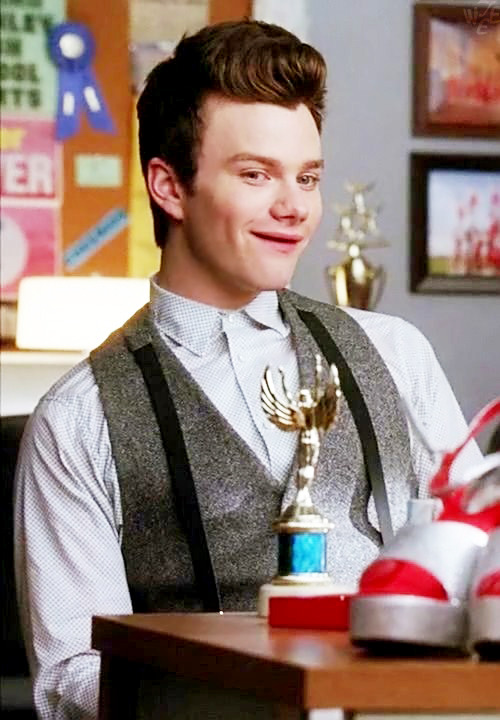
Mostly though, for an episode with lots of delicious detail and micro-continuity glory that will probably matter more to the arc in retrospect once the season ends than we realize now, this episode was just painfully, painfully fun and has fandom asking all the best questions — like just what (or who) was Kurt thinking of when he eyed those sparkly platforms Sue wanted sent to Wade/Unique?

But all long-legged fantasies aside, fandom’s right, of course, that those platforms matter. Look at the composition of the shot, with the cheerleading trophy showing a female figure with wings (evoking faerie, again) in front of the glittery shoes.

Because let’s remember, the ruby slippers only became such for the film, and that Kurt’s always enraptured with his possible idendities in Oz. If home isn’t a place (and there’s no place like it), as Rachel tells Finn, but a person, isn’t the most fundamental home oneself? There’s that authenticity question again, this time sparked by Kurt’s sense of play even about serious things, that reminds the audience in a small, graceful and almost kind way that the people we pretend to be matter too.

(p.s., I use Wade/Unique throughout this piece because the character presents us with two identities and is dealt with throughout the script as such. It may be that we should be using Unique and female pronouns at all times; it may be that Wade/Unique is bi- or other gendered in a way where that might not be the best answer either, and I don’t feel comfortable making that decision when it’s intentionally unclear in the script, and I suspect the character and the related identity questions will be back soon, possibly with more clarification.  And yes, as usual, I have a theory).